Showing posts with label Reed Bank. Show all posts

Wednesday, July 08, 2015

China stakes out Philippines Recto Bank

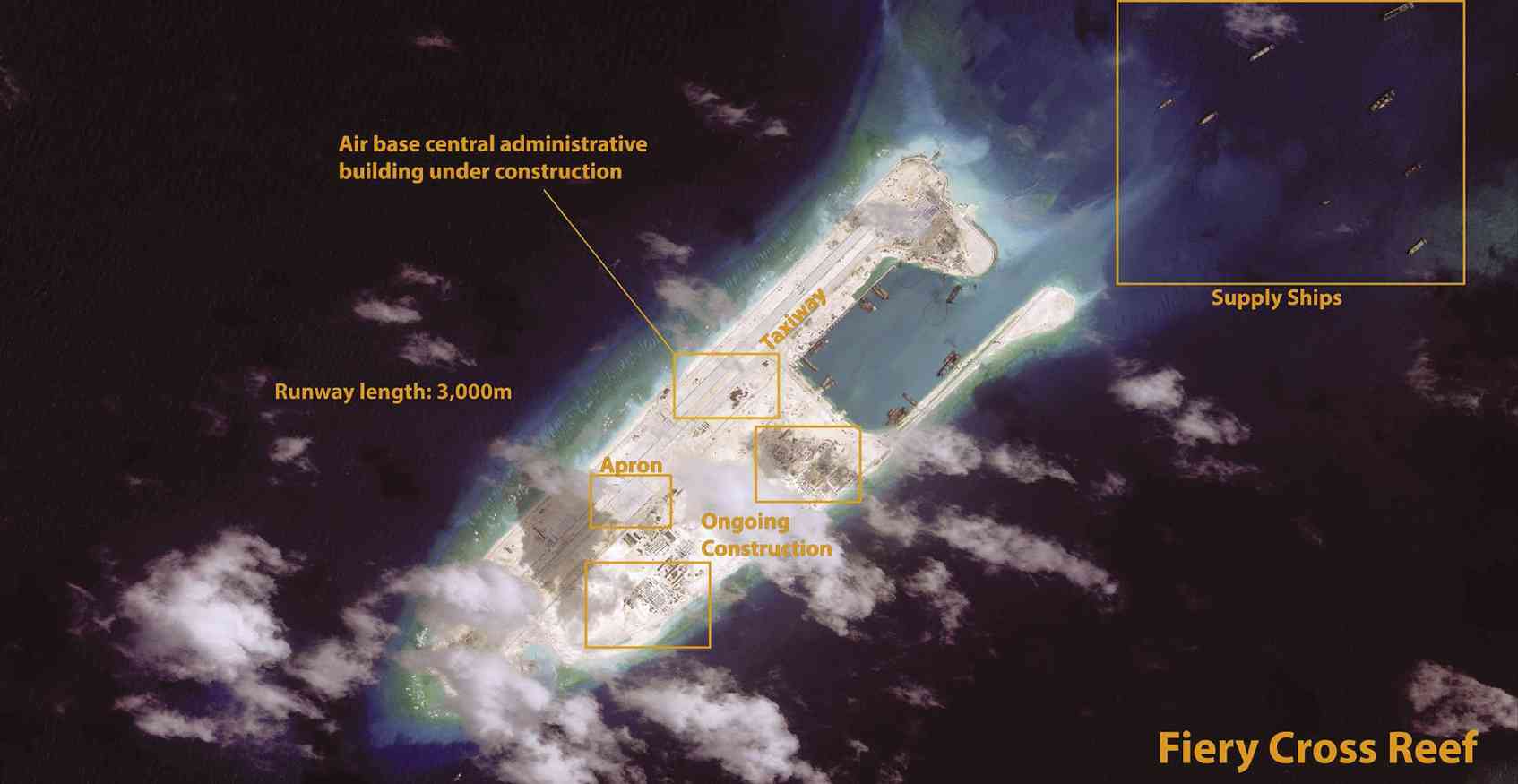
KAGITINGAN REEF  China is expanding construction on Fiery Cross Reef, also known as Kagitingan Reef, as seen in this June 28 satellite image. A 3,000-meter airstrip is nearly complete. China continues to pave and mark the airstrip and an apron and taxiway have been added adjacent to the runway. Personnel are now visible walking around the island. A sensor array has also been constructed and additional support facilities are being built. CSIS ASIA MARITIME TRANSPARENCY INITIATIVE/DIGITAL GLOBE
KAGITINGAN REEF China is expanding construction on Fiery Cross Reef, also known as Kagitingan Reef, as seen in this June 28 satellite image. A 3,000-meter airstrip is nearly complete. China continues to pave and mark the airstrip and an apron and taxiway have been added adjacent to the runway. Personnel are now visible walking around the island. A sensor array has also been constructed and additional support facilities are being built. CSIS ASIA MARITIME TRANSPARENCY INITIATIVE/DIGITAL GLOBE


“Our message to the world is clear: What is ours is ours; setting foot on Recto Bank is no different from setting foot on Recto Avenue,” President Aquino said in his second State of the Nation Address in July 2011.

But the Philippine Navy recently found a large steel marker bearing Chinese inscriptions and hundreds of yellow buoys in waters near Recto (Reed) Bank, an area of the West Philippine Sea where Manila has long explored for oil and gas, naval sources said.

A Reuters dispatch on Tuesday from Puerto Princesa City said one sailor reported he was on a fishing boat being used by the Navy that discovered the rubber buoys and the floating steel marker at the end of May.

The buoys stretched “as far as the eye could see,” the sailor said.

The newest discovery of Chinese markers was confirmed by two senior Philippine naval officials. One said the buoys were still there when the Navy checked the site mid-June, although the steel marker was gone. No attempt was made to remove the buoys, he said.

“Our boys tried to cut and remove the buoys but a large Chinese patrol ship emerged on the horizon and they hurriedly left,” the sailor said, adding it was unclear what the Chinese inscriptions on the steel marker meant.

The three sources declined to be identified because they were not authorized to speak to the media.
Philippine military officials said it was the first time in recent years that such markers had been found near Recto Bank.

The sailor also said there was no hard evidence Chinese ships had placed the marker and buoys near Recto Bank, which is also claimed by Beijing.

But efforts to remove the buoys were thwarted by the sudden appearance of a Chinese naval patrol vessel, prompting the Philippine boat to flee, the sailor said in an interview in Puerto Princesa, the Philippine military’s jump-off point to the disputed South China Sea.

The Reuters report on the Chinese incursion at Recto Bank coincided with the opening hearing on Tuesday in the arbitration court in The Hague of the Philippine petition against China on Manila’s maritime disputes with Beijing.

Solicitor General Florin Hilbay will open the presentation, according to Malacañang’s deputy spokesperson Abigail Valte.

Foreign Secretary Albert del Rosario will “speak on the reason for the filing of the Philippines’ case,” said Valte, who is with the delegation. Lawyers from the Washington-based law firm Foly Hoag, led by Paul Reichler, will present the arguments.

Muscle-flexing

China has refused to participate in the hearing.

The Spratly islands, where China is flexing its naval muscles as it builds seven man-made islands on top of coral reefs, lie to the southwest of Recto Bank, farther away from the Philippines.

Asked to comment on the buoys, the Chinese foreign ministry said, “We do not understand what you are talking about,” adding that China had “indisputable sovereignty” over the Spratly islands and its nearby waters.

“China’s position on this is clear and consistent,” it said.

The Chinese defense ministry did not respond to a request for comment.

Col. Edgard Arevalo, the Philippine Navy spokesman in Manila, said he had not seen any report on the discovery.
China claims most of the South China Sea, of which the West Philippine Sea is a part. An estimated $5 trillion in shipborne trade passes the disputed waterway every year. The Philippines, Vietnam, Malaysia, Brunei and Taiwan also have overlapping claims.

Fishing ban

Philippine military strategists have long worried that China wants to occupy Recto Bank.

One Air Force general said he suspected the buoys were put there so Chinese fishermen could tether their boats, then if the Philippine Navy tried to evict the fishermen, Chinese Coast Guard ships would appear to protect them.

In 2012, China seized Panatag (Scarborough) Shoal, which lies 230 km west of the Philippines, after a three-month standoff with the Philippine Navy.

China has since prevented Philippine fishermen from getting close to the rocky outcrop’s rich fishing grounds, the Philippine government and fishermen say.

The Philippine Navy has previously found markers with Chinese inscriptions around shoals in other parts of the West Philippine Sea.

In 2011, a steel marker the size of a 4-meter container was discovered in Escoda (Sabina) Shoal in the Spratlys. A Navy boat towed it away while concrete markers found in the same area last July were blown up, naval officials said.

The Philippines said in March it was suspending exploration at Recto Bank while it pursued international arbitration. Manila is seeking a ruling to confirm its right to exploit waters in its EEZ as allowed under the UN Convention on the Law of the Sea (Unclos).

‘Absurd claims’

In a statement issued during a protest at the Chinese Embassy on Tuesday, the militant Bagong Alyansang Makabayan (Bayan) said it believed the Philippines had a strong case.

“The arbitral tribunal should give the case due course. If the Philippines wins, then we would have gained an important legal and moral victory against China’s absurd claims. It would aid our assertion of our sovereignty and gain us the support of the international community,” said Bayan secretary general Renato Reyes.

Lauro Baja Jr., former permanent representative of the Philippines to the United Nations and one of the senior diplomats who crafted the 2002 Declaration on the Conduct of Parties in the South China Sea, warned the Philippines should not fall into Beijing’s trap.

“China is being clever and smart. They frame their responses to the Philippines’ case through the issue of territorial sovereignty,” he said.

–Nikko Dizon and Niña P. Calleja, Philippine Daily Inquirer


Saturday, March 31, 2012

Philippine, Chinese ships face off near Spratlys

A senior Philippine military officer has revealed that Philippine and Chinese naval ships faced off near the disputed islands in the South China Sea in mid-March.

The military officer told NHK that a Chinese naval vessel approached a Philippine naval frigate on patrol in waters near the Spratly Islands.


The officer said tensions mounted between the 2 ships when they remained so close for some time as to be able to visually confirm each other's existence.


The officer said the face-off ended when the Chinese vessel left the scene.


The Philippines and China have territorial disputes over the Spratlys. The Philippines is conducting oil explorations in the waters called the Reed Bank near the islands. The country claims that the waters are within its exclusive economic zone. However, China strongly disputes this, arguing that the waters are within its EEZ.


Meanwhile, another Philippine military officer said his country agreed with Vietnam to stage a joint military exercise near the Spratlys.


Vietnam is also engaging in territorial disputes with China in the South China Sea. The Philippines and Vietnam are apparently boosting their military collaboration to keep China in check.
----------------------------------------------------------------
NHK World (Japan Broadcasting Corporation) | March 30, 2012 | Article Link

Thursday, March 01, 2012

Defense chief belittles China protest of Philippine oil exploration invitations


MANILA, Philippines—Defense Secretary Voltaire Gazmin on Thursday dismissed China’s protestations over the Philippine government’s invitation to major foreign oil companies to invest in fuel exploration near Palawan in the West Philippine Sea, saying the offshore areas were well within the country’s territory.
In an  interview at Camp Aguinaldo, Gazmin also said he saw no reason for fresh tensions to build up over the disputed waters.
“I don’t think so. I don’t think so,” Gazmin said in answer to a question whether the Philippine move might strain relations with China.
“Now, if they get angry, we cannot control their emotions. But then, we still stick to the fact that these [areas] are within our territory. It is ours. Like our President said, ‘what is ours is ours.’ That’s very definite,” he told reporters.
Gazmin said he did not see any particular need to step up patrols in the West Philippine Sea (South China Sea), although “we will continue to maintain our patrols in the area.”
He said foreign oil companies should rest assured that their operations would be secure should they accept the Philippine invitation.
“Of course, the investors would not come here if they weren’t assured of their safety. We are doing all that we can in order to protect what’s ours,” Gazmin said.
Energy Secretary Jose Almendras earlier said the Philippine government had invited major foreign oil companies to invest in fuel exploration in two offshore areas northwest of Palawan province within the country’s 200-nautical-mile exclusive economic zone.
But when asked to comment, a Chinese foreign ministry spokesperson said the offshore areas were under China’s jurisdiction.
The Philippines and China traded barbs early last year over repeated incursions by the latter into the former’s territory, including an incident in which two Chinese vessels allegedly harassed a Philippine exploration ship at Reed Bank, prompting the Philippines to send planes and Coast Guard ships to the area.
This was followed by a string of other incidents over the next few months that drew protests from the Philippines. China then issued strong words warning the Philippines about its statements.
At the heart of the dispute is competing claims over the Spratly group of islands, a reputedly oil-rich chain of tiny islands and reefs located near Palawan. The chain is claimed wholly by China, and partly by the Philippines, Malaysia, Brunei, Vietnam and Taiwan.
--------------------------------------------------------
5:26 pm | Thursday, March 1st, 2012

China hits out at 'troublemaker' Manila in maritime row


China and the Philippines are continuing to trade barbs amid a rumbling row over disputed areas in the South China Sea.
A China Daily editorial called Manila a "troublemaker" and criticised its move to allow oil and gas companies to bid for contracts in two offshore areas.
Both countries claim sovereignty over the areas in the South China Sea.
The exchange began after Manila said on Monday that it would start awarding exploration contracts next month.
The territorial dispute in the South China Sea between China and the Philippines has been going on for decades.
But the exchange of words between the two countries spiked after the Philippines' announcement that two offshore areas 49 miles (79km) off Palawan were to be included in the bid for oil and gas licences.
China states its "indisputable sovereignty" in the China Daily editorial, warning that the Philippines "should assume direct responsibility for the fresh flare up of the South China Sea issue".
Earlier this week, China's Foreign Ministry spokesman Hong Lei also said that it was "unlawful for any country or company to explore oil and gas in areas under Chinese jurisdiction".
But the Philippines insists it does not need China's permission.
Philippine Foreign Secretary Albert del Rosario said the oil and gas contracts off Palawan did not need Beijing's approval and that under the United Nations Convention on the Law of the Sea (UNCLOS), the area was "well within our sovereignty".
Last year, the Philippines claimed that China had repeatedly intruded into its territorial waters in relation to oil exploration in a separate area near Palawan.
China is engaged in multiple territorial disputes in the South China Sea with its neighbours, including Vietnam and Malaysia.
Vietnam this week lodged a protest with China after 11 fishermen were reportedly assaulted by Chinese forces in a disputed area on 22 February after they reportedly tried to avoid a storm.
---------------------------------------------------------
1 March 2012 Last updated at 07:45 GMT
BBC News

Philippines, US to hold war games in South China Sea


Manila: The Philippines will hold joint war games with the United States in March at the same time that the department of energy will award to private firms oil exploration contracts in several areas including an offshore area in the South China Sea which is contested by China, sources said.
The department of energy has already prepared the awarding of 15 service contract areas to oil exploration firms. Announcement will be made in March, said Energy Secretary Jose Almendras, but did not give more details.
Some of the proposed service contracts are in east and northwest Palawan and the Sulu Sea, in southwest and southern Philippines, respectively.
The department of energy launched several contracting rounds since last year, to implement a plan to make the Philippines 60 percent self sufficient in its energy requirement.
The offshore oil drilling areas are in the South China Sea which is being claimed by China, Taiwan, and Vietnam. Only China has been vocally against the plans of the Philippine government in the South China Sea which the Philippines has called the West Philippines Sea.
Earlier, Philippine Foreign Affairs Secretary Albert del Rosario said that the Philippine government has offered foreign private firm oil exploration projects within its territory, within the country's 200- nautical mile exclusive economic zone.
He referred to the United Nations Convention of the Law of the Sea as a basis of the Philippines' claim in the South China Sea.
It was in response to two former Chinese envoys in Manila who offered joint Philippines and China drilling exploration in the contested areas, to prevent making the South China Sea a flashpoint in the region.
In Beijing, Chinese foreign ministry spokesman Hong Lei said was quoted as saying that the Philippine government's offer of service contract areas to private firms was illegal, adding, "It is illegal for any country, government or company, without the Chinese government's permission, to develop oil and natural gas in waters under Chinese jurisdiction."
Joint exercises
The joint war games between the Armed Forces of the Philippines and the United States were coincidentally scheduled with plans to announce the granting of service contract areas to private firms.
At the same time, the Armed Forces of the Philippines vowed to secure oil companies exploring in the Philippines, with the help of surveillance planes and patrol ships.
The AFP will spend P 1 billion (Dh 83,333.33) to secure the country's maritime borders with the so-called coast watch system on the country's western flank facing the South China Sea. The project, to be implemented in two years, will cover training, purchase of radars, command and control communication equipment.
Last year, President Benigno Aquino called for US assistance in containing China's flexing of muscle in the South China Sea.
This was done after the Philippine government accused China of launching seven incidents in the disputed South China Sea.
China, Taiwan, and Vietnam claim the whole of the South China Sea, while the Philippines, Malaysia, and Brunei claim some parts of the Spratly Archipelago in the South China Sea.
------------------------------
  • By Barbara Mae Dacanay, Bureau Chief
  • Published: 17:50 February 29, 2012
  • Gulf News
  • Article Link


Tuesday, February 28, 2012

DFA: No to joint development with China


The joint development of areas in the West Philippine Sea (South China Sea) that “are clearly ours is not a viable solution” to our problem with China, according to Foreign Secretary Albert del Rosario.
As for the potentially resource-rich Spratlys group of islands, the Philippines is “open to considering joint development in the disputed areas,” Del Rosario told the Philippine Daily Inquirer Sunday.
Del Rosario said that during his meeting last week with Wang Yingfan and Wang Chungui, two former Chinese ambassadors to the Philippines who were here on a goodwill visit, he “reiterated our position that we are open to inviting China in the Recto Bank as an investor to be governed by [our] laws.”
The Recto Bank (Reed Bank), he pointed out, was an “integral part of the Philippines and, as such, cannot be jointly developed.”
“To do so would be in violation of our Constitution,” he said.
The Recto Bank had drawn China’s interest several months ago when the Philippine Air Force discovered several Chinese vessels in its vicinity.
Other option
As another option, Del Rosario said “we again asked if China would join us in availing of the dispute settlement mechanism under the United Nations Convention on the Law of the Sea,” or Unclos.
He said he told his guests the government was “endeavoring to look at all means to arrive at a peaceful solution of the disputes in the West Philippine Sea in accordance with international law, specifically Unclos.”
Apart from China’s suggestion that the Philippines revisit the concept of joint development of the Spratlys, the two sides also discussed “how both nations are advancing our bilateral agenda while treating contentious issues separately, and the view that we should not accept all that appear in the press as being factual,” Del Rosario said.
According to the secretary, the retired ambassadors were “very appreciative (they) came to enhance our friendship and cooperation.”
Earlier, he told this paper that “their visit serves to put substance in the initiative (of China and the Philippines) on friendly visits.”
During President Benigno Aquino III’s state visit to Beijing last August, both sides declared 2012 and 2013 the “Years of Friendly Exchanges” between the two Asian neighbors.
Set aside quarrel
On Wednesday, Wang Yingfan told a media forum organized by the Chinese Embassy that the Philippine government should consider the “Deng Xiaoping Solution” to the Spratlys dispute, that is, setting aside the territorial quarrel in favor of a joint exploration and development of the disputed waters.
Wang, who served in Manila from 1988 to 1990, stressed “it is time for cooperation, not confrontation, not fighting.”
He said he had “talked with some important people in your government that we should work hard to find ways that are acceptable to both sides, that we must work hard to prepare the ground so that we could share the resources together.”
According to Wang, the response he got “was very encouraging. They said they would consider this kind of thinking. So with patience, with goodwill and with hard work, we could find a way out that’s agreeable and acceptable to both sides.    ”
Wang also advised Filipinos to “spend your energy on economic development.”
He said it would be some time before the two Spratlys claimants could find a solution to the dispute.
Wang also warned the Philippines against bringing the United States into the equation, saying this would be unacceptable to China which would “certainly react” if that happened.
Wang stressed that allowing the US to meddle in the six-nation Spratlys conflict was another story. “That would make the issue more complicated and more difficult to settle among ourselves,” he said.
The Philippines and China claim all or part of the Spratlys along with Vietnam, Taiwan, Malaysia and Brunei.
------------------------------------------------
2:29 am | Monday, February 27th, 2012

Conflict looms in South China Sea oil rush


Reuters - When Lieutenant-General Juancho Sabban received an urgent phone call from an oil company saying two Chinese vessels were threatening to ram their survey ship, the Philippine commander's message was clear: don't move, we will come to the rescue.
Within hours, a Philippine surveillance plane, patrol ships and light attack aircraft arrived in the disputed area of Reed Bank in the South China Sea. By then the Chinese boats had left after chasing away the survey ship, Veritas Voyager, hired by U.K.-based Forum Energy Plc (FEP.L).
But the tension had become so great Forum Energy chief Ray Apostol wanted to halt two months of work in the area.
"They were so close to finishing their work. I told them to stay and finish the job," Sabban, who heads the Western Command of the Philippine Armed Forces, told Reuters at his headquarters in Puerto Princesa on Palawan island.
Over the next few days, President Benigno Aquino would call an emergency cabinet meeting, file a formal protest with China, and send his defense secretary and armed forces chief to the Western Command in a show of strength.
The March 2011 incident is considered a turning point for the Aquino administration. The president hardened his stance on sovereignty rights, sought closer ties with Washington and has quickened efforts to modernise its military.
A year later, Forum Energy is planning to return. Top company executives told Reuters the company intends to sail to Reed Bank within months to drill the area's first well for oil and natural gas in decades, an event that could spark a military crisis for Aquino if China responds more aggressively.
The U.S. military has also signalled its return to the area, with war games scheduled in March with the Philippine navy near Reed Bank that China is bound to view as provocative.
"This will be a litmus test of where China stands on the South China Sea issue," said Ian Storey, a fellow at the Singapore Institute of Southeast Asian Studies. "They could adopt the same tactics as they did last year and harass the drilling vessels, or they might even take a stronger line against them and send in warships."
A decades-old territorial squabble over the South China Sea is entering a new and more contentious chapter, as claimant nations search deeper into disputed waters for energy supplies while building up their navies and military alliances with other nations, particularly with the United States.
Reed Bank, claimed by both China and the Philippines, is just one of several possible flashpoints in the South China Sea that could force Washington to intervene in defense of its Southeast Asian allies.
OBAMA PIVOT
U.S. President Barack Obama has sought to reassure regional allies that Washington would serve as a counterbalance to a newly assertive China, part of his campaign to "pivot" U.S. foreign policy more intensely on Asia after a decade of war in Iraq and Afghanistan.
Obama brought up the South China Sea at an Asia-Pacific summit in Bali last November, and had a surprise one-one-one with Chinese Premier Wen Jiabao on the subject, although Beijing had insisted the issue should not be on the agenda at all.
"As Southeast Asian nations run to the U.S. for assistance, Beijing increasingly fears that America aims to encircle China militarily and diplomatically," said Stephanie Kleine-Ahlbrandt, Northeast Asia Director for the International Crisis Group. "Underlying all of these concerns is the potential that discoveries of oil and natural gas beneath the disputed sections of the South China Sea could fuel conflict."
The area is thought to hold vast untapped reserves of oil and natural gas that could potentially place China, the Philippines, Vietnam and other claimant nations alongside the likes of Saudi Arabia, Russia and Qatar.
Manila is beefing up its tiny and outdated naval fleet and military bases, adding at least two Hamilton-class cutters this year and earmarking millions of dollars to expand its Ulugan Bay naval base in Palawan.
It's no match for China's fleet, the largest in Asia, which boasts 62 submarines, 13 destroyers and 65 frigates, according to the International Institute for Strategic Studies.
China last month launched the fourth of its new 071 amphibious landing ships that are designed to quickly insert troops to trouble spots, disputed islands, for example.
The U.S. Navy has announced it will deploy its own new amphibious assault vessels, the Littoral Combat Ships, to the "maritime crossroads" of the Asia-Pacific theater, stationing them in Singapore and perhaps the Philippines.
Washington's renewed presence in the Philippines, a former U.S. colony that voted to remove American naval and air bases 20 years ago, follows the U.S. announcement last year of plans to set up a Marine base in northern Australia and possibly station warships in Singapore.
Manila is talking about giving Washington more access to its ports and airfields to re-fuel and service U.S. warships and planes. The two countries will conduct war games off Palawan island in late March -- focusing on how to deal with a takeover of an oil rig in the South China Sea.
'SOUNDS OF CANNONS'
China has warned oil companies not to explore in the disputed South China Sea, over which Beijing says it has "indisputable sovereignty". Chinese ships have repeatedly harassed vessels that have tried.
After ExxonMobil (XOM.N) discovered hydrocarbons off the coast of Danang in central Vietnam, an area also claimed by China, one of China's most popular newspapers warned in October that nations involved in territorial disputes should "mentally prepare for the sounds of cannons" if they remain at loggerheads with Beijing.
Despite the threats, the Philippines and Vietnam have continued to explore for oil and natural gas further offshore in the South China waters, driven by persistently high oil prices and more advanced deepsea technology.
The Philippines has reported as many as 12 incidents of Chinese vessels intruding into its sovereign waters in the past year, an unusually high number, Sabban said.
In one of the most serious incidents last October, a Philippine navy ship seized Chinese fishing boats after colliding with one of them, prompting protests from China for their return.
At least 12 Chinese fishermen have been arrested over the past year. Half of them remain in detention in Palawan.
"China has no right to tell us that we should first ask for permission from them to explore the area," Sabban said. "We have explored that area back in the 1970s, so why can't we explore it now? We knew that there is a substantial deposit of natural gas even before all of these things started."
Manila says Reed Bank, about 80 nautical miles west of Palawan island at the southwestern end of the Philippine archipelago, is within the country's 200-nautical mile exclusive economic zone. Beijing, however, believes it is part of the Spratlys, a group of 250 uninhabitable islets spread over 165,000 square miles, claimed entirely by China, Taiwan and Vietnam and in part by Malaysia, Brunei and the Philippines.
While China prefers to solve the disputes one-on-one with its smaller Southeast Asian neighbour, Washington has sought to internationalize the issue, given that half the world's merchant fleet tonnage sails across the sea and around these islets each year, carrying $5 trillion worth of trade.
"If we don't develop our positions in our exclusive economic zone, then we will only be giving it away and will be at the losing end," Eugenio Bito-Onon, the mayor of Kalayaan islands in the Spratlys, told Reuters at a coffee shop in Puerto Princesa.
China's oil exploration has been limited in the South China Sea with less than 15 deep sea wells drilled so far. Chinese offshore oil and gas specialist CNOOC Ltd (0883.HK), along with international partners Canada's Husky Energy (HSE.TO) and U.S. company Chevron Corp. (CVX.N), plan to step up exploration in the area but focus mainly in the north, staying away from the politically sensitive waters to the south.
Estimates for proven and undiscovered oil reserves in the South China Sea range from 28 billion to as high as 213 billion barrels of oil, the U.S. Energy Information Administration said in a March 2008 report. That would be equivalent to more than 60 years of current Chinese demand, under the most optimistic outlook, and surpass every country's proven oil reserves except Saudi Arabia and Venezuela, according to the BP Statistical Review.
OIL MANDATE
General Sabban said the necessary patrol ships and surveillance planes will be provided to protect Forum Energy's exploration vessels in Reed Bank.
"We have a mandate to protect all oil companies exploring in our territory," he said. "We don't exactly escort them, but we are in the area to deter any outside force from harassing them."
Forum Energy, whose majority shareholder is the Philippines' top miner Philex Mining Corp. (PX.PS), plans to spend around $80 million through 2013 to explore the Sampaguita gas field in Reed Bank, covered by Service Contract 72.
The field is estimated to hold at least 3.4 trillion cubic feet of natural gas, with the potential for five times that amount. That is at least 25 percent bigger than the nearby Malampaya gas field, operated by Royal Dutch Shell (RDSa.L), which fuels half of the power needs for the country's main island of Luzon.
The Philippines is eager to further increase its natural gas production to meet growing domestic demand for gas-fired power, which is estimated to surge to 5,000 megawatts per day in 2016, from the current 2,700 megawatts.
"There is no question that there is gas there. We already know one or two locations we would like to drill on," said Apostol, Forum Energy's president, in an interview. "If the first drill is a bonanza, there might be a need to drill back to back."
The company said it is closely coordinating its Reed Bank plans with the military and the energy department, hoping to send drill ships by the fourth quarter.
"We are aware of the implementation risks that have to be taken into account when we contract the drilling services," said Forum Energy's executive director Carlo Pablo. "We have to have plans in case of delays in operations, on mitigating cost overruns, and contractual penalties that may be imposed."
A flotilla of ships could soon follow Forum Energy in disputed waters, with Manila later this year awarding two offshore oil and gas exploration contracts in territory also claimed by China.
That could well keep the phones busy for Sabban and his sailors at Western Command for some time to come.
--------------------------------------------------------
Reporting by Randy Fabi in Puerto Princesa and Manuel Mogato in Manila; 
Editing by Bill Tarrant
PUERTO PRINCESA, Philippines | Tue Feb 28, 2012 8:00am IST
INSIGHT - Reuters.com

Featured Posts

AFP Modernization 2017: Highlights and Review

The modernization of the Armed Forces of the Philippines was on a roll this year, as we've seen a few big ticket items having completely...

Popular Posts