Showing posts with label vietnam. Show all posts

Friday, March 08, 2013

Philippines, Vietnam agree to boost defense cooperation


MANILA, Philippines - Defense officials of the Philippines and Vietnam have agreed to explore ways to boost the defense cooperation between their countries.
The Defense department said Wednesday that the matter was discussed during the meeting of the Joint Defense Cooperation Working Group of the two countries last week in Manila.
“The meeting served as a mechanism for reviewing bilateral defense cooperation leading to a discussion of specific proposals on how to enhance defense cooperation between the two countries,” the department said in a statement.
“With a Memorandum of Agreement on Defense Cooperation signed in 2010, both sides identified mechanisms to substantiate the agreement,” it added.
The mechanisms include “practical cooperative activities” in the West Philippine Sea (South China Sea) and the east that seek to enhance confidence among their respective personnel.
The West Philippine Sea has been the subject of a long-standing territorial dispute in the region. China claims virtually the entire area while the Philippines, Vietnam, Malaysia Taiwan and Brunei have overlapping claims.
Other mechanisms being considered include defense and military officials exchanges, personnel exchanges, information-sharing, analyst-to-analyst exchanges.
The two countries also exchanged updates on the situation in the West Philippine Sea and other regional issues.
“The Philippines emphasized the importance it accords to the peaceful approach to the issue and stressed that it is principle that underpins the country’s decision to bring the matter to the International Arbitral Tribunal of the United Nations Convention on the Law of the Seas,” the Defense department said.
Defense Assistant Secretary Raymund Quilop led the Philippine delegation while Maj. Gen. Vu Chien Than, director of the foreign relations department of Vietnam’s Ministry of Defense headed the Vietnamese contingent.
------------------------------------------------------------------------------------------
Alexis Romero | The Philippine Star | March 6, 2013 | Article Link

Tuesday, June 12, 2012

Keep China in check (No pun intended)

"The Chinese are too strong, too assertive. That is why a Pax Sinica is very threatening to us," said an analyst from Vietnam's Diplomatic Academy to a reporter from the Atlantic magazine. Vietnam has cause for concern: China invaded it 17 times. 

Vietnam is not resting on China's assurances that it is only interested in business and harbors no imperial ambitions. Vietnam recently spent $200 million to rehabilitate Cam Ranh Bay, probably the largest and most important US naval base during the Vietnam War, to make it available for use by foreign navies.

In Vietnamese "making Cam Ranh Bay available for foreign navies" means laying out the welcome mat for the US. In Chinese "laying out the welcome mat for the US" means containment, a bad word to the communist tyrants in Beijing. The phrase also means containment in Vietnamese and English but it's a good word as far as they and the rest of the civilized world are concerned.

Everybody wants to keep China in check. (No pun intended.)

Nobody wants Pax Sinica or Chinese hegemony. Everybody welcomes increased "US meddling in Asia-Pacific affairs", to use Beijing's characterization of US presence, because no civilized country wants an utterly corrupt totalitarian regime exercising exclusive control over the South China Sea. Everybody wants someone who can guarantee that Beijing will not make unilateral moves that violate "the rules-based order that has served the region for six decades." Everybody understands that a countervailing power to Beijing is necessary and the US is it. It's the only country that can keep Beijing from running wild.

Why point out the obvious? Because there are those in this country who still persist in promoting juvenile nationalism, blind anti-Americanism fueled by outdated Cold War propaganda. Well, times have changed my dear Jomanians and we have to adjust to new realities: a former oppressor is now our bodyguard against a future oppressor, yesterday's imperialist is now our only protection against tomorrow's imperialist. 

The best national security decision made so far is to allow the US access to Subic and Clark.  We are not selling out, we are simply doing what is best for us, at this time and under the circumstances. If Vietnam can open Cam Ranh Bay to a former enemy why can't Subic and Clark be made available to an old friend and ally? Besides, there is a commonality of national interest between the US and the nations around the South China Sea: the US wants freedom of navigation, we want freedom from Beijing's incursions into our seas.

Will the occasional US visits turn into permanent US bases? Maybe they could but it definitely won't happen anytime soon. The US cannot afford permanent overseas bases right now, "places not bases" is the new Pentagon mantra. Besides, experience has shown that bases agreements are messy and expensive while visiting or status of forces agreements are neater and cheaper, both for the US and the host country, so why go back to it?

The Jomanians' fear that US bases will return and become US territory once again is not grounded on reality, it comes from robotic thinking. We have to celebrate a new era in Philippine-US relations instead of mindlessly chanting slogans that give Beijing an erection.
Another thing to keep in mind is the new US Pacific strategy does not stand on access to Subic and Clark. The US can port its ships and land its planes in India, Australia, Indonesia, Singapore, Thailand, Japan, South Korea, and soon in places like Cam Ranh Bay. We need US presence to fend off China more than the US needs Philippine hospitality to keep the sea lanes open to navigation. We have to live with that reality until we become strong enough to stand up to China or any other ambitious neighbor.

-------------------------------------------------------------------------------------------------------------
is a fellow of Action for Economic Reforms

Sunday, May 27, 2012

China’s Small Stick Diplomacy

China’s combination of fishing boats, unarmed law-enforcement ships, and military power allows Beijing to act as a provocateur – and to use small stick diplomacy.

It seems everything old is new again. My (online) colleague Jens Kastner published an important article in Asia Times this week, detailing how Beijing enlists fishermen as an arm of its maritime strategy. His story will strike a familiar chord with any U.S. Navy sailor of a certain age. During the Cold War it was hard for an American task force of any consequence to leave port without a Soviet “AGI” in trail. These souped-up fishing trawlers would shadow U.S. task forces, joining up just outside U.S. territorial waters. So ubiquitous were they that naval officers joked about assigning the AGI a station in the formation, letting it follow along – as it would anyway – without obstructing fleet operations.

AGIs were configured not just to cast nets, but to track ship movements, gather electronic intelligence, and observe the tactics, techniques, and procedures by which American fleets transact business in great waters. Few seafaring nations use nonmilitary assets that way. Wielded deftly, though, they can play a vital part in sea power, broadly construed as encompassing not only government but commercial shipping, and not only navy personnel but private mariners. Maritime strategy is about more than navies. It’s about using all implements available to governments – sea- and land-based, public and private – to shape events at sea.

AGIs were mainly passive platforms sent to watch, listen, and report. While intelligence collection is part of Chinese fishing vessels’ job description as well, Beijing entrusts more active duties to these small craft. They can discharge combat missions. Some of them can lay or clear sea mines, for example. Or, as Naval War College professor Peter Dutton put it in another context, the fishing fleet is an unofficial maritime auxiliary that Beijing can deploy to stoke “managed confrontation” with neighbors whose seaborne interests contradict China’s. Kastner portrays it as a stick with which the Chinese government can stir up maritime Asia at opportune moments, whether to solidify its claims to contested islands and seas, appease a restive populace at home, or support a cross-strait offensive against Taiwan.

Japan, the Philippines, and other claimants to waters and soil China considers its historic patrimony constitute special targets for managed confrontation. Fishing boats have been in the thick of such scuffles as the war of words that ensued in 2010 after the Japan Coast Guard apprehended a Chinese fishing boat near the Senkaku/Diaoyutai islets. Fishermen have been at the vanguard of Chinese policy in the ongoing impasse with the Philippines at Scarborough Shoal, an atoll west of Luzon. Does Beijing control the whereabouts and actions of fishing boats directly? It’s not entirely clear, and Chinese diplomats aren’t saying. There must be some mix between conscious action and opportunism. While they may or may not exercise operational command over a given boat, Chinese officials can certainly encourage its skipper to ply his trade in disputed water – and respond if he runs into trouble.

If a foreign coast guard or navy tries to shoo Chinese boats away, Beijing gains plausible grounds to act. It can intervene diplomatically on Chinese nationals’ behalf, as in the Senkakus in late 2010. Or nonmilitary maritime services like China Maritime Surveillance can dispatch assets to protect the fishermen, as at Scarborough Shoal. Call it gunboat diplomacy without the guns –  or at least without an open display of guns. The People’s Liberation Army is the unseen adjunct to Chinese nautical diplomacy. Military power held in reserve represents an enormous Chinese advantage, especially when the opponent is as completely outmatched as the Philippines.

As Henry Kissinger notes, deterrence is a product of a nation’s capability, its leadership’s resolve to use that capability under well-defined circumstances, and the adversary’s belief in both capability and intentions. If any of those factors is zero, deterrence is zero. Manila disbelieves in Chinese will or military might at its own peril. In all likelihood, deterrence results.

This imposes a Catch-22 on regional capitals. If Manila, Hanoi, or some other government is deterred from upholding its claims – leaving Chinese units holding the contested ground by default – then Beijing scores an incremental diplomatic victory. That’s the best outcome from China’s standpoint. If a rival government isn’t deterred – if it deploys ships to the scene to put steel behind its claims – it does so at a lopsided material disadvantage. It again stands to lose. And if it’s rash enough to use force to impose its will, as sovereign states do to preserve order within their territory, it looks like the bully vis-à-vis unarmed Chinese ships. Philippine leaders have been trying to escape the no-win situation that Beijing has imposed on them, to no avail thus far.

If successful, Chinese strategy creates facts on the ground. Its maritime claims calcify into accepted state practice. And what states do has a habit of finding its way into international law over time – of becoming what they should do.

Which is the point for China, which finds itself bestriding awkward legal ground. No one outside China takes seriously the extralegal idea that documents, artifacts, and oral traditions dating from antiquity entitle China to the waters and landmasses within the “nine-dashed line” enclosing most of the South China Sea. That’s especially true when these claims skirt close along another Asian state’s shorelines, as is the case with the Philippine Islands, Brunei, and Malaysia, which comprise the eastern arc of the South China Sea. The law of the sea apportions maritime rights by geographic distance from landmasses, not by who fished where two millennia ago. But the Chinese government can establish a physical presence in these expanses and deploy overpowering might to dissuade others from opposing it.

If this approach prevails at Scarborough Shoal – deep within the 200-nautical-mile exclusive economic zone encircling the Philippine island of Luzon – it will probably form the pattern for Beijing’s handling of maritime territorial disputes. If it works there, where Manila’s legal rights are at their strongest – indeed, unassailable – why not try it elsewhere? Maybe might does make right.

While they would probably deplore China’s political goals in the East and South China seas, the greats of sea-power theory might applaud its strategic artistry. In a way, Beijing’s strategy extrapolates from British historian Sir Julian Corbett’s writings on the design of fleets, published just over a century ago. For Corbett, two broad components constituted any navy: the battle fleet, designed to wrest command of the sea (a.k.a. “permanent general control” of the sea) from enemy fleets, and the “flotilla” of lesser craft that exercises maritime command, either in peacetime or once the battle line has put adversaries out of action in wartime. Frigates, patrol boats, and other lightly armed craft that are inexpensive and can be built in large numbers comprise the flotilla. Once rival navies have been cleared away, even their minimal armament overmatches likely antagonists.

It’s no stretch to include noncombatant craft like law-enforcement ships, coast guard cutters, merchantmen, and even fishing vessels as part of the flotilla should a government choose to employ them that way. China apparently does so choose. And there’s precedent for this approach. In bygone ages, the boundary dividing the navy from private seafaring often blurred into invisibility.

China’s unconventional flotilla lets Beijing accomplish some of the things in peacetime that Corbett envisioned the battle fleet’s accomplishing in wartime. He pointed out, for instance, that it was hard for the strong to compel the weak to fight when the weak stood to lose everything. Corbett advised the stronger fleet’s commanders to create a forcing function. They should attack something the opponent couldn’t refuse to defend. He would have to run the risks of sea combat despite the likelihood of defeat.

Ample historical precedent stood behind Corbett’s counsel. By the late 17th century, Britain’s Royal Navy had come to outclass its long-time nemesis, the Dutch Navy. (To this day gentle Dutchmen will remind you that they won two out of the three Anglo-Dutch naval wars of the 1600s – just not the last one.) Dutch admirals feared challenging a stronger opponent. But the British Isles lay astride sea lanes connecting the Netherlands to overseas trading partners. That meant the Royal Navy enjoyed the option of attacking Dutch merchant shipping. The Dutch Navy must either hazard combat or abandon the merchant fleet, the wellspring of national prosperity. Britain used its combination of naval might and geographic advantage to wear down Dutch sea power over time.

While they have no desire for an armed conflict – nonviolent coercion promises rewards without the diplomatic fallout – Chinese leaders can try a similar stratagem in the China seas. Its combination of fishing boats, unarmed law-enforcement ships, and military power in reserve lets Beijing act as a provocateur. No East or Southeast Asian state wants to pick a fight with China. The mismatch between the Chinese and Southeast Asian armed forces far exceeds that between 17th-century Britain and Holland. It’s a chasm between the Philippines, with no operational combat aircraft, and China, with its vibrant and improving air force.

But Beijing can mount a direct challenge to its neighbors’ maritime claims, forcing them to respond. It can send fishing vessels to places like Scarborough Shoal, provoking a showdown with a foreign navy or coast guard and compelling a rival claimant to back down. Or it can take advantage should fishermen provoke a controversy on their own. This may have been the case at Scarborough Shoal. Either way, superior power grants new options.

China’s margin of superiority determines its options. The greater its margin, the wider its horizons for managed confrontation.“Small stick diplomacy” offers the greatest prospects of success in the South China Sea, where regional sea powers lag far behind notwithstanding their efforts to bulk up. Beijing has been more circumspect in the East China Sea, where Japan is a serious naval power with the capacity to push back, a strong ally in the form of the U.S. Seventh Fleet, and an apparent allied commitment to defend the Senkakus should it come to a trial of arms. A showdown over the Senkakus would be a high-stakes, high-risk affair.

Accordingly, Beijing affords Tokyo more respectful treatment than it does Manila. Should the naval balance come to favor China over the U.S.-Japan alliance, though, it may well take a more forceful stance – exercising its Scarborough Shoal option.

--------------------------------------------------------------------------------------------------------
James R. Holmes | The Diplomat | May 21, 2012 | Article Link

Tuesday, May 22, 2012

Vietnamese intellectuals back Philippines Panatag claim

HANOI: Sixty-six Vietnamese from various backgrounds and fields, supported the Philippines’ claim on the Panatag (Scarborough) Shoal and called on China to abandon its “absurd marital claim” on the area.

The group, which include well-known intellectuals and academicians in Vietnam and overseas, sent a letter to Philippine Ambassador to Vietnam Jerril Galban Santos to express their support for the Philippines in the standoff with China.


Among the signatories are a former Vietnamese ambassador to China, several heads of tertiary institutions, poets and social scientists.

“We fully support the sovereign rights of the Philippines in the Panatag Shoal area and the Philippines’s actions to defend her sovereign rights,” they said in their letter.

“We resolutely oppose China’s attempts to use its “nine-dashed line”, which is completely without historical or legal basis, to encroach on the Exclusive Economic Zones and continental shelves of the Philippines, Vietnam and other Association of Southeast Asian Nations (Asean) countries. We strongly oppose China’s illegal actions and threats of force in the Panatag Shoal dispute,” they added.

The group also backed the Philippine government’s proposal to submit the dispute to the International Tribunal for the Law of the Sea (Itlos).

“We call on the governments and citizens of all Asean countries to take concrete actions to show solidarity with the Philippines, to assist her in the defense of her sovereign rights in the Panatag Shoal area, and to defend the sovereign rights of each and every Asean country as affirmed in United Nations Convention on the Law of the Seas (Unclos),” they said.

“We solemnly declare that China’s illegal “nine-dashed line” constitutes a threat to peaceful cooperation and sustainable development in Southeast Asia. To re-establish stability and ensure freedom of navigation in the West Philippines Sea/East Sea, we demand that China gives up its absurd maritime claims in these waters. The just cause of the government and people of the Philippines will prevail,” they added.

Those who signed the letter were Major-General Nguyen Trong Vinh, Former Ambassador of The Socialist Republic of Vietnam to PR China, Prof. Nguyen Minh Thuyet, PhD, Former Vice-President, The Committee for Culture, Education and Youth, National Assembly, Nguyen Ngoc, Writer, Bui Ngoc Tan, Writer, Thanh Thao, Poet, Prof. Pham Duy Hien, PhD, Former Director, Da Lat Institute of Atom, Prof. Nguyen Hue Chi, Former President of Scientific Committee, Institute of Vietnamese Literature, Pham Toan, Educator, Prof. Nguyen The Hung, PhD, University of Da Nang, Vice President, Vietnamese Association of Hydromechanics, Prof. Chu Hao, Director, Tri Thuc Publisher, Dr. Nguyen Dinh Nguyen, PhD, Garvan Institute of Medical Research, Sydney, Australia. Association Prof. Hoang Dung, PhD, Ho Chi Minh City University of Pedagogy, Pham Xuan Nguyen, President, Association of Ha Noi Writers, Nguyen Ba Dung, Engineer, Pham Hoang Quan, Independent Researcher, Hoang Hung, Poet, Prof. Tuong Lai, Former President, The Institute of Sociology of Vietnam, Nguyen Quang A, PhD, Former President, The Institute of Development Studies, Nguyen Ngoc Giao, Former Lecturer, Freelance Writer, Paris, France, Thai Van Cau, Space Science Specialist, USA, Nguyen Xuan Dien, PhD, Institute of Han-Nom, Dinh Kim Phuc, Researcher on the East Sea and Vietnamese Islands, Le Dang Doanh, PhD, Former Director, Central Institute of Economic Management (CIEM), Prof. Hoang Tuy, PhD, Former President, Scientific Committee of Vietnam Institute of Mathematics, Prof. Emeritus Nguyen Dang Hung, PhD, University of Liege, Belgium, To Van Truong, PhD, Specialist of Vietnamese Natural Resources and Environment, Ha Si Phu, PhD, 4E Bui Thi Xuan Str., Dang Thi Thanh Bien, Phan Dac Lu, Poet, Mac Lam, Journalist, Mai Thai Linh, Former Teacher, Researcher, Huynh Nhat Hai, retired Official, Huynh Nhat Tan, Ha Dinh Nguyen, 76, Tran Thanh Van, Association Prof. Dang Ngoc Le, PhD, President, Association of Linguistics of Ho Chi Minh City, Tran Thi Khanh, Editor, Nguyen Thi Tu Huy, PhD, lawyer Tran Quoc Thuan, Former Permanent Vice Chairman, Office of National Assembly of the SR of Vietnam, Kha Luong Ngai, Former Deputy Editor-in-Chief, Sai Gon Giai Phong News, Cao Lap, Former Political Prisoner in Con Dao, Tran Minh Thao, Writer, Dang Thi Hao, PhD, Former Vice Head, Section of Ancient and Mediveal Literature, Institute of Literature, Ha Noi, Vu Quang Viet, Specialist of Economics for UN, USA, Prof. Nguyen Dinh Cong, PhD, Former Chair of the Construction Department, University of Construction, Ha Noi, Nguyen Duc Hiep, Specialist of the Atmosphere, Office of Environment and Heritages, NSW, Australia.

Paulus Nguyen Thai Hop, Archbishop, Chairman, Committee of Justice and Peace, Nguyen Chi Thanh Long, Prof. Tran Van Tho, PhD, Waseda University, Tokyo, Tran Duc Que, Lawyer Ta Van Tai, Former Lecturer, Research Fellow, Harvard Law School, Lawyer Le Hieu Dang, Deputy Head, Services of Legal and Democratic Issues, Central Committee of Vietnam Fatherland Front, Dr. Huynh Tan Mam, PhD, former president, Association of Students of Saigon before 1975, Former Editor-in-Chief of Thanh Nien Newspaper, Former Member, National Assembly of SR Vietnam Le Cong Giau, Former General Secretary, Association of Students of Saigon before 1975, Former Director, Center for the Promotion of Investment and Trades, Nguyen Phu Yen, Composer, Ho Hieu, Association of Students and Youths of Da Lat for Democracy before 1975, Nghiêm Phuong Mai, Biologist and Educator, Canada Prof. Pham Xuan Yem, Former Director of Research on Physics, CNRS, Former Professor, University Paris VI, France, Prof. Ha Duong Tuong, Former Professor, University of Technology Compiegne, France, Tong Van Cong, and Mai Hien, Journalists, Prof. Do Dang Giu, Former Director of Research, CNRS, Former Professor, University Paris Sud, France, Phan Hoang Oanh, PhD, Lecturer, Association. Prof. Ha Thuc Huy, College of Natural Sciences - Ho Chi Minh City National University, Huy Duong, United Kingdom Do Minh Tuan, Poet and Film Director.

------------------------------------------------------------------------------------------------------
The Manila Times | May 22, 2012 | Article Link

Thursday, April 12, 2012

Vietnamese fishermen arrested off Palawan for illegal fishing

MANILA, Philippines -- Fishermen on board a Vietnamese fishing vessel loaded with sea turtles were arrested by maritime authorities at the West Philippine Sea off Palawan, intelligence sources revealed.

The fishing vessel was apprehended southwest off Martinez Point, Balabac Island. It was loaded with at least two sea turtles. The fishing vessel will be escorted by authorities to land for the filing of appropriate charges.

------------------------------------------------------------------------------------------------

Wednesday, April 11, 2012

Philippines, Vietnam to hold 'fun games' in Spratlys

Philippine and Vietnamese troops plan to hold joint "fun games" in the Spratlys to calm tensions over the disputed island chain in the South China Sea, the Philippine navy chief said Tuesday.

The islands, also claimed by China, are regarded as one of Asia's most dangerous potential flashpoints but there will be no weapons involved, said Vice Admiral Alexander Pama.
"We will be sending some of our boys to their occupied islands and they will also be sending their boys to our occupied islands," Pama told correspondents, dubbing it "fun games."

"They will actually be doing games, like basketball or soccer (and) there will be no firearms (training) involved."

Pama said the joint activity was part of an agreement with his Vietnamese counterpart who accompanied President Truong Tan Sang on a visit to Manila late last year.
Apart from the games, he said troops from both sides would also boost information sharing on the weather and search and rescue operations involving fishermen who may run into trouble in disputed areas.

Asked whether other claimants to the Spratlys could also be invited to take part in the games, Pama replied: "There are no discussions along those lines."
The Spratlys is a group of islets and atolls believed to be potentially rich in mineral and gas deposits.

China and Taiwan both claim the entire South China Sea, which is called the West Philippine Sea by Manila, while the Philippines, Malaysia, Brunei and Vietnam have overlapping claims to parts of it.

The Philippines and Vietnam have both accused China of increasingly flexing its military muscle in the region, despite a pledge from all claimants to avoid actions that could further stoke tensions.

Manila last year accused the Chinese military of firing on Filipino fishermen, laying buoys and harassing an oil exploration vessel in waters that fall within the Philippines' exclusive economic zone.

Regional leaders at a summit in Cambodia last week reaffirmed a commitment to settle the row peacefully by crafting a code of conduct in the area, but were divided over China's participation in the discussion.

----------------------------------------------------------------------------------
Yahoo News | April 11, 2012 | Article Link

Tuesday, April 03, 2012

Philippines wants enhanced rules in West Philippine Sea

THE Philippines is looking for a more specific content of the Declaration on the Conduct of Parties in the South China Sea/West Philippine Sea (DOC) by the Association of South East Asian Nations (Asean).

In his speech at the Asean Foreign Ministers Meeting Monday, Department of Foreign Affairs (DFA) Secretary Albert del Rosario called on his regional counterparts to join in pushing for a more comprehensive Code of Conduct (COC) being created by the Asean Working Group.

“The Philippines hopes that the Code of Conduct will be a real ‘move forward’ not merely in terms of form, but more importantly in substance,” del Rosario told his colleagues in Phnom Penh, Cambodia.

He said the Philippines believe that the COC must include guidelines by which stakeholder-states are to conduct themselves in the West Philippine Sea; as well as the setting of mechanisms on dispute settlement including the appropriate structure for its effective implementation.

Also being pushed by the country is the clarification and segregation of disputed from non-disputed areas in accordance with international law, including the United Nations Convention on the Law of the Sea (Unclos); and the crafting of provisions relating to cooperative activities, as may be appropriate, for the disputed areas.

“We believe that a rules-based approach under the dispute settlement mechanism established in UNCLOS is the legitimate solution in addressing conflicting and overlapping claims in the West Philippine Sea,” added del Rosario.

Aside from the Philippines, the West Philippine Sea, particularly the Spratly Islands, is being disputed by fellow Asean members Brunei, Malaysia, and Vietnam, as well as China and Taiwan.

The DFA chief also opined that it would be best if such a compact guideline would be set first by the region before involving other parties.

“It is important for Asean to first agree among themselves on the draft text of the COC before meeting with China,” said del Rosario.

------------------------------------------------------------------------
SunStar.Com.Ph | April 2, 2012 | Article Link

Saturday, March 31, 2012

Philippine, Chinese ships face off near Spratlys

A senior Philippine military officer has revealed that Philippine and Chinese naval ships faced off near the disputed islands in the South China Sea in mid-March.

The military officer told NHK that a Chinese naval vessel approached a Philippine naval frigate on patrol in waters near the Spratly Islands.


The officer said tensions mounted between the 2 ships when they remained so close for some time as to be able to visually confirm each other's existence.


The officer said the face-off ended when the Chinese vessel left the scene.


The Philippines and China have territorial disputes over the Spratlys. The Philippines is conducting oil explorations in the waters called the Reed Bank near the islands. The country claims that the waters are within its exclusive economic zone. However, China strongly disputes this, arguing that the waters are within its EEZ.


Meanwhile, another Philippine military officer said his country agreed with Vietnam to stage a joint military exercise near the Spratlys.


Vietnam is also engaging in territorial disputes with China in the South China Sea. The Philippines and Vietnam are apparently boosting their military collaboration to keep China in check.
----------------------------------------------------------------
NHK World (Japan Broadcasting Corporation) | March 30, 2012 | Article Link

Thursday, March 29, 2012

Navy eyes warship building deal with Vietnam

MANILA — The Philippine Navy (PN) plans to send a contingent of Filipino sailors to the Vietnam People's Navy (VPN)'s Naval Shipyard X46 for training on the art of modern warship construction. 
 
Naval Shipyard X46, also known as Hai Long Shipbuilding, is equipped with state-of-the-art shipbuilding equipment and is capable of constructing modern, high-speed warships weighing up to 500 tons.

This proposal came up during PN flag-officer-in-charge Vice Admiral Alexander Pama's visit to Vietnam early this month.

During his visit, the PN chief discussed the proposal with VPN head Admiral Nguyen Van Hien , who was described as very receptive to the proposal.

If the deal push through, PN personnel would gain more knowledge in refurbishing and repairing their naval vessels thus translating to saving as the PN would no longer rely on foreign and commercial dockyards for their maintenance.

----------------------------------------------------------------------------------------
PNA | ZamboTimes.Com | March 28, 2012 | Article Link

Wednesday, March 28, 2012

Philippines, Vietnam eye Spratlys ‘war games’

The Philippines and Vietnam plan to hold joint naval exercises and patrols along common maritime borders in the West Philippine Sea where the two nations have staked claims to some of the Spratly islands.

The agreement was made during the visit of Philippine Navy officials led by Flag Officer in Command Vice Admiral Alexander Pama to Vietnam from March 11 to 14.

The territorial claims of the Philippines and Vietnam are up against those of regional giant China, which claims the entire Spratlys island chain.

Pama and his staff met with Admiral Nguyen Van Hien, chief of the Vietnam People’s Navy, and General Do Ba Ty, Chief of the General Staff of the Vietnam People’s Army.

“This visit is expected to provide opportunities for the conduct of joint maritime exercises in the West Philippine Sea (northeast of Vietnam) and other common maritime domains following proper diplomatic channels under guidance from the Department of National Defense,” the Philippine Navy said in a statement issued Tuesday.

The two Navy chiefs agreed on standard operating procedures (SOPs) to guide interaction between their respective navies in the vicinity of Southeast Cay and the Northeast Cay Island.

Memorandum of Understanding

The SOPs implement a memorandum of understanding (MOU) signed by the two Navy chiefs last October.

The Philippines occupies Northeast Cay Island, which it refers to as Parola Island.
It lies 45 kilometers northwest of Pag-asa Island, the biggest of the Philippine-occupied islets in the Spratlys. It is three kilometers north of Vietnam-occupied Southwest Cay Island which the Philippines refers to as Pugad Island.

The Spratly chain of islands is contested by the Philippines, Vietnam, Taiwan, Malaysia and Brunei, which have laid claim on parts of the islands, and by China which claims the entire Spratlys.

Pama and his Vietnamese counterpart also discussed the possible establishment of a communication hotline between the operations center of the Philippine Navy and the Vietnam People’s Navy covering common areas of naval operations, especially for search and rescue.

“This includes the proposed conduct of joint maritime patrols in these common maritime domains,” the Navy said.

The Vietnam navy chief thanked the Philippine Navy delegation for the recent rescue of 12 Vietnamese fishermen who were found in distress by the Philippine Navy, and another nine fishermen rescued by the Philippine Coast Guard.

Vietnam offered to host Navy-to-Navy talks in the last quarter of this year.

Naval officials from the Philippines and Vietnam also discussed sharing of shipbuilding expertise as Philippine Navy officials were given a tour of Naval Shipyard X46 of the Hai Long Shipbuilding Company.

Navy-to-Navy

The shipyard is “equipped with state of the art shipbuilding and repair yard facilities with the capability to build various kinds of warships and high speed vessels up to 500 tons displacement.”

Pama proposed sending Philippine Navy personnel to train at X46.

Pama was joined by Commodore Joseph Rustom Pena, commander of Naval Forces West stationed in Palawan, and Captain Danilo Rodelas, Assistant Chief of Naval Staff for plans (N5).

The naval officials also visited Thailand from March 14 to 17.

They called on the Thai Ministry of Defense, the Royal Thai Navy and the Royal Thai Armed Forces.

They held exploratory talks on wide avenues of cooperation with proposals of a possible joint exercise and ship visit by the Thai Navy to the Philippines.”

The Philippine Navy officials also visited the Sattahip Naval Base, headquarters of the Royal Thai Navy.

Major General Rustico Guerrero, commandant of Philippine Marine Corps, joined the delegation during the Thai visit.

-----------------------------------------------------------

Tuesday, March 27, 2012

Philippine Navy eyes joint maritime exercises with Thai, Vietnamese counterparts

MANILA, Philippines—The Philippine Navy plans to hold joint maritime exercises with its Vietnamese and Thai counterparts as part of efforts to strengthen ties with the navies of neighboring Asian countries, a military spokesman said.

Lieutenant Colonel Omar Tonsay disclosed this following the visit of a Philippine Navy delegation led by its chief, Vice Admiral Alexander Pama, to Vietnam on March 11-14 and Thailand on March 14-17.

The Philippine delegation toured the Naval Shipyard X46 or the Hai Long Shipbuilding Co. in Vietnam, which is equipped with state-of-the-art shipbuilding and repair facilities and which is capable of building warships and military vessels, Tonsay said.

“This visit is expected to provide opportunities for the conduct of joint maritime exercises in the West Philippine Sea (northeast of Vietnam) and other common maritime domains following proper diplomatic channels under guidance from the Department of National Defense,” Tonsay said.

“Sharing of shipbuilding expertise is clearly seen as one possible area for cooperation during this tour,” Tonsay added. The delegation, he said, suggested possible training for Philippine Navy personnel at the X46 shipyard.

Likewise, the leaders of the two navies discussed a proposal to establish a communication hotline between the operations centers of the Philippine Navy and the Vietnam People’s Navy (VPN) especially for search-and-rescue operations.

Pama and VPN’s commander in chief, Admiral Nguyen Van Hien, also signed the standard operating procedure regarding interactions among Philippine and Vietnamese navies’ personnel in the vicinity of Southeast Cay and the Northeast Cay Island, located between the two countries.

Nguyen offered to host the first “Navy to Navy Talks” with the Philippines in Vietnam in the last quarter of 2012, the Philippine Navy spokesman said.

“The visit paved the way for continued Staff to Staff Talks and exchange of visits between the Philippine Navy and VPN, which is hoped to sustain the active engagements of the Philippine Navy and the VPN and effectively address maritime security issues in common maritime domains,” Tonsay added.

In Thailand, Pama and other delegation members met with the Thai Ministry of Defense and held exploratory talks on avenues of cooperation for the Philippine Navy and the Royal Thai Navy (RTN). Joint maritime exercises and ship visits by the Thai Navy to the Philippines were also discussed.

Likewise, the RTN also committed to host Navy to Navy Talks to further discuss matters that will strengthen the bilateral activities of both navies.

---------------------------------------------------------------------------------

Wednesday, February 22, 2012

Philippines, Vietnam discuss cooperation on Spratlys By Jerry E. Esplanada


The Philippines and Vietnam on Monday discussed “cooperative actions” in the West Philippine Sea (South China Sea) during the inaugural meeting of the two countries’ Joint Commission on Maritime and Ocean Cooperation (JCMOC), according to the Department of Foreign Affairs (DFA).
Among issues taken up at the first JCMOC meeting were Manila’s proposal for the establishment of a Zone of Peace, Freedom, Friendship and Cooperation in the disputed sea, as well as a Code of Conduct for Spratlys claimant-countries, the DFA said.
Aside from the Philippines and Vietnam, all or part of the Spratlys island chain are also being claimed by China, Taiwan, Malaysia and Brunei.
The DFA did not provide details of the conference, which it said aimed to “achieve a more responsive and effective mechanism for bilateral cooperation on maritime and ocean concerns.”
Foreign Undersecretary for Policy Erlinda Basilio headed the 10-member Philippine panel in the JCMOC.
The 16-man Vietnamese side was headed by Deputy Foreign Minister Ho Xuan Son.
Son called on Foreign Secretary Albert del Rosario before the start of the meeting held at DFA headquarters in Pasay City.
Holding the JCMOC meeting at the deputy foreign minister level was agreed upon by both governments in October.
Resolve claims
In January, Del Rosario called again on Vietnam and the eight other members of the Association of Southeast Asian Nations (Asean) to call a meeting of Spratlys claimant-countries, including China, to resolve the conflicting claims in the West Philippine Sea.
The secretary made the call during the Asean foreign ministers meeting in Siem Reap, Cambodia.
Del Rosario said Asean was “at a critical juncture of playing a momentous role in the resolution of disputes in the West Philippine Sea based on the rules-based regime of the United Nations Convention on the Law of the Sea,” or Unclos.
Muster will
He asserted that Asean members “must muster the will as an Asean community to face these sensitive issues with determination.”
Del Rosario urged Asean members to “now play a positive and meaningful role to solve the disputes peacefully in accordance with the Treaty of Amity and Cooperation and reach a stage whereby we are able to help resolve sensitive issues decisively without letting such issues fester and adversely affect the progress of our bilateral and multilateral decisions.”
----------------------------------------------------
2:36 am | Wednesday, February 22nd, 2012

Thursday, October 27, 2011

Philippines, Vietnam forge naval agreement on Spratlys

The navies and coast guards of the Philippines and Vietnam have forged cooperation agreements despite the continuing disputes among the countries claiming the resource-rich Spratly Islands.

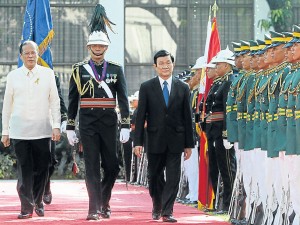
President Benigno Aquino III and visiting Vietnamese President Truong Tan Sang also agreed on Wednesday that adherence to the UN Convention on the Law of the Sea (Unclos) was important in the peaceful resolution of territorial issues in the WestPhilippine Sea (South China Sea).

The two leaders witnessed the signing in Malacañang of the memoranda of understanding for information sharing between the two navies and for a hotline between the two coast guards.

“We also exchanged information and views on issues relating to the West Philippine Sea [which Vietnam calls East Sea] and reaffirmed the importance of the maintenance of peace, stability, maritime safety and security in the region,” Mr. Aquino said in a press statement issued after his bilateral meeting with Sang.

“We agreed that a rules-based approach, adhering to international law, especially the 1982 UN Convention on the Law of the Sea, is essential to the pursuit of a peaceful resolution of these issues through multilateral dialogue and consultations,” he said.

The two leaders also reiterated the importance of the full implementation of the Declaration on the Conduct of Parties in the South China Sea, which was signed in 2002 by Asean countries and China.

Recto Bank

The countries with overlapping claims to the Spratlys are the Philippines, Vietnam, China, Malaysia and Taiwan.

The Philippines has protested China’s intrusions into Recto Bank.

Invoking the Unclos, the Philippines maintains that there should be no dispute over territories like Recto Bank, which is a mere 148 kilometers away from the province of Palawan and 1,017 km away from China.

The Unclos, which was enacted in 1982, states that a country’s exclusive economic zone extends 370 km from its continental shelf.

Sang, 62, arrived on Wednesday for a three-day state visit on board a chartered Vietnam Airlines flight that landed at Villamor Air Base in Pasay City at around 1 p.m.

He is the first foreign head of state to visit the country under Mr. Aquino’s administration.

Foreign Secretary Albert del Rosario and Manila International Airport Authority general manager Jose Angel Honrado led the welcomers, who included female staff members of the Vietnamese Embassy dressed in the traditional ao dai.

Sang’s visit is in line with the 35th anniversary of the establishment of bilateral relations between the Philippines and Vietnam.

Safer maritime area

Explaining the new agreements with Vietnam, Mr. Aquino said: “Maritime cooperation between the two countries has evolved to become one of the principal pillars of our bilateral relations. Thus, I welcome the elevation of our consultations on maritime and ocean concerns to the vice ministerial level.

“Moreover, our agreements on oil spill preparedness and response, and on search and rescue at sea which was signed last year, as well as the agreements on the establishment of a hotline communications mechanism between our coast guards, and the agreement linking our two navies mark significant progress in ensuring a safer and more secure maritime area.”

The salient features of the agreement between the Philippine Navy and the Vietnam People’s Navy include the conduct of annual talks, cooperation in naval technology and equipment, exchange in personneleducation and training, sharing of information, and interaction of personnel.

The agreement on the establishment of a hotline between the Philippine Coast Guard and the Vietnam Marine Police aims to establish a mechanism for the regular sharing of information, particularly incidents that occur at sea; protection of marine resources; prevention of smuggling, drug trafficking, illegal immigration and piracy; and the conduct of search-and-rescue operations at sea.

Philippine and Vietnamese officials also signed an action plan for 2011-2016 in 13 general areas of cooperation: political; defense and security; economic; maritime and ocean issues; agriculture, fisheries and forestry; environment and climate change; energy security; tourism; health; education and culture; science and technology; social welfare and development; and regional and internal cooperation.

Another agreement signed was the Tourism Cooperation Plan for 2012-2015, which involves the conduct of joint tourism promotions, development of cultural tourism exchanges and exchanges in human resources and relevant tourism information.

Multilateral approach

In his own speech, the Vietnamese president said his country was also dedicated to a multilateral approach to territorial disputes in the region.

He said Vietnam would support and work closely with the Philippines and other Asean countries to promote the Philippine proposal for a zone of peace, freedom, friendship and the cooperation of parties in the West Philippine Sea/East Sea.

Sang said the two countries underlined the settlement of disputes through peaceful means on the basis of full respect for international law, particularly the 1982 Unclos.

He said the Philippines and Vietnam had agreed on the measures to further boost cooperation in areas such as politics, foreign affairs, defense and security, economics, trade, investment, maritime and ocean concerns, education and training.

“[At] the same time, [both] agree that the two sides need to expand our cooperation in other potential areas like tourism, energy, petroleum and mining,” he said.

Sang also indicated an agreement for increased trade between the two countries.

“We are pleased to see that the bilateral trade turnover is increasing year on year and has surpassed the set target of $2 billion set by the fourth meeting of the joint commission on bilateral cooperation. We agreed to strive to bring the bilateral trade turnover to $3 billion or more in 2016,” he said. With a report from Tina G. Santos

----------------------------------

By

Featured Posts

AFP Modernization 2017: Highlights and Review

The modernization of the Armed Forces of the Philippines was on a roll this year, as we've seen a few big ticket items having completely...

Popular Posts