Showing posts with label west philippine sea. Show all posts

Wednesday, July 08, 2015

China stakes out Philippines Recto Bank

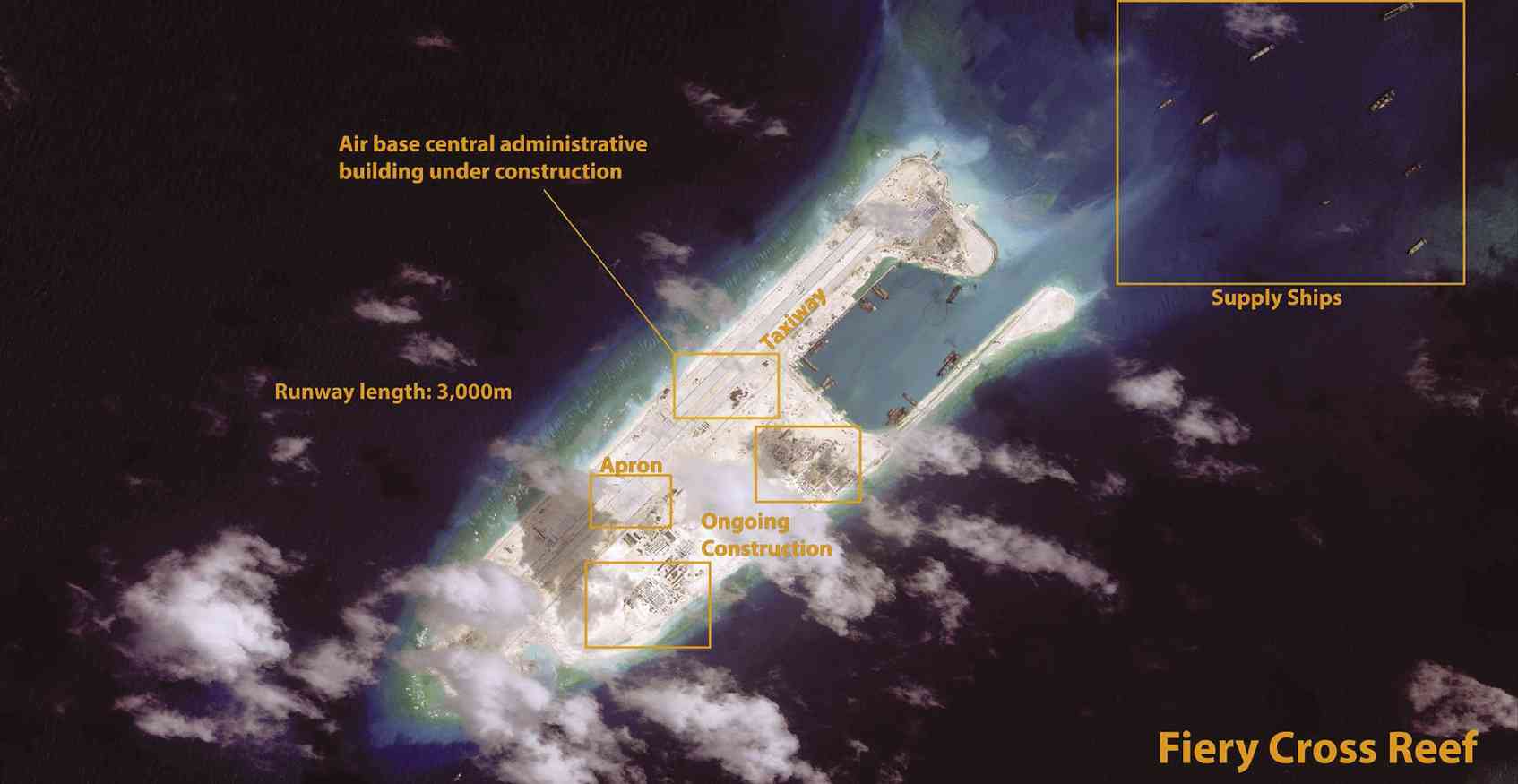
KAGITINGAN REEF  China is expanding construction on Fiery Cross Reef, also known as Kagitingan Reef, as seen in this June 28 satellite image. A 3,000-meter airstrip is nearly complete. China continues to pave and mark the airstrip and an apron and taxiway have been added adjacent to the runway. Personnel are now visible walking around the island. A sensor array has also been constructed and additional support facilities are being built. CSIS ASIA MARITIME TRANSPARENCY INITIATIVE/DIGITAL GLOBE
KAGITINGAN REEF China is expanding construction on Fiery Cross Reef, also known as Kagitingan Reef, as seen in this June 28 satellite image. A 3,000-meter airstrip is nearly complete. China continues to pave and mark the airstrip and an apron and taxiway have been added adjacent to the runway. Personnel are now visible walking around the island. A sensor array has also been constructed and additional support facilities are being built. CSIS ASIA MARITIME TRANSPARENCY INITIATIVE/DIGITAL GLOBE


“Our message to the world is clear: What is ours is ours; setting foot on Recto Bank is no different from setting foot on Recto Avenue,” President Aquino said in his second State of the Nation Address in July 2011.

But the Philippine Navy recently found a large steel marker bearing Chinese inscriptions and hundreds of yellow buoys in waters near Recto (Reed) Bank, an area of the West Philippine Sea where Manila has long explored for oil and gas, naval sources said.

A Reuters dispatch on Tuesday from Puerto Princesa City said one sailor reported he was on a fishing boat being used by the Navy that discovered the rubber buoys and the floating steel marker at the end of May.

The buoys stretched “as far as the eye could see,” the sailor said.

The newest discovery of Chinese markers was confirmed by two senior Philippine naval officials. One said the buoys were still there when the Navy checked the site mid-June, although the steel marker was gone. No attempt was made to remove the buoys, he said.

“Our boys tried to cut and remove the buoys but a large Chinese patrol ship emerged on the horizon and they hurriedly left,” the sailor said, adding it was unclear what the Chinese inscriptions on the steel marker meant.

The three sources declined to be identified because they were not authorized to speak to the media.
Philippine military officials said it was the first time in recent years that such markers had been found near Recto Bank.

The sailor also said there was no hard evidence Chinese ships had placed the marker and buoys near Recto Bank, which is also claimed by Beijing.

But efforts to remove the buoys were thwarted by the sudden appearance of a Chinese naval patrol vessel, prompting the Philippine boat to flee, the sailor said in an interview in Puerto Princesa, the Philippine military’s jump-off point to the disputed South China Sea.

The Reuters report on the Chinese incursion at Recto Bank coincided with the opening hearing on Tuesday in the arbitration court in The Hague of the Philippine petition against China on Manila’s maritime disputes with Beijing.

Solicitor General Florin Hilbay will open the presentation, according to Malacañang’s deputy spokesperson Abigail Valte.

Foreign Secretary Albert del Rosario will “speak on the reason for the filing of the Philippines’ case,” said Valte, who is with the delegation. Lawyers from the Washington-based law firm Foly Hoag, led by Paul Reichler, will present the arguments.

Muscle-flexing

China has refused to participate in the hearing.

The Spratly islands, where China is flexing its naval muscles as it builds seven man-made islands on top of coral reefs, lie to the southwest of Recto Bank, farther away from the Philippines.

Asked to comment on the buoys, the Chinese foreign ministry said, “We do not understand what you are talking about,” adding that China had “indisputable sovereignty” over the Spratly islands and its nearby waters.

“China’s position on this is clear and consistent,” it said.

The Chinese defense ministry did not respond to a request for comment.

Col. Edgard Arevalo, the Philippine Navy spokesman in Manila, said he had not seen any report on the discovery.
China claims most of the South China Sea, of which the West Philippine Sea is a part. An estimated $5 trillion in shipborne trade passes the disputed waterway every year. The Philippines, Vietnam, Malaysia, Brunei and Taiwan also have overlapping claims.

Fishing ban

Philippine military strategists have long worried that China wants to occupy Recto Bank.

One Air Force general said he suspected the buoys were put there so Chinese fishermen could tether their boats, then if the Philippine Navy tried to evict the fishermen, Chinese Coast Guard ships would appear to protect them.

In 2012, China seized Panatag (Scarborough) Shoal, which lies 230 km west of the Philippines, after a three-month standoff with the Philippine Navy.

China has since prevented Philippine fishermen from getting close to the rocky outcrop’s rich fishing grounds, the Philippine government and fishermen say.

The Philippine Navy has previously found markers with Chinese inscriptions around shoals in other parts of the West Philippine Sea.

In 2011, a steel marker the size of a 4-meter container was discovered in Escoda (Sabina) Shoal in the Spratlys. A Navy boat towed it away while concrete markers found in the same area last July were blown up, naval officials said.

The Philippines said in March it was suspending exploration at Recto Bank while it pursued international arbitration. Manila is seeking a ruling to confirm its right to exploit waters in its EEZ as allowed under the UN Convention on the Law of the Sea (Unclos).

‘Absurd claims’

In a statement issued during a protest at the Chinese Embassy on Tuesday, the militant Bagong Alyansang Makabayan (Bayan) said it believed the Philippines had a strong case.

“The arbitral tribunal should give the case due course. If the Philippines wins, then we would have gained an important legal and moral victory against China’s absurd claims. It would aid our assertion of our sovereignty and gain us the support of the international community,” said Bayan secretary general Renato Reyes.

Lauro Baja Jr., former permanent representative of the Philippines to the United Nations and one of the senior diplomats who crafted the 2002 Declaration on the Conduct of Parties in the South China Sea, warned the Philippines should not fall into Beijing’s trap.

“China is being clever and smart. They frame their responses to the Philippines’ case through the issue of territorial sovereignty,” he said.

–Nikko Dizon and Niña P. Calleja, Philippine Daily Inquirer


Saturday, March 15, 2014

Manila air-drops supplies to troops on disputed reef

The Philippines air-dropped food and water to soldiers posted on a grounded transport ship on a disputed South China Sea shoal, after China blocked two supply ships from reaching the troops, a senior navy official said on Wednesday.

Chinese ships patrolling waters around Second Thomas Shoal, known in China as the Ren'ai reef, on Sunday ordered the Philippine ships carrying construction materials to leave the area.

Beijing claims Manila is trying to start construction on the disputed reef after it ran aground an old transport ship in 1999 to mark its territory and stationed marines on the ship. Manila claims the Shoal is part of the Philippine's continental shelf.

"We only intend to improve the conditions there, we have no plans to expand or build permanent structures on the shoal," said a Philippines navy official, who declined to be identified because he was not authorized to speak to the press.

"On Monday, we sent a navy Islander plane to drop food and water, but it will only last a few days. We really have to send back the civilian boats. Since last year, we've been resupplying our troops using civilian ships to avoid confrontation and this was the first time China blocked them."

On Tuesday, Manila summoned the second highest Chinese embassy official to hand over a strong-worded protest, calling the blockade "a clear and urgent threat to the rights and interests of the Philippines".

Chinese foreign ministry spokesman Qin Gang said China had called in Philippine diplomats in Beijing to lodge a protest in response.

"The Philippines' motive in trying to illegally occupy Ren'ai reef and create incidents in the South China Sea is abundantly clear. China calls on the Philippines to stop all its provocative actions," he added.

The Second Thomas Shoal, a strategic gateway to Reed Bank, believed to be rich in oil and natural gas, is one of several possible maritime flashpoints that could prompt the United States to intervene in defense of Asian allies troubled by increasingly assertive Chinese maritime claims.

WASHINGTON CALLS BLOCKADE "PROVOCATIVE"

On Wednesday, Washington said it was troubled by China's blockage of the Philippines ships, calling it "a provocative move that raises tensions."

"Pending resolution of competing claims in the South China Sea, there should be no interference with the efforts of claimants to maintain the status quo," U.S. State Department spokeswoman Jen Psaki said in a statement. She added that "freedom of navigation" in the area "must be maintained."

China has objected to efforts by Manila to challenge its territorial claims under the Law of the Sea at the Permanent Court of Arbitration at The Hague.

Ernest Bower of the Center for Strategic and International Studies think tank said new pressure on Manila could be due to China's perception that the United States has shown weakness in dealing with crises in Syria and Ukraine and will be similarly lacking in resolve in Asia - in spite of its declared policy "pivot" to the region.

It also reflected Chinese concerns about negotiations expected to bring about broader access for U.S. troops to the Philippines, he said.

"The Chinese see a very unhappy situation in the Philippines - that one of their smaller neighbors is taking them to court and working with the Americans for expanded military access," Bower said. "It does not fit with the Chinese script of where they want to be in terms of the South China Sea and their sovereign claims."

Bower said such incidents raised the risk that a small clash could escalate and it was important for the United States to make its commitment to the region clear ahead of a planned visit to Asia, including the Philippines, by President Barack Obama next month.

"The Chinese look at the situation in Syria and Ukraine and they look at the so-called Asia pivot and they don't think there is any political foundation that has been built that would support American action in Asia if push came to shove," he said.

Beijing's claim over islands, reefs and atolls that form the Spratlys, a group of 250 uninhabitable islets spread over 165,000 square miles, has set it directly against U.S. allies Vietnam and the Philippines, while Brunei, Malaysia and Taiwan also lay claim to parts of the South China Sea. China also has competing territorial claims further north with Japan, a major U.S. ally in Asia.

The South China Sea provides 10 percent of the global fish catch, carries $5 trillion in ship borne trade a year and its seabed is believed to be rich with energy reserves.

Article Source: Yahoo News

Philippines protests China stopping troop resupply

The Chinese coast guard prevented delivery of supplies to Filipino soldiers guarding a disputed shoal in the South China Sea and an envoy rejected a Philippine protest over the interference, officials said Tuesday.

Chinese ships prevented two Filipino civilian vessels hired by the Philippine navy from reaching Second Thomas Shoal on Sunday, the Philippine Department of Foreign Affairs said in a statement. The shoal is called Ayungin Shoal by Manila and Ren'ai Reef by the Chinese.

"Ayungin Shoal is part of the continental shelf of the Philippines and therefore, the Philippines is entitled to exercise sovereignty rights and jurisdiction in the area without the permission of other states," the statement said.

China's actions "constitute a clear and urgent threat to the rights and interests of the Philippines" under the Law of the Sea, it added.

Foreign Affairs spokesman Raul Hernandez said the resupply was a routine activity that hasn't been interrupted by the Chinese in the past.

"For 15 years we have conducted regular resupply missions and personnel rotation without interference from China," he said.

He said the Chinese ships used digital signs, sirens and megaphones in ordering the Filipino vessels to leave. The Filipinos returned to Palawan, the nearest Philippine province east of the Shoal.
China's charge d'affaires was summoned and handed the protest note. Hernandez said that as in the past, Beijing rejected the protest.

Less than a month ago, Manila also protested a Chinese water cannon attack on Filipino fisherman near another disputed shoal. No one was injured in the Jan. 27 incident at the Scarborough Shoal off the country's main island of Luzon in the north.

The Filipino troops awaiting fresh supplies are stationed on a decrepit military hospital ship that ran aground in 1999 on the shallow coral outcrop of the Second Thomas Shoal. The rusty ship has since become the symbol of the country's sovereignty over the area.

China has been demanding the removal of the ship, claiming that the area is part of Chinese territory.
Department of National Defense spokesman Peter Paul Galvez said "the Chinese coast guard ships blocked our two vessels which were en route to Ayungin to reprovision" the troops. He did not give other details.

The Chinese did not block Philippine marines and supplies to the station last June, a month after the deployment of Chinese ships to the area that also prompted diplomatic protests from Manila.

China's official Xinhua news agency on Monday quoted Chinese Foreign Ministry spokesman Qin Gang as saying that the two Philippine ships were loaded with construction materials and were driven away by Chinese coast guard vessels as they approached the shoal.

"China has indisputable sovereignty over the Nansha Islands and their adjacent waters including the Ren'ai Reef," Qin said.

China claims virtually the entire South China Sea. Nansha is the Chinese name for the Spratlys, a chain of resource-rich islands, islets and reefs claimed partly or wholly by China, Brunei, Malaysia, Philippines, Taiwan and Vietnam.

Article Source: Yahoo News

Wednesday, February 19, 2014

Tensions Set To Rise In The South China Sea

A series of recent events points to a declining state of stability and security in the South China Sea.


Over the last month and a half, seven significant developments indicate that tensions in the South China Sea are set to rise in both the short and long term. The five short-term trends include: Philippine defiance of China’s fishing ban; continued inaction by the Association of Southeast Asian Nations (ASEAN); the Chinese navy’s repeated assertions of sovereignty over James Shoal; the possibility of an Air Defense Identification Zone (ADIZ) over the South China Sea; and stronger United States opposition to China’s ADIZ and maritime territorial claims.

First, in January, the Philippines stepped up its public defiance of China and its territorial claims in the South China Sea. On January 15, Emmanuel Bautista, Chief of Staff of the Armed Forces of the Philippines, stated in a television interview with respect to new fishing regulations issued by Hainan province that Filipino fisherman should not give in to threats or intimidation. A day later, Secretary of Defense Voltaire Gazmin stated that the Philippines would disregard Hainan province’s new fishing regulations and would provide escorts to Filipino fishermen in the West Philippines Sea “if necessary.”

On January 17, the local media published aerial reconnaissance photographs taken at Ayungin Shoal (Second Thomas Reef) on August 28, 2013. The photographs showed the presence of two People’s Liberation Army Navy (PLAN) warships, including a frigate, and a Coast Guard vessel. The press quoted from a confidential government report that stated the Chinese naval presence “could be part [of] a renewed and possibly more determined effort to remove Philippine military presence on Ayungin Shoal and from the whole Spratly island group.”

On February 4, President Benigno Aquino in an interview with The New York Times called on the international community to lend its support to resist China’s claims in the South China Sea.

Second, the ASEAN Foreign Ministers held a Retreat in Bagan, Myanmar from January 16-17. Philippines Secretary of Foreign Affairs Albert del Rosario called on ASEAN to “maintain regional solidarity” in response to China’s imposition of an ADIZ and new fishing regulations in the South China Sea.

“Clearly, in addition to unilateral measures to change the status quo and threats to the stability of the region,” del Rosario stated, “these latest developments violate the legitimate rights of coastal and other states under international law, including UNCLOS, and more specifically the principles of freedom of navigation and overflight, and is contrary to the ASEAN-China Declaration on the Conduct of Parties in the South China Sea.”

The ASEAN Ministers “expressed their concerns on the recent developments in the South China Sea. They further reaffirmed ASEAN’s Six-Point Principles on the South China Sea and the importance of maintaining peace and stability, maritime security, freedom of navigation in and overflight above the South China Sea.”

The ministers repeated ASEAN’s standard line that all disputes should be resolved by peaceful means in accordance with international law and that all parties should show “self-restraint in the conduct of activities.” The ministers declined to be specific and took no further action.

Third, on January 20 a PLAN flotilla comprising three ships, the Amphibious Landing Craft Changbaishan, and two destroyers, Wuhan and Haikou, left the naval base on Hainan to commence annual naval exercises in the South China Sea. The flotilla first conducted drills off the Paracel islands including amphibious landings “on every reef guarded by China’s navy,” according to the commander of the flotilla.

The flotilla then sailed south to the Spratly islands. On January 26 the Chinese media reported that when the ships reached James Shoal eighty kilometers off Sarawak, PLAN sailors conducted an oath taking ceremony vowing to safeguard China’s sovereignty and maritime interests.

The following day Qin Gang, a spokesperson for China’s Foreign Ministry, reiterated China’s “indisputable sovereignty” over James Shoal.

However, when Admiral Tan Sri Abdul Aziz Jaafar, the Chief of the Malaysian Navy, was interviewed by the New Straits Times on January 29 about the PLAN activities at James Shoal, he denied they took place.

According to Admiral Aziz, “There has been no act of provocation on the part of the Chinese or threat to our sovereignty as they are conducting their exercises in international waters” one-thousand kilometers away. Admiral Aziz was apparently referring to naval exercises conducted previously by the aircraft carrier Liaoning and its escorts.

This is the second time in two years that PLAN warships have visited James Shoal to assert Chinese sovereignty claims. On both occasions Malaysian authorities have denied any knowledge of Chinese activities. This raises questions about the veracity of Malaysian accounts, deficiencies in Malaysia’s maritime domain awareness capacity, or whether Malaysia ordered its navy out of the area to avoid any incident.

Fourth, the Asahi Shimbun reported on January 31 that a draft ADIZ for the South China Sea had been drawn up by air force officers at the working level at the Air Force Command College and submitted to the government in May 2013. The draft ADIZ reportedly covers the Paracel islands and some of the South China Sea. The Japanese report stated that Chinese officials were still deliberating on the extent of the ADIZ and the timing of the announcement.

Immediately after the Asahi Shimbun report was published it was dismissed by China’s Foreign Ministry. A spokesperson declared “generally speaking, China does not feel there is an air security threat from ASEAN countries” and therefore does not feel a need for an ADIZ.
It should be recalled, however, that in November last year when China announced its ADIZ in the East China Sea, a Ministry of National Defense spokesperson affirmed that “China will establish other Air Defense Identification Zones at the right moment after necessary preparations are completed.”

Fifth, in February, high-level United States officials became more assertive in opposing China’s ADIZ and territorial claims in the South China Sea. For example, on February 1, Evan Medeiros, Director for Asia at the National Security Council, stated in an interview, “We oppose China’s establishment of an ADIZ in other areas, including the South China Sea. We have been very clear with the Chinese that we would see that as a provocative and destabilizing development that would result in changes in our presence and military posture in the region.”

On February 5, Daniel Russel, Assistant Secretary of State for East Asian and Pacific Affairs, stated in testimony to the House Foreign Affairs Subcommittee on Asia and the Pacific that China should refrain from establishing other ADIZs in the region.

Russel also said, “any use of the ‘nine-dash line’ by China to claim maritime rights not based on claimed land features would be inconsistent with international law” and that China’s “pattern of behavior in the South China Sea reflects an incremental effort by China to assert control over the area contained in the so-called ‘nine-dash line’.”

Finally, Russel provided the strongest U.S. endorsement of the Philippines’ action in taking its territorial dispute with China to arbitration. Assistant Secretary Russel, “We fully support the right of claimants to exercise rights they may have to avail themselves of peaceful dispute settlement mechanisms. The Philippines chose to exercise such a right last year with the filing of an arbitration case under the Law of the Sea Convention.”

The two long-term trends include new U.S. assessments of the future balance of power in the Asia-Pacific and continued Chinese maritime modernization.

During January and February, three high-level U.S. officials proffered sober assessments of the changing balance of power in the Western Pacific.

On January 15, Admiral Samuel Locklear, Commander U.S. Pacific Command, was quoted by Defense News as stating, “our historic dominance that most of us… have enjoyed is diminishing, no question.” Admiral Locklear was referring to the rise of China’s naval power that would take time to eventuate. He concluded, “That’s not something to be afraid of, it’s just to be pragmatic about.”
In late January, Frank Kendall, Deputy Undersecretary of Defense for Acquisition and Technology, stated that U.S. military technological superiority is being “challenged in ways that I have not seen for decades, particularly in the Asia-Pacific Region.” He cited China’s military modernization and shrinking U.S. defense budgets as the main causes.

On February 4, James Clapper, Director of National Intelligence told a hearing of the House Intelligence Committee with respect to China, “They’ve been quite aggressive about asserting what they believe is their manifest destiny, if you will, in that part of the world. “ Clapper noted that China’s “very impressive military modernization” was designed to address what China views as U.S. military strengths.

According to testimony by the Office of Naval Intelligence (ONI) to the U.S. China Economic and Security Review on January 30, “The Chinese navy has ambitious plans over the next 15 years to rapidly advance its fleet of surface ships and submarines as well as maritime weapons and sensors.” The ONI reported that China laid down, launched or commissioned more than 50 naval ships in 2013 with a similar number planned for this year.

At the same time, it was reported that China has begun construction a second aircraft carrier which it hopes to launch in 2018. Security analysts believe that China plans to operate a carrier battle group in the “far seas” by 2020. There were also reports that China was building a hypersonic missile capable of penetrating the U.S. missile defense system.

In an analysis released in early February, IHS Jane’s estimated that China’s defense spending would reach nearly $160 billion in 2015, up from $139 billion spent in 2013. According to Deputy Undersecretary Kendall, “Overall, China’s military investments are increasing in double-digit numbers each year, about 10 percent.”

China continued to make similar advances on the paramilitary front. On January 10, a new 5,000 tonne ship was commissioned into China Coast Guard South Sea Fleet and stationed at Sansha City on Woody island in the Paracels. The China Ocean News reported on January 21 that the new vessel would commence regular patrols in the South China Sea to protect China’s maritime interests and provide a “speedy, orderly and effective emergency response to sudden incidents at sea.” Also on the same day, the Global Times and Beijing Times reported that China was building a 10,000-ton marine surveillance ship, the largest of its kind in the world.

Current short-term and long-term security trends appear likely to exacerbate tensions over territorial disputes in the South China Sea. The Philippines continues to engage in a war of words with China, while China continues to invest in Second Thomas Reef by stationing warships in the area.

Differences in approach between the Philippines and Malaysia make it unlikely the four claimant states can reach a common position for ASEAN to endorse. ASEAN itself appears unable to reach a consensus that Chinese fishing bans in the South China Sea, coupled with the possible imposition of a Chinese ADIZ, are security issues affecting the whole of Southeast Asia.

China is continuing its build-up and modernization of both PLAN warships and paramilitary Coast Guard vessels. The former continue to conduct military exercises in areas where China’s nine-dash line overlaps with the Exclusive Economic Zones of claimant states. The latter are increasing in size thus enabling them to patrol and remain on station in the South China Sea for longer periods.

The current proactive U.S. challenge to China’s nine-dash line claim and opposition to any ADIZ in the South China Sea is likely to meet Chinese political, diplomatic and possibly military resistance in the form of challenges in contested waters. In the long-term, China’s naval modernization and expansion will result in the relative decline of U.S. naval primacy in the Western Pacific.

Article Source: The Diplomat

Wednesday, January 22, 2014

Philippine Navy launches strategy in the south amid China's aggressiveness

The Philippine Navy has launched its "active archipelagic strategy" to defend and secure the country's territory  in the face of China's aggressiveness over the disputed West Philippine Sea, said Naval Chief Vice Admiral Jose Luis Alano.
 
However, Alano  refused to elaborate about the naval effort in asserting its mission following Beijing's  fishing rule in the disputed waters it claimed to be as part of its territory.

According to Alano, their security effort has been there and was not in response to the posturing of the Chinese  over the resource-rich disputed territory.

“This (active archipelagic strategy security plan) is something that has already been there. As we do that, we are creating more prosperity. And with prosperity more things needs to be secure for our people,” Alano said when asked by newsmen if the naval operational plan was in response to the Chinese domination and control of the disputed territory.

Alano said the Navy is developing its capability.

Defense Secretary Voltaire Gazmin earlier said  the military is willing to escort and secure Filipino fishermen following China's fishing rules.

Alano said the Navy continues to improve increase its capabilities and the upgrades are  in the pipeline under the modernization of the Armed Forces of the Philippines (AFP).

Alano has also installed Tuesday a new commander of the naval command base here.

Alano placed Rear Admiral Jesus Millan as commander of the Naval Forces Western Mindanao (NFWM), the largest navy operational command  to replace Vice Rear Admiral Isabelo Gador in a formal turn-over of command ceremony held at the ground of Romula Espaldon naval base in Lower Calarian in this city.

Gador was promoted to a higher position being the incoming Naval Vice Commander.

Alano, who presided  over the change of command ceremony, credited Gador’s leadership in helping quell the siege staged by the rebels of the Nur Misuari faction of the  Moro National Liberation Front (MNLF) in September in this city.

The attack of the MNLF rebels was detected initially by the patrolling naval boat following the encounter that left one of its personnel killed and prevented possible succeeding reinforcement of the rebels coming from Sulu and Basilan through the seas.

Alano reminded the new leadership of the NFWM of the vital role of the base here as the Philippine Navy's largest operational command in ensuring  stability in this part of the country.

Article Source: The Philippine Star

Sunday, January 19, 2014

Philippine report spies more 'assertive, aggressive' China in West Philippine Sea


A more assertive and aggressive Chinese military presence has been monitored near the Philippine garrison on Ayungin Shoal, located in the disputed Spratly Islands in the West Philippine Sea (South China Sea). 

A confidential government report, obtained by TV5, indicates the "assertive and aggressive" stance of China could be part a renewed and possibly a more determined effort to remove Philippine military presence on Ayungin Shoal and from the whole Spratly Islands group. A dilapidated Philippine Navy Ship, the BRP Sierra Madre, was grounded on the shoal in 1999 and now serves as the barracks and command facility of Philippine Marines deployed there.

China had accused the Philippines of intentionally grounding the BRP Sierra Madre as part of what it claimed was an occupation strategy. Since then, China has made repeated demands that the ship and soldiers be removed. In 2013, Beijing offered to remove the BRP Sierra Madre at no cost to the Philippines.


Consistent demand 

Ayungin Shoal, internationally known as Second Thomas Shoal, is located 108 nautical miles from Palawan and is only 13 nautical miles southeast of Mischief Reef, where China has built a formidable garrison.

The confidential report states that China has been consistent with its demand that Manila remove the BRP Sierra Madre. It points out that in 2013, Beijing began stepping up the pressure.

On April 19, 2013, China sent a strongly worded communication demanding that the Philippine government remove the BRP Sierra Madre on Ayungin Shoal “but this time, they are also insinuating the removal and/or dismantling of all Philippine structures in the entire West Philippine Sea – citing the area as Chinese territory.”


“It must be noted that China has heightened its presence in the area as evidenced by the continuous sightings of Chinese Maritime Surveillance (CMS) and People’s Liberation Army – Navy (PLAN) vessels immediately after it conveyed its intentions to the Philippine government,” the report stated.

The increased presence of Chinese patrols in the disputed territory is particularly worrisome for Manila as the report points out the vessels may block supply routes to starve out the Philippine garrison.

"Although it is expected that the presence of CMS and PLA Navy ships will be regularly sighted in the area, the positioning or encircling of the Philippine Navy vessel by the Chinese could be an indication that China might block Philippine troops of their much needed supply and thus force the deployed soldiers to eventually withdraw in the area,” the report noted.

Aerial Surveillance photos taken in August 2013 show a Chinese Coast Guard ship, with bow number 3164, anchored off Ayungin Shoal and in full view of the BRP Sierra Madre.

Other photos show the presence of Chinese naval warships, including a frigate, and Chinese Coast Guard ships anchored off Mischief Reef.

Last May 2013, the Philippine government report said a Chinese missile armed frigate, Janghu–V class with bow number 563, was stationed close to Ayungin Shoal.

China has also maintained two to three ships near the shoal for the whole of 2013 and sent aircraft to fly over the Philippine garrison on Ayungin Shoal.


No plan to withdraw 

According to the report, the Philippine Navy has made it clear it “has no plan of withdrawing/removing the ship from the shoal.”

The Chinese garrison on Mischief Reef is capable of sustaining and supporting naval patrols in the Spratlys for extended periods and PLA Navy ships are “rotationally deployed” there.

The Spratly Island Group is a cluster of small islands, reefs and shoal covering 150,000 square miles in the South China Sea. The Philippines, China, Taiwan, Malaysia, Vietnam and Brunei are claiming either in whole or in part as their territory.

China has built heavily fortified garrisons, complete with radar, helipads and piers, in several areas well inside the Philippine claimed territory.

Chinese media recently reported that the People’s Liberation Army had prepared an combat plan to “re – take” Pag–asa Island in the Kalayaan Island Group, which is part of Palawan.

Pag–asa Island is where the main Filipino community in the Kalayaan Island Group is located.

Chinese media reports added that the Chinese plan limits military activity to the Spratlys and that Beijing would not invade Philippine territories.

The Philippine government acknowledges the presence of the BRP Sierra Madre, although dilapidated, serves as deterrent to China. “The presence of the BRP Sierra Madre in Ayungin Shoal prevents China from controlling and ultimately taking back ownership,” the report said.

It went on to say that China is also sensitive to world opinion and if it forcibly asserts its sovereignty in the disputed areas, “it may negatively project them as invaders or predators...in the international community as it will violate the Declaration of Conduct of Parties in the South China Sea.”

The Code of Conduct, signed by the Association of Southeast Asian Nations and China in 2002, binds claimant countries to avoid any action that may worsen tensions over territorial disputes.


 Article Source: InterAksyon

Wednesday, January 15, 2014

China planning permanent structures on Bajo de Masinloc?

China has maintained a continued naval presence on Bajo de Masinloc or Scarborough Shoal, which is widely seen as a preparation for the establishment of a permanent structure well within Philippine territorial waters in the West Philippine Sea (South China Sea). 

A confidential Philippine government report acknowledged that Beijing will use its growing military capability to assert its sovereignty and control in the disputed territories despite Manila’s assertions and continued diplomatic efforts to resolve the disputes.

Documents obtained by News5 showed that Chinese Coast Guard and Marine Surveillance vessels have been constantly present on the shoal as far back as April 2012.

Apart from the ships, it appears China has also been placing buoys as a “prelude” to the establishment of a permanent presence on the shoal. 

Bajo de Masinloc, the largest atoll in the West Philippine Sea, which China calls Huangyan Island, sits on an area believed to hold vast mineral, oil, and gas reserves. 


China's presence 

The Philippine government report of China’s continued naval presence comes after major developments involving the South China Sea disputes: China’s enforcement of a fisheries law and China state media reports that Beijing has readied a “detailed combat plan” to seize control of Pag–asa Island in the Kalayaan Island Group, located in the Philippine zone of the disputed Spratly islands.


“The Philippines is so arrogant as to announce in the New Year that it will increase its navy and air force deployment at Zhongye (Pag–Asa)  Island, a Chinese island that it has illegally occupied for years,” the Qianzhan report said, emphasizing further: “The battle is aimed at recovery of the island stolen by the Philippines from China.”


But the report assured that, “There will be no invasion into Filipino territories.”


Government documents showed that for whole 2013, China has maintained at least one ship in the Bajo de Masinloc/Scarborough Shoal area. The only times the Chinese ships withdrew from the area was in July and November due to bad weather “but returned a few days after.”


In April 2012, the Philippines intercepted eight Chinese fishing vessels on Bajo de Masinloc and seized large amounts of illegal collected corals, giant clams, and live sharks. China protested the seizures, insisting Bajo de Masinloc is within Chinese territory.


Manila strongly argued that Bajo de Masinloc is not part of the disputed territories wit China and that it is 124 nautical miles from the coast of Luzon – well within the 200 nautical mile exclusive economic zone of the Philippines.


Similar to Mischief Reef? 


Since the start of the standoff in April 2012, Chinese Maritime Surveillance and PLA Navy ships were present on Bajo de Masinloc. The government report stated the presence of the ships there is part of a China’s pattern to establish a permanent presence – similar to what they did in Mischief Reef.


“China has a history of occupying islands or territory that does not belong to her, just like the case of Mischief Reef. We should not discount the possibility that it will exert its full influence and capacity in order to occupy disputed areas in the West Philippine Sea and Scarborough Shoal as evidence by the prepositioning of naval frigates and destroyers,” the confidential government report stated.


Surveillance photos, taken in August 2013, show three Chinese coast guard vessels were seen at the shoal’s entrance. The photos also showed that China has placed a white buoy and built a concrete platform near the shoal’s entrance.


The Chinese Coast Guard vessels were identified by their hull numbers: BN 1127, BN 1117, and BN 3412.


“The sighting of buoys at Scarborough Shoal is seen as a prelude to occupation as patterned from the occupation of Mischief Reef in 1995,” the documents stated, adding that the Chinese ships allows them to respond “quickly to a contingency at Scarborough Shoal.”


The buoy and concrete platform are different from the 75 concrete blocks found in the area, which Manila had earlier claimed was placed by China. It was later found out the blocks were placed by the US since the area was once used as a gunnery range.


In the Mischief Reef case, the Philippine discovered buoys and concrete platforms placed by China but Beijing at that time insisted they wouldl just build shelters on stilts for its fishermen.


However, over the years, Beijing gradually built a massive garrison made up of four complexes with 13 multi–storey buildings that can house up to 50 soldiers. The Mischief Reef complex is also equipped with satellite communications and radar facilities, a windmill to provide power, helicopter landing pads, and docks for patrol ships.


The report likewise warned that China is expected to show “more assertive actions” should Manila confront them anew over Bajo de Masinloc.


According to the report, among the expected Chinese reponses to Manila are: a show of force to demonstrate effective control of Scarborough Shoal; deploy more maritime law enforcement ships to prevent the Philippines’ from patrolling the area and the construction / placement of more buoys around Scarborough Shoal.


Philippine Coast Guard has maintained patrols in the area, shadowing the Chinese ships.


The report concluded by stressing that “the situation at Scarborough Shoal requires the Philippines to remain vigilant and ready in any eventuality should tensions escalate between the two claimants.”


Bajo de Masinloc's importance to China


French geographer Francois-Xavier Bonnet, research associate of the Bangkok-based Research Institute on Contemporary Southeast Asia, explains the importance of Bajo de Masinloc to China in his November 2012 paper titledGeopolitics of Scarborough Shoal


He says the shoal is part of a larger archipelago called Zhongsha Qundao, whose only features above sea level are the few rocks on Bajo de Masinloc. 


“The stakes are high... If China loses these rocks, it would not only lose the natural resources around the shoal (fishing grounds and the potential deposits of polymetallic nodules4) but also the possibility of claiming Zhongsha Qundao and, by consequence, the whole of the South China Sea,” says Bonnet. 


Article Source: InterAksyon

Tuesday, January 14, 2014

China preparing to seize Pag-asa Island


The Chinese Navy has drawn up a detailed plan to seize this year the Philippines’ Pag-asa Island in a battle that will be restricted in the South China Sea, according to a Chinese news network.
A report of business and strategy news platform Qianzhan (Prospects) in Mandarin was translated by English news site China Daily Mail and titled “Chinese troops will seize Pag-asa Island, which is called by China Zhongye, back from the Philippines in 2014.”
The report said the Philippines is so arrogant as to announce in the New Year that it will increase its navy and air force deployment at Pag-asa Island which is part of the disputed Spratly Islands.
“According to experts, the Chinese Navy has drawn a detailed combat plan to seize the island and the battle will be restricted within the South China Sea. The battle is aimed at recovery of the island stolen by the Philippines from China,” the report said.
The Philippines’ arrogance, the report said, is an intolerable insult to China.
“There will be no invasion into Filipino territories,” the report said.
The Department of Foreign Affairs (DFA) declined to comment on the report.
“We don’t comment on news articles that have unnamed and unofficial sources,” said DFA spokesman Raul Hernandez.
The Department of National Defense would have to validate the report about China’s supposed plan to seize Pag-asa Island, defense department spokesman Peter Galvez said.
Military officials declined to comment, saying the DFA is the agency authorized to speak on the matter.
China’s plan to invade Pag-asa Island could be part of Beijing’s 20-year expansion plan for its navy to have total dominance of the disputed Spratlys archipelago, security documents showed.
The document also showed that China’s plan was conceived 14 years ago following Beijing’s illegal occupation of Panganiban (Mishchief) Reef, some 130 nautical miles off Hulugan Bay in mainland Palawan and only 97 nautical miles east of Pag-asa Island.
“China has four to five years left to complete the plan,” an informed security official said, adding that it is already an open secret among Spratly claimant countries – the Philippines, Vietnam, Malaysia, Taiwan – that China has established a forward naval station at Panganiban Reef.
International defense analyst Greg Polling of the Washington-based Center for Strategic and International Studies, Southeast Asia Program, had warned two years ago that China has been rushing the construction of several warships specifically designed for its Spratlys naval operations.
Some of these warships that China has been building include hovercrafts capable of carrying one battalion of Marines and four tanks.
Several hovercraft units have already been completed and are just awaiting deployment after several sea trials.
China’s hovercraft project has reportedly solved the People Liberation Army’s problem of transporting warships directly into shallow waters surrounded by coral reefs, shoals and islets occupied by troops of other Spratly claimant countries.
Aside from Panganiban Reef, China has built another naval facility at Subi Reef where its transport ship has regularly been sighted. 
Article Source: The Philippine Star

Thursday, January 09, 2014

DND verifying reports of China's fishing rule in disputed seas


The Department of National Defense (DND) said Thursday that it is ready to enforce the country’s maritime laws in the wake of reports that China is imposing fishing regulations in the West Philippine Sea ****.
“The defense establishment is ready to assist in enforcing the maritime rules in the Philippine EEZ (exclusive economic zone),” DND spokesman Peter Galvez said.
“We will enforce [measures to protect] our resources,” he added.
Galvez was asked to comment on reports that China is now requiring foreign fishermen to seek its permission to operate in the West Philippine Sea, the subject of a territorial row in the region.
The policy reportedly took effect last month and covered two million hectares of the area, which is rich in oil and maritime resources.
The Philippine government, however, is still validating the reports about the new fishing regulation.
“We will have to verify statements regarding this alleged fishing rules by China,” Galvez said.
The defense official, nevertheless, stressed that all countries “are free to enforce fishing rules within their own EEZ.”
Reports about the fishing regulation came two months after China imposed an air defense zone above waters separating China, Japan, South Korea and Taiwan.
The policy which required all aircraft to identify themselves and to report their flight plans to the Chinese government while flying through the zone.
The zone, which spans 1,000 kilometers from north to south, drew flak from several countries who view it as an infringement on the freedom of flight in international airspace.
China is claiming almost the entire West Philippine Sea through its so-called nine-dash line, which covers more than 100 islets, atolls and reefs. China’s claims also overlap with those of the Philippines, Malaysia, Taiwan, Brunei and Vietnam.
Last January, the Philippines challenged China’s territorial claim before an international tribunal of the United Nations.
The Philippines said China’s nine-dash line is exaggerated and contrary to the United Nations Convention on the Law of the Sea.
The country has also called on China to desist from unlawful activities that violate its sovereign rights and jurisdiction. China has ignored the Philippines’ protests and insisted that the dispute be settled through bilateral negotiations.
Chinese vessels even insensified the conduct of illegal fishing and patrols in areas that are well within the Philippines’ 200-nautical mile EEZ. The lack of military capability, however, has prevented the Philippine government from scaring or repelling the intruders.
Article Source: The Philippine Star

Sunday, January 05, 2014

Philippine Military starts deployment of troops in Spratlys


 The military yesterday started its rotation of Air Force and naval contingents for deployments in Pag-Asa Island in the Spratlys.
Originally scheduled before Christmas, the airmen were not immediately relieved by their counterparts at Armed Forces of the Philippines-Western Command (AFP-Wescom) headquarters in Palawan due to the prevailing weather system hovering over the region for the entire month of December.
Kalayaan Mayor Eugenio Bito-onon Jr. confirmed the deployment of fresh troops in the island municipality.
Since the sea around the island is very rough, Wescom has started shuttling new Air Force troops to the island town using a Navy plane, giving the islanders a chance to visit Palawan aboard the returning Navy aircraft.
Pag-Asa Island is located within the hotly contested Spratlys archipelago area but is closer by several miles to mainland Palawan than from the coastline of Vietnam, which is laying maritime claim over the region along with China, Brunei and Taiwan.
All claimant countries except Brunei have troops deployed in the region, with China becoming more aggressive in pressing its maritime claim to almost 80 percent of the entire South China Sea by deploying its warships and surveillance vessels to conduct regular maritime patrol over the area.
The other day, Beijing announced the completion of the training exercises of its aircraft carrier Liaoning in the region.
The training exercises almost resulted in a naval confrontation between a Chinese frigate and the US warship USS Cowpens in December.
Aside from the airmen who are deployed on rotation basis in Pag-Asa Island, the seat of Kalayaan Island town with a current population of almost 200 civilian inhabitants including children, contingents from the Philippine Navy are also stationed in the area to bolster the country’s territorial hold over the seven islets and two shoals in the region.
“We don’t monitor any naval activities of China out there because of the prevailing weather. The sea is very rough and it is very dangerous for any ship to venture out in the open sea for now,” Bito-onon said.
He added that he has yet to receive reports from local fishermen if the two Chinese maritime vessels have returned to Ayungin Shoal. The vessels left the area last month after taking up position near the shoal for several months.
Ayungin Shoal is located between Pag-Asa Island and mainland Palawan.
China, insisting that the shoal is an integral part of its maritime domain, has tried to dislodge a contingent of Marine troops stationed in the shoal aboard the grounded Navy logistic ship BRP Sierra Madre.

Thursday, January 02, 2014

Deployed Marines’ kin get cheer


The wife of a Marine sergeant deployed to the disputed Ayungin Shoal off Palawan thought the Marine officers who had pulled up in front of her home over the holidays had come to bring the news every soldier’s wife and family dread.

Verginia Galvan, married to Marine Sgt. Edwin Galvan Sr., prayed she would not be handed a Philippine flag, a military gesture of final respects to the family of a soldier killed in action.

But a flag was the last thing Marine Col. Edgard Arevalo, commander of the Philippine Navy’s Civil Military Operations Group, and his team had in store for Galvan’s family when they visited them in their home in Signal Village, Taguig City, on Christmas.

Instead, the military men had brought with them a surprise—baskets of food and Christmas gifts for the family that had to spend the holidays without Galvan, who is stationed on Ayungin Shoal, one of the Philippine territories in the West Philippine Sea that China also claims.

In a press statement, Arevalo said Christmas gift packs were also handed over to the families of the other soldiers assigned to Ayungin.

Arevalo said the money to buy the presents for the Galvans came from the savings of the civil military operations group from its “toned down” Christmas party.

Arevalo said the Philippine Navy visited “fatherless” or “brotherless” families this Christmas and New Year’s in a show of solidarity to those “manning our isolated and distant posts.”

Galvan spent Christmas and New Year’s with a handful of colleagues on board the BRP Sierra Madre, a rusty Navy hospital ship intentionally run aground on the shoal.

It is their job to guard the country’s territorial waters, undermanned and underequipped as they may be.

Last May, the Marines posted on Ayungin Shoal reported the encroachment of Chinese sailors on Philippine territory. The Philippines has filed an international protest against China’s territorial claims before a United Nations arbitral committee.

Arevalo said Verginia told him she was “in near tears thinking something bad happened” to her husband. It didn’t help that she had to wait for Arevalo and his team for hours after they were held up in heavy traffic. It was a “long and agonizing wait,” she said.

“What proceeded during the visit was an exchange of pleasantries and cordial conversation where (Verginia)… confided, among other things, the difficulties of being a soldier’s wife,” Arevalo said. 

Particularly heartbreaking was when the Galvans’ youngest son, Junior, asked Verginia why they had not picked up his dad from the airport for Christmas.

The visit of the Navy’s civil military operations group to the Galvan family was one of the several organized by the military, as well as private individuals, to bring cheer to soldiers and their families after a challenging 2013 that saw massive military mobilization.

These included guarding territorial waters amid growing tensions with China; responding to a daring revival of the Sulu sultanate’s claim to a portion of Sabah; responding to the siege of Zamboanga City by Moro rebels; and relief and rescue operations in provinces hit by calamities.

Arevalo noted that Twitter user @PinkOliveDrab used social media to collect gifts for the soldiers and their families assigned in Ayungin Shoal and also those guarding Philippine territory within the West Philippine Sea.


Read more: http://newsinfo.inquirer.net/555713/deployed-marines-kin-get-cheer#ixzz2pCvxbi6A 

Monday, December 23, 2013

Troopers guarding West Philippine Sea get Christmas gifts from OFWs


Overseas Filipino workers have forwarded boxes of Christmas items to soldiers guarding the West Philippine Sea.

Dubbed as the "Saludo Package", the Christmas packages contain canned goods, news magazines, DVDs, toiletries and even cigarettes.

Lt. Col. Harold Cabunoc, 7th Civil Relations Group (CRG) commander, was among those who spearheaded the collection of gifts for the soldiers.

He said that he started the "Saludo Package" project in 2012 through his Facebook friends.

“My FB friends had always expressed their intent to provide support for the soldiers who are in the frontlines. Having experienced the hard life in the distant posts, I was motivated to gather all these donations and send them to the soldiers in the field,” Cabunoc stressed.

The recent donations were forwarded to the Marine unit which has operational control over the troopers deployed in the nine reefs and islets claimed by the Philippines.

The 7th CRG intends to send at least one box of assorted goods to every territory that is guarded by the soldiers.

Sometime in August 2013, Cabunoc used his FB account to float the idea of sending Christmas gifts for the military personnel stationed to protect the Philippine territories in the Kalayaan Island Group (KIG).

He said that Filipinos from all corners of the globe promptly replied to send their pledges.

“We received donations from OFWs who are working in the US, Germany, Australia, Japan and the Middle East. This is on top of the donations sent by Manila-based Pinoys who also wanted to show their appreciation for the service of our soldiers,” Cabunoc said.

Initially, three "balikbayan" boxes were sent for soldiers guarding Ayungin shoal and Rizal reef. Another box intended for Lawak reef is now gradually filled with assorted goods.

Kent Flores a Japan-based OFW from Iloilo is one of the donors.

He said that he wanted to make the soldiers happy during Christmas.

“Gusto ko lang na magpasalamat sa ating mga sundalo na taos-pusong nagsisilbi sa ating bayan. Kahit sa ganitong pamamaraan ay maipakita ko sa kanila na kinikilala namin ang kanilang kabayanihan (I want to thank our soldiers and give something in return for their heroism),” said Flores upon his arrival at NAIA barely a week ago.

Priscilla Sheppard of Australia also sent donations through a courier service which would be arriving after Christmas.

“Please let the soldiers know that a friend from Down Under appreciates their service,” said Sheppard in her FB message.

Meanwhile, Georgio Dano of New York, sent cash donation intended to buy provisions. He said that he will convince more people to support the project.

“I will forward the story to some officer friends of mine in the United States Navy. I've always been helping the Armed Forces here and abroad,” said Dano, a native of Cebu City, in his FB message.


Cabunoc said that aside from the "Saludo Package", he has also started the "Equip a Soldier" program this year.Five soldiers from the Army Scout Ranger, Philippine Marine Corps and the Philippine Air Force had received US made tactical boots that can last longer during foot patrols in the rugged terrain of the country. 

Source

Featured Posts

AFP Modernization 2017: Highlights and Review

The modernization of the Armed Forces of the Philippines was on a roll this year, as we've seen a few big ticket items having completely...

Popular Posts