Showing posts with label philippines. Show all posts

Sunday, May 20, 2018

Protecting The Philippine Rise (Benham Rise)

The Philippine Rise, also known as Benham Rise, has been the hot topic lately. While the Philippine government is trying to show and assure that the country has sovereignty over the Philippine Rise, the Armed Forces of the Philippines in general is starting to make headway that it is capable of keeping that posture of Philippine sovereignty of the Philippine Rise.


BRP Gregorio Velasquez committed to help in Philippine Rise studies


BRP Gregorio Velasquez (AGR-702) is capable of conducting oceanographic and hydrographic surveys. (PNA photo by Benjamin Pulta)

The BRP Gregorio Velasquez (AGR-702) will commit to help Filipino scientists in conducting further research off the 13-million-hectare Philippine Rise.

This was disclosed by Defense Undersecretary Cardozo Luna during the first anniversary of the renaming of the Philippine Rise in Casiguran off Aurora province on May 16.

Luna said this is in line with President Rodrigo R. Duterte's order that all available support be provided to Filipino scientists tasked to conduct additional studies off the Philippine Rise.

"I understand (that) the BRP Gregorio Velasquez is already here. She is our research ship. I will tell (Defense) Secretary Delfin Lorenzana that I am committing her to you and you can use her anytime," Luna said in Filipino.

The ship is capable of conducting oceanographic and hydrographic surveys.

The BRP Gregorio Velasquez (formerly the R/V Melville) is one of the two ex-American ships pledged by then president Barack Obama during his visit to the Philippines during the APEC Leaders Summit in November 2015.

The other ship is the USCGC Boutwell, which is now renamed to BRP Andres Bonifacio (FF-17) – the third Hamilton-class cutter of the Philippine Navy (PN).

The BRP Gregorio Velasquez was commissioned into the PN service in June 2016. In 1976, then R/V Melville was used in the movie “King Kong” starring Jessica Lange because of its Hypoid propulsion drive capability to move sideways. This type of drive is used on research vessels for station-keeping in the ocean over drill and coring sites.

As per policy, auxiliary research vessels are to be named after national scientists, hence her namesake, Dr. Gregorio Velasquez – a pioneer in Philippine phycology, a branch of science pertaining to the study of algae and seaweeds.

Velasquez was named an academician in 1978 and conferred as National Scientist in 1982.

He was also conferred with a Distinguished Science Medal and Diploma of Honor from the Republic of the Philippines (1956), the John Simon Guggenheim Memorial Foundation Fellowship (1956-57), Men of Science, Division of Biological Sciences in 1969, World's Who's Who in Sciences in 1970, and the Republic of the Philippines Cultural Heritage award in 1972.

While BRP Velasquez is the sole MSR vessel of the Navy, it is not the only one that can assist the team of scientists. The mapping of the area was done by two multidisciplinary vessels – BRP Hydrographer Presbitero and BRP Hydrographer Ventura of the National Mapping and Resources Information Authority (NAMRIA) while key MSR sorties have been utilizing M/V DA BFAR (Bureau of Fisheries and Aquatic Resources).

Activities for the first year anniversary of the renaming of the Philippine Rise started with a send-off ceremony for the marine scientists by President Duterte at the mouth of Casiguran Bay and the signing of Presidential Proclamation declaring Portions of the Philippine Rise as Marine Resource Reserve Area.

These events were highlighted by an on-deck flag raising ceremony at BRP Davao del Sur (LD-602), simultaneous with the laying of underwater flag marker at 47 feet below sea level (shallowest part of Philippine Rise). The activities were documented by an underwater video conducted by geologists of the Department of Environment and Natural Resources-Mines and Geosciences Bureau using a remotely-operated vehicle.

This was followed by the casting of the first buoy off the Philippine Rise.

The one-ton buoy was made of fully urethane foam with a stainless body attached to a five-ton concrete anchor by a 40 mm. fully ethylene rope.

It was designed in Malabon but was fabricated in San Fernando, Pampanga for 10 days from April 2, 2018.

A transponder costing PHP85,000 was also attached to the buoy to determine its exact location.

Article source: Philippine News Agency (May 18, 2018)


Northern Luzon Command Head eyes port improvements to enhance PH Rise patrols


In order to enhance the country's capabilities to protect the Philippine Rise (formerly Benham Rise), Northern Luzon Command (Nolcom) head Lt. Gen. Emmanuel Salamat is looking at the possibility of upgrading the various ports near the above-mentioned territory.

He made this statement when asked on whether there are plans to construct a naval facility in Casiguran, Aurora, the landmass nearest to the 13-million-hectare Philippine Rise.

The Nolcom chief was aboard BRP Davao Del Sur (LD-602), the lead ship of the Filipino flotilla tasked to arrange the commemoration of the first anniversary of President Rodrigo Duterte's Executive Order 25 which renamed Benham Rise to Philippine Rise on May 16, 2017.

The BRP Davao del Sur was joined by eight ships from the Navy, Coast Guard and Bureau of Fisheries and Aquatic Resources (BFAR).

Two FA-50PH jet fighters, a Coast Guard Islander plane and a Navy C-90 patrol aircraft also made a series of fly-by during the dropping of a buoy where a Philippine tricolor was drawn.

"As of now, I don't have an idea except that they have a proposal to, I myself have (a) proposal (to) upgrade and capacitate (the) development of our port facilities so that they can sustain (our) rotational presence here in Philippine Rise," Salamat said.

"Without port facilities, our ships, our maritime (patrol vessels) cannot sustain sustain longer (operations) in the seas," he added.

He admitted, though, that these proposals, should they near fruition, need a considerable amount of resources.

The Philippine Rise buoy laying and flag-raising mission, he said, will set the tempo on more patrols in the area.

"Of course as (soon) as the requirements (we need) are (provided as soon as possible to) Nolcom and (Area Task Force North) in coordination with other maritime agencies like the Philippine Coast Guard, the BFAR, we will continue our rotational presence in Philippine Rise," the Nolcom chief said.

Article Source: Philippine News Agency (May 17, 2018)

Area Task Force-North to cast first buoy, lay flag marker in PH Rise Wednesday


The Area Task Force North (ATF-North) is set to cast the first buoy and lay a flag marker at the shallowest point of the Philippine Rise (formerly Benham Rise) on May 16.

A fleet from the ATF-North, headed by Northern Luzon Command (NOLCOM) Lt. Gen. Emmanuel Salamat, will sail to the underwater feature following President Rodrigo Duterte’s send-off of a team of Filipino marine researchers to the maritime area on Tuesday.

The event will kick off with a flag raising ceremony onboard the BRP Tarlac which will be simultaneously held with the laying of a flag marker by volunteer Filipino divers at the shallowest point of the undersea region while waving their Philippine flags underwater.

Various agencies conducting the Maritime Air Patrol will also hold a fly-by of aircrafts. This will be done twice, during the singing of national anthem and at the end of the program proper.

Defense Secretary Delfin Lorenzana will be the keynote speaker at the event.

The program will end with the casting of the buoy above the flag marker laid by divers.

The buoy, which was crafted by the Bureau of Fisheries and Aquatic Resources, was designed based on international standards.

"This undertaking simply reveals to our fellowmen that in unity, we are strong, and that we are passionate in defense and protection of our sovereignty." Salamat noted.

"With the grace of Almighty God, we are blessed as a maritime nation, our country the Philippines, and the whole Filipino nation." he added.

ATF-North is an inter-agency coordinating body in charge of planning and execution of government programs in relation to maritime domain awareness, maritime security patrols and maritime presence over the Bajo de Masinloc in the West Philippine Sea, Luzon Strait in Batanes Province and the Philippine Rise east of Aurora Province.

The Armed Forces of the Philippines, together with other government agencies like the Philippine Coast Guard, Philippine Marines, Philippine National Police, Department of Environment and Natural Resources, Department of Interior and Local Governments and the Bureau of Fisheries and Aquatic Resources, formed ATF-North to safeguard national interests in the West Philippine Sea. Specifically, the Northern Luzon Command of the Armed Forces of the Philippines leads the inter-agency organization.

On May 16, 2017, President Duterte signed Executive Order No. 25 changing the name of the undersea feature to Philippine Rise.

“The Benham Rise Region is subject to sovereign rights and jurisdiction of the Philippines pursuant to relevant provisions of the 1987 Philippine Constitution, national legislation, and the UNCLOS and applicable international law,” the EO 25 stated.

In 2012, the United Nations, through recommendations of Commission on the Limits of the Continental Shelf, approved the Philippines’ claim that the Philippine Rise is within the country’s 200-nautical-mile exclusive economic zone.

The Philippines first sought recognition for its claims to the Philippine Rise on April 8, 2009.

Article Source: Philippine News Agency (May 15, 2018)

Corrected as President Duterte didn't jet skied at the Philippine Rise.

Thursday, May 17, 2018

Philippine Navy Contingent Returns Home from Exercise Komodo 2018

PH Navy contingent returns home from naval exercise in Indonesia

Photo by Philippine Navy

The Philippine Navy (PN) accorded a fitting arrival and welcome ceremony on May 16 at Pier 13 South Harbor, Manila for the returning more or less 200-man contingent onboard BRP Gregorio Del Pilar (FF15) after the successful participation in the 3rd Multilateral Naval Exercise codenamed, KOMODO 2018 on May 4 to 9, 2018 at Lombok Island, West Nusa Tenggara, Indonesia.

Photo by Philippine Navy


The PN’s participation in KOMODO 2018 was another big leap in enhancing and advancing the organization’s core competency and operational capabilities of surface assets in naval operations to multilateral level, thereby increasing readiness and interoperability. Further, it was an opportunity to showcase that the PN can keep up with its counterparts in the conduct of various naval exercises and maritime operations.

Monday, February 12, 2018

Philippines to scrap P12-B helicopter deal with Bell Helicopter and Canadian Commercial Corporation


The Department of National Defense (DND) is now preparing the letter for the cancellation of the purchase of 16 Bell EPI combat utility helicopters (CUHs) worth PHP12 billion from Canada.

Photo by Hukbong Sandatahan ng Pilipinas Fb page

Defense Secretary Delfin Lorenzana said Monday he will sign the letter anytime this week.

“The formal letter cancelling the contract is being prepared and I will sign it this week. We are looking at Korea, Russia, China and Turkey and other countries for our the medium lift helicopters in lieu of the Bell 412,” Lorenzana emphasized.

But he admitted that the cancellation will affect the DND project to acquire medium-lift helicopters as this has set the process “back to square one”.

The cancellation came in wake of the Canadian government’s move to review the deal after receiving reports that the Philippines is planning to use the helicopters against rebel forces, a claim strongly denied by the DND and Armed Forces of the Philippines (AFP).
This prompted President Rodrigo Duterte to order the DND and AFP to cancel the deal with Bell Helicopter and Canadian Commercial Corporation (CCC) which is licensed to manufacture the Bell 412 EPI being ordered by country.

Earlier, the DND chief said that they are more than enough suppliers to meet the Philippine requirement for CUHs should the country’s contract with Bell Helicopter and CCC fall through or be terminated.

“Are there other suppliers if the Canada deal will not push through? Yes, there are,” Lorenzana stressed.
http://bit.ly/Security_Bank_Philippines

Earlier, AFP deputy chief of staff for plans Major Gen. Restituto Padilla said from the onset both Bell Helicopter and CCC are aware that the soon-to-be acquired 16 Bell 412 EPI choppers will be utilized as “combat utility helicopter”.

“The AFP deal for the acquisition of the Canadian Bell 412 as a combat utility helicopter is a very transparent one. From the very onset, the contract has specified that we are acquiring a CUH,” he added.

“It’s intended use as combat utility helicopter is for the transport of troops especially combat casualties and for troop sustainment. It is not an offensive platform and not armed as such. We have dedicated attack helicopters as offensive platforms for such operations,” the military official pointed out.

And since the Philippines lies in the path of the Pacific Rim of Fire, a disaster prone area, Padilla said the nation’s disaster response plan had tasked the AFP to take the lead in undertaking humanitarian assistance and disaster response (HADR) during such times of contingencies.

On Dec. 29, 2017, Lorenzana and representatives of Bell Helicopter and CCC signed the deal for the purchase of the helicopters worth PHP12 billion. Representing Bell Helicopter in the contract signing was James Williamson and Yvonne Chin, CCC Director for Asia.

Delivery of the first Bell 412 EPI helicopters units are supposed to start by the first quarter of 2019 while the last batch will be handed over by the second quarter of 2020.

Acquisition of these helicopters is part of the AFP Modernization Program Horizon 2 and will be use in humanitarian assistance and disaster relief and other-related missions.

These aircraft are fully configured and equipped with advance features, which includes an electronic engine control, a glass cockpit display system and Garmin touchscreen navigation system. Generally, these helicopters are capable of carrying 14 passengers and flying at a maximum speed of 140 knots (around 259 kilometers), cruise speed of 122 knots (226 kilometers per hour) and a range of 402 nautical miles (745 kilometers). It is powered with an enhanced Pratt and Whitney PT6T-3D Twin Pac.

Article source: PTV News

Wednesday, January 17, 2018

Philippine Soldiers receive 3000 protective eyewear for combat


Armed Forces of the Philippines Chief of Staff Gen. Rey Leonardo Guerrero (right) through Secretary of National Defense Delfin Lorenzana (third from left), receives the protective eyewear from Mr. Sabin Aboitiz (second from left) who donated a total of 3,000 for soldiers in combat operations in a handover ceremony Monday, 15 January 2018 at the DND Social Hall. (Photo by SN1 Donald Viluan/PAOAFP)

The Armed Forces of the Philippines (AFP) through the Department of National Defense (DND) received the second batch of protective eyewear meant for soldiers engaged in combat operations on the ground.

Secretary of National Defense Delfin N. Lorenzana and AFP Chief of Staff General Rey Leonardo Guerrero received the Delta Plus safety glasses from Aboitiz Foundation, Inc. led by Mr. Sabin Aboitiz in a ceremonial handover ceremony held today, 15 January, 2018 at the DND Social Hall here.

Some 700 pieces were initially turned over to soldiers in Marawi City at the height of the battle against Deash - Maute terrorists to protect frontline troops from eye injury resulting from IED explosions, debris, and shrapnel.

A total of 3,000 safety eyewear were turned over to the Philippine Army for use of soldiers in combat operations.

“We in the Aboitiz Group appreciate very much the sacrifices made by our soldiers. We can never thank them enough for their service and sacrifice that they have done for the country,” Mr. Aboitiz said. "On behalf of our One Defense Team, I thank the Aboitiz Group for giving protective eyewear for our frontline troops...

http://bit.ly/Security_Bank_Philippines

It should be noted that this donation demonstrates the strong cooperation and collaboration that has always existed between the private sector and the government. Aside from being a tangible and visible indicator of our joint efforts, it demonstrates our concern and love for our valiant soldiers who continue to sacrifice their lives for our freedom and who continuously face threats at sea and on land,” Lorenzana said.

The DND notes that in modern combat operations, the risk of soldiers incurring damage to their eyes is very high, leading to either partial or total blindness or a lifetime of disability and suffering, not just for the soldiers but for the families as well. This was evident in places like Marawi and in other areas where soldiers operate.

The Aboitiz Group’s donation is not only timely but significant as well because it will augment our current efforts to boost the AFP’s capability to conduct focused, surgical, and sustained military
operations.

Source: DND Press Release 1/15/2018

Wednesday, January 10, 2018

Philippine Coast Guards Fast Patrol Boats this 2018

I've chance upon today an article shared by a Facebook page named "Defense Review", contents was about the selection of OCEA to supply 4 fast patrol boats and 1 offshore patrol boats to the Philippine Coast Guard. So I was looking for the source article but it wasn't on the FB post. I tried searching online and it pointed me to an article posted January 8, 2018 at NavyRecognition.com entitled "OCEA to Supply Patrol Boats and OPV to Philippines Coast Guards".

So I said to myself, Cool! I have the source article, but something was still bugging me with the article, since I haven't encountered any news from our local media outlets regarding this purchase. So I went back to the google search results and all of the articles were from 2014, except for 1, the article was from the Diplomat dated September 13, 2017 and entitled "When will the Philippines Get its New French Vessels?"

So this project was really from 2014. According to the Diplomat, the project was formalized with a contract signing between the Department of Transportation and French shipbuilder OCEA in September 2014. The Philippines was expected to receive 5 ships - one (1) 82 meter Offshore Patrol Vessel and four (4) 24 meter fast patrol boats. It also includes a five-year preventive maintenance, spare parts for five years, and technical assistance and training for the crew.

The project moved along even with the change of administration back in 2016. Sometime around April, Transportation Secretary Arthur Tugade visited the OCEA shipyard in Sables d’Olonne, France to inspect the four 24-meter fast patrol boats.

Then on September 6, Department of Transportation Undersecretary for Maritime Affairs Felipe Judan and OCEA’s director of maritime safety and security, Fabrice Weinbach, signed the contract effectiveness agreement for the acquisition of the vessels. The signing was witnessed by Secretary Arthur Tugade and French Embassy representative Laurent Estrade.

The first fast patrol boat is expected to be delivered to the Philippines after eight months, with remaining ones arriving in succession after a 45-day delivery gap, and the OPV arriving up to 23 months following the signing of the contract, according to the Diplomat.

After reading the Diplomat article, I tried to look again for the source of the January 8, 2018 article that was posted in the Navy Recognition website, so I went to the OCEA SSM website which is the website for OCEA's Maritime Safety & Security. And there I found the source, the manufacturer themselves. The article was entitled "World Premier - an 84 meter OPV in Aluminum". It highlighted a portion of the project and as well as the capabilities of the ships.

FPB 72MKII

Photo from OCEA SSM website.

The 24 meter fast patrol boats model name is FPB 72MKII. OCEA already delivered a number of these to Nigeria (2) and Suriname (1). The Philippines will be its 3rd user with the most number of ships for this model.

According to the manufacturers website, the FPB 72MKII will have a speed of 20-35 knots and a range of 600NM @ 12 knots. Crew of 8 plus an additional 3 personnel. The FPB is designed to operate in territorial waters and EEZ's

OPV 270

Photo from OCEA SSM website.

The OPV 270 is an 84 meter vessel designed to patrol exclusive economic zones. It can stay on patrol for 30-45 days and has a range of 4,500-8,000NM @ 12 knots. Ship speeds will be in the 20-30 knots. Crew size of 44, plus an additional 26 personnel, and can carry another 35 survivors during rescue situations.

According to OCEA the vessels are scheduled for delivery in 2018 for the 4 FPB 72MKII and in 2019 for the OPV 270.


Can we add more OPV 270's for the coast guard? What do you think?

Friday, December 29, 2017

Philippine Navy Aids Stranded Passengers in Matnog, Sorsogon

Central Command thru Philippine Navy Aids Stranded Passengers in Matnog, Sorsogon


Report received by higher headquarters revealed the congestion of stranded passengers at Matnog Port, Matnog, Sorsogon and a 7-km long queue of vehicles along the highway leading to Matnog, Sorsogon going to Allen, Samar.

Central Command immediately responded thru Naval Forces Central by sending BRP AGTA (LC 290) to Matnog, Sorsogon, with a mission to ferry the stranded passengers and vehicles to Allen, Samar in order to help decongest the port of Matnog until such time that the RORO transport operation can absorb the influx of passengers and vehicles. BRP AGTA departed Captain Veloso Pier, Naval Forces Central on Wednesday, December 27, 2017 arrived in Matnog Port the next day (December 28, 2017).

After series of coordination with the local government units, Philippine Ports Authority and the Philippine Coast Guard, BRP AGTA ferried one hundred nine (109) passengers to Allen, Samar. They were generally referred to as “chance passengers” and they were the ones who commuted from Manila thru buses in the hope of spending the holidays with their families. Unfortunately, upon their arrival in Matnog Port, tickets were no longer available for them to be ferried to Allen, Samar.

The Navy vessel and the passengers were ably assisted by personnel of 803rd Infantry Brigade, 8ID, Philippine Army. The prevailing weather condition made the ferry mission challenging and difficult as strong winds and current affected the ship’s movement. Nevertheless, BRP AGTA safely arrived in Allen, Samar that same afternoon.


http://bit.ly/Security_Bank_Philippines


Originally posted by Naval Forces Central Facebook Page

Thursday, December 28, 2017

Special Forces Assault Boat and the Philippine Aerospace Development Corporation

Special Forces assault boats to beef up patrols in Davao Gulf


Special Forces assault boats will soon patrol Davao Gulf to detect and deter piracy and terrorist threats in southern waters.

Two of these boats were formally turned over by Special Forces Regiment commander Brig. Gen. Ramiro Manuel Rey to Eastern Mindanao Command chief Lt. Gen. Benjamin Madrigal in Davao City on Tuesday, the EastMinCom said in a statement.

Madrigal said the boats will be “an additional capability in securing the municipal waters in the area of responsibility, particularly Davao Gulf, to preempt terrorists, piracy and other security threats from using the sea lanes in their terrorist and criminal acts. It can also be used for water search and rescue operations.”

The boats have counter/anti-terrorist capability and will be manned by Special Forces Riverine troopers.

The boats will be initially deployed with Joint Task Force Haribon which has the jurisdiction of Mega Davao, the Eastern Mindanao Command said.

Original article posted at Inquirer.net


http://bit.ly/Security_Bank_Philippines


Aerospace dev’t firm may face axe in GOCC rationalization

The Philippine Aerospace Development Corp. (PADC) will be among the government-owned and -controlled corporations (GOCCs) which may be shut down next year.

Finance Secretary Carlos G. Dominguez III, an ex-officio member of the Governance Commission for GOCCs (GCG), said that the agency has not fulfilled its mandate.

“We just had a GCG meeting. One was Philippine Aerospace Development Corp.,” Mr. Dominguez told reporters earlier this month when asked what GOCCs are being considered for rationalization in 2018.

“They are supposed to design a plane. It’s been 45 years already, and they have not designed a plane yet. Their record is unblemished by accomplishment,” he added.

The agency was created in September 1973, under Presidential Decree No. 286.

The PADC is tasked with developing the Philippine aerospace industry by designing and manufacturing aircraft, while developing domestic capability in aircraft maintenance and repair.

Original article posted at Business World Online.

Saturday, December 23, 2017

Philippine Navy's BRP Tarlac to carry relief supplies to Tacloban - PNA


The Philippine Navy (PN)'s largest ship, the landing platform BRP Tarlac (LD-601), is now getting ready to transport medicines and other relief supplies for "Urduja"-battered Tacloban City.

Photo from Naval Forces Central Facebook Page

"The PN's newest landing dock and largest vessel, BRP Tarlac (LD-601), is getting ready to depart here (Pier 13, Manila South Harbor) once the loading of tons of relief items intended for our countrymen in Visayas Region particularly Tacloban City that have been devastated by 'Urduja' is complete and the sea condition has improved for the vessel's safe navigation," Navy Spokesperson Capt. Lued Lincuna in a message Friday.

Lincuna said personnel from different PN units together with the crew of BRP Tarlac are now completing the hauling and loading of more or less 220 tons of assorted relief items such as food and non-food items like hygiene kits, medical kits, mosquito nets, plastic mats, and solar lamps consolidated by the Department of Social Welfare and Development, Department of Health and National Disaster Risk Reduction and Management Council.

BRP Tarlac is among the most recent acquisitions of the PN which allows the command to efficiently fulfill its duties in the area of humanitarian assistance and disaster response.

The ship has an overall length of 120 meters,breadth of 21 meters, draft of five meters and can carry a payload of 2,800 tons.

It has a cruising speed of 13 knots and maximum speed of 16 knots and a minimum operating range of 7,500 nautical miles.

BRP Tarlac can also carry 500 troops, two rigid-hull inflatable boats, two landing craft units and three helicopters. "It is a manifestation of the PN being always ready and committed in providing prompt assistance to our disaster-stricken countrymen in order to alleviate them from their current ordeals," Lincuna said.

http://bettercards.ph/l/8PaUIXa6GhYniHCML6WXYw/7633ije763meVFqpTOOMbVTH2g/Yhf2VWyu6qbLh5JGtjtUTA


Original article posted here by Philippine News Agency

Friday, December 15, 2017

Duterte visits Pakistan navy ship docked in Manila - CNN Philippines

 Metro Manila (CNN Philippines, December 14) — President Rodrigo Duterte toured a Pakistani naval ship Thursday and extended an open invitation to its crew to visit the country any time.

The Navy Ship SAIF, one of the four F-22P or Zulfiguar-class frigates of Pakistan, is on a three-day goodwill visit. It will stay in the country until December 17.

For more about the CNN Philippines article.


According to the Naval Technology website:
The F-22P or Zulfiquar (English: Sword) class frigate is a 2,500t multi-mission, conventionally powered frigate built for the Pakistan Navy. Design and construction of the F-22P started after a $750m deal was signed in 2005 between Pakistan’s Ministry of Defence Production (MoDP) and China Shipbuilding Trading Co (CSTC).
It is equipped with a 76.2mm main gun, an 8 round FM-90 Surface-to-Air Missile, C-802/CSS N-8 Surface-to-Surface Missile in 2 containers each containing 4 missiles, 2 Type-730B 30mm Close-in Weapon System, and 2 Triple ET-52C Torpedo Tubes.

F-22P's 76.2mm main gun.

The F-22P has a range of 4,000 nautical miles and has a speed of 20kt.

C-802/CSS N-8 Surface-to-Surface Missile in 2 containers each containing 4 missiles

8 round FM-90 Surface-to-Air Missile

http://bit.ly/Security_Bank_Philippines


For more about the F-22P or Zulfiquar.

*Images owned by their respective owners.


Monday, April 25, 2016

Philippine Airforce opens bid for plane parts

The Department of National Defense (DND) is purchasing P40-million worth of spare parts and ground equipment for its three brand new C-295 Airbus medium lift aircraft.

The DND made the announcement as it opened the P40.2-million contract to bidders who had completed two contracts similar to the project in the last five years.

The contract involves the purchase of 47 line items of aircraft ground support equipment as additional integrated logistics support for the C-295 aircraft.
 
Project funds will be sourced from the military’s Modernization Act trust fund.

In 2015, the Philippine Air Force (PAF) received three C-295 aircraft delivered from Spain by Airbus Defense and Space.

The three aircraft cost P5.3 billion.

The first plane in arrived in March 2015, with the second coming in September and the third in December last year. The PAF’s 220th Airlift Wing operates and maintains the aircraft.

The C-295 Airbus is categorized as a medium lift aircraft, similar to the Fokker F-27 of the 220th Airlift Wing.

It can carry up to 20,000 pounds of cargo, or 71 passengers, 50 paratroopers and 24 stretchers with seven attendants.

A pre-bid conference will be held on April 29, at 10 a.m., at the DND bids and awards committee conference room in Camp Aguinaldo, Quezon City.

Bidders have until May 11 to submit their bids, while the winning bidder would have to deliver the items within 60 days.

-----
Inquirer.net

Wednesday, July 08, 2015

China stakes out Philippines Recto Bank

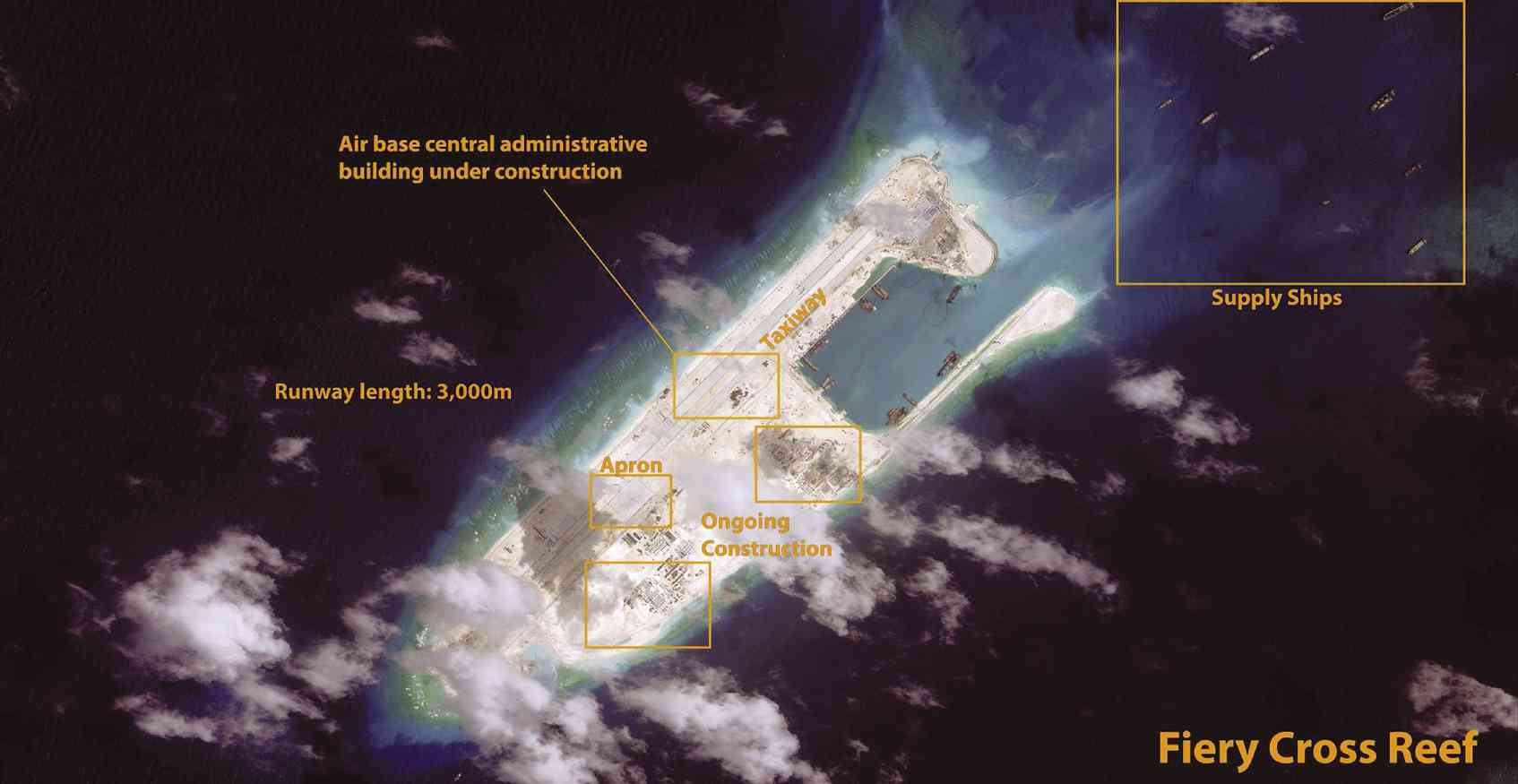
KAGITINGAN REEF  China is expanding construction on Fiery Cross Reef, also known as Kagitingan Reef, as seen in this June 28 satellite image. A 3,000-meter airstrip is nearly complete. China continues to pave and mark the airstrip and an apron and taxiway have been added adjacent to the runway. Personnel are now visible walking around the island. A sensor array has also been constructed and additional support facilities are being built. CSIS ASIA MARITIME TRANSPARENCY INITIATIVE/DIGITAL GLOBE
KAGITINGAN REEF China is expanding construction on Fiery Cross Reef, also known as Kagitingan Reef, as seen in this June 28 satellite image. A 3,000-meter airstrip is nearly complete. China continues to pave and mark the airstrip and an apron and taxiway have been added adjacent to the runway. Personnel are now visible walking around the island. A sensor array has also been constructed and additional support facilities are being built. CSIS ASIA MARITIME TRANSPARENCY INITIATIVE/DIGITAL GLOBE


“Our message to the world is clear: What is ours is ours; setting foot on Recto Bank is no different from setting foot on Recto Avenue,” President Aquino said in his second State of the Nation Address in July 2011.

But the Philippine Navy recently found a large steel marker bearing Chinese inscriptions and hundreds of yellow buoys in waters near Recto (Reed) Bank, an area of the West Philippine Sea where Manila has long explored for oil and gas, naval sources said.

A Reuters dispatch on Tuesday from Puerto Princesa City said one sailor reported he was on a fishing boat being used by the Navy that discovered the rubber buoys and the floating steel marker at the end of May.

The buoys stretched “as far as the eye could see,” the sailor said.

The newest discovery of Chinese markers was confirmed by two senior Philippine naval officials. One said the buoys were still there when the Navy checked the site mid-June, although the steel marker was gone. No attempt was made to remove the buoys, he said.

“Our boys tried to cut and remove the buoys but a large Chinese patrol ship emerged on the horizon and they hurriedly left,” the sailor said, adding it was unclear what the Chinese inscriptions on the steel marker meant.

The three sources declined to be identified because they were not authorized to speak to the media.
Philippine military officials said it was the first time in recent years that such markers had been found near Recto Bank.

The sailor also said there was no hard evidence Chinese ships had placed the marker and buoys near Recto Bank, which is also claimed by Beijing.

But efforts to remove the buoys were thwarted by the sudden appearance of a Chinese naval patrol vessel, prompting the Philippine boat to flee, the sailor said in an interview in Puerto Princesa, the Philippine military’s jump-off point to the disputed South China Sea.

The Reuters report on the Chinese incursion at Recto Bank coincided with the opening hearing on Tuesday in the arbitration court in The Hague of the Philippine petition against China on Manila’s maritime disputes with Beijing.

Solicitor General Florin Hilbay will open the presentation, according to Malacañang’s deputy spokesperson Abigail Valte.

Foreign Secretary Albert del Rosario will “speak on the reason for the filing of the Philippines’ case,” said Valte, who is with the delegation. Lawyers from the Washington-based law firm Foly Hoag, led by Paul Reichler, will present the arguments.

Muscle-flexing

China has refused to participate in the hearing.

The Spratly islands, where China is flexing its naval muscles as it builds seven man-made islands on top of coral reefs, lie to the southwest of Recto Bank, farther away from the Philippines.

Asked to comment on the buoys, the Chinese foreign ministry said, “We do not understand what you are talking about,” adding that China had “indisputable sovereignty” over the Spratly islands and its nearby waters.

“China’s position on this is clear and consistent,” it said.

The Chinese defense ministry did not respond to a request for comment.

Col. Edgard Arevalo, the Philippine Navy spokesman in Manila, said he had not seen any report on the discovery.
China claims most of the South China Sea, of which the West Philippine Sea is a part. An estimated $5 trillion in shipborne trade passes the disputed waterway every year. The Philippines, Vietnam, Malaysia, Brunei and Taiwan also have overlapping claims.

Fishing ban

Philippine military strategists have long worried that China wants to occupy Recto Bank.

One Air Force general said he suspected the buoys were put there so Chinese fishermen could tether their boats, then if the Philippine Navy tried to evict the fishermen, Chinese Coast Guard ships would appear to protect them.

In 2012, China seized Panatag (Scarborough) Shoal, which lies 230 km west of the Philippines, after a three-month standoff with the Philippine Navy.

China has since prevented Philippine fishermen from getting close to the rocky outcrop’s rich fishing grounds, the Philippine government and fishermen say.

The Philippine Navy has previously found markers with Chinese inscriptions around shoals in other parts of the West Philippine Sea.

In 2011, a steel marker the size of a 4-meter container was discovered in Escoda (Sabina) Shoal in the Spratlys. A Navy boat towed it away while concrete markers found in the same area last July were blown up, naval officials said.

The Philippines said in March it was suspending exploration at Recto Bank while it pursued international arbitration. Manila is seeking a ruling to confirm its right to exploit waters in its EEZ as allowed under the UN Convention on the Law of the Sea (Unclos).

‘Absurd claims’

In a statement issued during a protest at the Chinese Embassy on Tuesday, the militant Bagong Alyansang Makabayan (Bayan) said it believed the Philippines had a strong case.

“The arbitral tribunal should give the case due course. If the Philippines wins, then we would have gained an important legal and moral victory against China’s absurd claims. It would aid our assertion of our sovereignty and gain us the support of the international community,” said Bayan secretary general Renato Reyes.

Lauro Baja Jr., former permanent representative of the Philippines to the United Nations and one of the senior diplomats who crafted the 2002 Declaration on the Conduct of Parties in the South China Sea, warned the Philippines should not fall into Beijing’s trap.

“China is being clever and smart. They frame their responses to the Philippines’ case through the issue of territorial sovereignty,” he said.

–Nikko Dizon and Niña P. Calleja, Philippine Daily Inquirer


Tuesday, July 07, 2015

Philippines ramps up military spending in face of China threat

MANILA, July 7 (Reuters) - The Philippines plans to ramp up military spending over the next 13 years, earmarking more than $20 billion to modernise its forces in the face of Beijing's maritime ambitions in the disputed South China Sea, a top air force official told Reuters.

Major-General Raul del Rosario, military chief of plans, said the blueprint includes installing radars and sensors, and buying equipment such as submarines, frigates, fighters, surveillance planes and missile systems.

"By the time, we complete this plan, we will have complete coverage of the South China Sea," said del Rosario, a former fighter pilot, showing the military's detailed plan that was approved on Friday.

"We will have 24/7 awareness of what is happening in the disputed area and we'll be able to respond quicker to any contingency in our own exclusive economic zone."

He said the ambitious plan was initiated in 2013, but top brass had only approved overall spending of 998 billion pesos ($22.11 billion) last week.

Del Rosario said 83 billion pesos had been earmarked for the first five years, 444 billion pesos for the second five years and 471 billion pesos for the last five years.

In 1995, Congress had earmarked 364 billion pesos for a similar 15-year plan. Less than one-tenth of that sum was actually spent by 2010.

The modernisation programme is designed to strengthen Manila's claims in the South China Sea, believed to be rich in energy deposits.

China has become increasingly assertive in the South China Sea, building artificial islands in areas over which the Philippines and other countries have rival claims. The moves have sparked alarm regionally and in Washington.

SUBMARINES, MISSILES AND SURVEILLANCE PLANES

President Benigno Aquino has promised the military about 34 billion pesos this year, which will fund the purchase of two frigates and a twin-engine long range maritime aircraft.

So far, the government has given the military 9.4 billion pesos in 2014. This has been used to purchase eight combat utility helicopters and as a downpayment for 12 FA50 fighter-trainers from South Korea. Two of the aircraft are expected in 2016.

Del Rosario said that between 2018 and 2023 the Philippines would buy electric-diesel submarines and advanced missile systems.

Three aerial surveillance radars with a range of 350 nautical miles will also be installed in Ilocos Norte, Lubang island and Mount Salacot in Palawan, all facing the South China Sea to detect movements in the disputed area.

These will complement the navy's two surface sensors capable of detecting ship activities 200 miles away. Three surveillance planes will also be on constant patrol in the area.

"We do not aim to defeat China," del Rosario said. "But our goal is make any state think twice before attacking. We will make sure anybody attacking us would end up with a bloodied nose." 

By Manuel Mogato
Source: Reuters - Tue, 7 Jul 2015 10:04 GMT
Author: Reuters

Saturday, March 15, 2014

Philippines offers U.S. forces access to military bases

The Philippines has agreed to allow the United States access to its military bases under a new security deal being negotiated by the two allies, amid mounting concern over China's increasing assertiveness in the disputed waters of the South China Sea.

The offer was made during a sixth round of talks held in Washington last week, Filipino officials said on Friday. The two sides hope to finalize terms before U.S. President Barack Obama embarks on a visit to Asia, including the Philippines, next month.

"Consensus was arrived at on many provisions of the draft agreement," Pio Lorenzo Batino, defense undersecretary told a news conference, adding the deal is 80 percent done.

"The proposed agreement will allow the sharing of defined areas within certain AFP (Armed Forces of the Philippines)facilities with elements of the U.S. military."

The United States plans to "rebalance" its forces in Asia-Pacific region, and has similar arrangements with Australia and Singapore, as part of its strategy to counter China.

The new agreement on enhanced defense cooperation will allow the United States increased deployment of troops, ships, aircraft and humanitarian equipment.

U.S. military access in the Philippines is currently limited to during annual joint-exercises and port visits. The Philippines kicked the United States out two large military bases, including Subic Bay, in 1991.

While that ended a special relationship going back 40 years between the United States and its former colony won its independence in 1946, an alliance has endured.

Manila would welcome the return of a U.S. military presence to deter China's ambitions in the South China Sea, and to help provide humanitarian assistance during natural disasters.

"It will not stop China from its bullying tactics, but it will become more cautious and might exercise self-restraint due to the U.S. presence," Rommel Banlaoi, an analyst at Philippine Institute of Peace, Violence and Terrorism Research, said.

"The Philippines will also benefit from more exercises and more assistance from the U.S. and it will elevate the Philippines to a major non-NATO ally in the Pacific."

Friction between China and the Philippines and other states in the region, over disputed territories in the South China Sea has increased since last year despite diplomatic efforts to forge an agreement on maritime conduct.

The dispute revolves round competing claims over the Spratlys, a group of 250 uninhabitable islets spread over 165,000 square miles.

On Sunday, three Chinese coast guard ships stopped two Filipino civilian vessels from delivering food, water and construction materials to troops based on a ship that was deliberately run aground on reef in the Spratlys in 1999 to reinforce the Philippines' claim.

Manila called the Chinese actions "a clear and urgent threat to the rights and interests of the Philippines".

Under the draft accord, the Philippines will allow U.S. forces joint use of facilities in several military bases like Manila, Clark, Palawan, Cebu, Nueva Ecija, and La Union, a military official with knowledge of the negotiations.

"We are only offering U.S. military forces access to fewer military bases," Ambassador Eduardo Malaya, a member of the panel negotiating with the Americans, said.

Manila refused a request for use of civilian airfields and ports, like Subic Freeport Bay, Laoag and Davao international airports, according to the military official.

Batino said the agreement will be legally binding but will not require ratification by the Philippine Senate, which could delay the actual U.S. deployment.

Article Source: Yahoo News

Manila air-drops supplies to troops on disputed reef

The Philippines air-dropped food and water to soldiers posted on a grounded transport ship on a disputed South China Sea shoal, after China blocked two supply ships from reaching the troops, a senior navy official said on Wednesday.

Chinese ships patrolling waters around Second Thomas Shoal, known in China as the Ren'ai reef, on Sunday ordered the Philippine ships carrying construction materials to leave the area.

Beijing claims Manila is trying to start construction on the disputed reef after it ran aground an old transport ship in 1999 to mark its territory and stationed marines on the ship. Manila claims the Shoal is part of the Philippine's continental shelf.

"We only intend to improve the conditions there, we have no plans to expand or build permanent structures on the shoal," said a Philippines navy official, who declined to be identified because he was not authorized to speak to the press.

"On Monday, we sent a navy Islander plane to drop food and water, but it will only last a few days. We really have to send back the civilian boats. Since last year, we've been resupplying our troops using civilian ships to avoid confrontation and this was the first time China blocked them."

On Tuesday, Manila summoned the second highest Chinese embassy official to hand over a strong-worded protest, calling the blockade "a clear and urgent threat to the rights and interests of the Philippines".

Chinese foreign ministry spokesman Qin Gang said China had called in Philippine diplomats in Beijing to lodge a protest in response.

"The Philippines' motive in trying to illegally occupy Ren'ai reef and create incidents in the South China Sea is abundantly clear. China calls on the Philippines to stop all its provocative actions," he added.

The Second Thomas Shoal, a strategic gateway to Reed Bank, believed to be rich in oil and natural gas, is one of several possible maritime flashpoints that could prompt the United States to intervene in defense of Asian allies troubled by increasingly assertive Chinese maritime claims.

WASHINGTON CALLS BLOCKADE "PROVOCATIVE"

On Wednesday, Washington said it was troubled by China's blockage of the Philippines ships, calling it "a provocative move that raises tensions."

"Pending resolution of competing claims in the South China Sea, there should be no interference with the efforts of claimants to maintain the status quo," U.S. State Department spokeswoman Jen Psaki said in a statement. She added that "freedom of navigation" in the area "must be maintained."

China has objected to efforts by Manila to challenge its territorial claims under the Law of the Sea at the Permanent Court of Arbitration at The Hague.

Ernest Bower of the Center for Strategic and International Studies think tank said new pressure on Manila could be due to China's perception that the United States has shown weakness in dealing with crises in Syria and Ukraine and will be similarly lacking in resolve in Asia - in spite of its declared policy "pivot" to the region.

It also reflected Chinese concerns about negotiations expected to bring about broader access for U.S. troops to the Philippines, he said.

"The Chinese see a very unhappy situation in the Philippines - that one of their smaller neighbors is taking them to court and working with the Americans for expanded military access," Bower said. "It does not fit with the Chinese script of where they want to be in terms of the South China Sea and their sovereign claims."

Bower said such incidents raised the risk that a small clash could escalate and it was important for the United States to make its commitment to the region clear ahead of a planned visit to Asia, including the Philippines, by President Barack Obama next month.

"The Chinese look at the situation in Syria and Ukraine and they look at the so-called Asia pivot and they don't think there is any political foundation that has been built that would support American action in Asia if push came to shove," he said.

Beijing's claim over islands, reefs and atolls that form the Spratlys, a group of 250 uninhabitable islets spread over 165,000 square miles, has set it directly against U.S. allies Vietnam and the Philippines, while Brunei, Malaysia and Taiwan also lay claim to parts of the South China Sea. China also has competing territorial claims further north with Japan, a major U.S. ally in Asia.

The South China Sea provides 10 percent of the global fish catch, carries $5 trillion in ship borne trade a year and its seabed is believed to be rich with energy reserves.

Article Source: Yahoo News

Philippines protests China stopping troop resupply

The Chinese coast guard prevented delivery of supplies to Filipino soldiers guarding a disputed shoal in the South China Sea and an envoy rejected a Philippine protest over the interference, officials said Tuesday.

Chinese ships prevented two Filipino civilian vessels hired by the Philippine navy from reaching Second Thomas Shoal on Sunday, the Philippine Department of Foreign Affairs said in a statement. The shoal is called Ayungin Shoal by Manila and Ren'ai Reef by the Chinese.

"Ayungin Shoal is part of the continental shelf of the Philippines and therefore, the Philippines is entitled to exercise sovereignty rights and jurisdiction in the area without the permission of other states," the statement said.

China's actions "constitute a clear and urgent threat to the rights and interests of the Philippines" under the Law of the Sea, it added.

Foreign Affairs spokesman Raul Hernandez said the resupply was a routine activity that hasn't been interrupted by the Chinese in the past.

"For 15 years we have conducted regular resupply missions and personnel rotation without interference from China," he said.

He said the Chinese ships used digital signs, sirens and megaphones in ordering the Filipino vessels to leave. The Filipinos returned to Palawan, the nearest Philippine province east of the Shoal.
China's charge d'affaires was summoned and handed the protest note. Hernandez said that as in the past, Beijing rejected the protest.

Less than a month ago, Manila also protested a Chinese water cannon attack on Filipino fisherman near another disputed shoal. No one was injured in the Jan. 27 incident at the Scarborough Shoal off the country's main island of Luzon in the north.

The Filipino troops awaiting fresh supplies are stationed on a decrepit military hospital ship that ran aground in 1999 on the shallow coral outcrop of the Second Thomas Shoal. The rusty ship has since become the symbol of the country's sovereignty over the area.

China has been demanding the removal of the ship, claiming that the area is part of Chinese territory.
Department of National Defense spokesman Peter Paul Galvez said "the Chinese coast guard ships blocked our two vessels which were en route to Ayungin to reprovision" the troops. He did not give other details.

The Chinese did not block Philippine marines and supplies to the station last June, a month after the deployment of Chinese ships to the area that also prompted diplomatic protests from Manila.

China's official Xinhua news agency on Monday quoted Chinese Foreign Ministry spokesman Qin Gang as saying that the two Philippine ships were loaded with construction materials and were driven away by Chinese coast guard vessels as they approached the shoal.

"China has indisputable sovereignty over the Nansha Islands and their adjacent waters including the Ren'ai Reef," Qin said.

China claims virtually the entire South China Sea. Nansha is the Chinese name for the Spratlys, a chain of resource-rich islands, islets and reefs claimed partly or wholly by China, Brunei, Malaysia, Philippines, Taiwan and Vietnam.

Article Source: Yahoo News

Wednesday, February 19, 2014

Philippine Military on alert for 2 Malaysian bomb experts

Military forces in Mindanao raised their alert level following reports on the alleged presence of two Malaysian bomb experts out to train local terrorists.

Intelligence reports circulating in Cagayan de Oro said the Malaysians are in addition to four Jemaah Islamiyah members – three Indonesians and one Singaporean – in the region engaged in training the Abu Sayyaf militants in Basilan and the Bangsamoro Islamic Freedom Fighters (BIFF) in Central Mindanao.

The report said a foreign terrorist and 10 BIFF members were targeting Cagayan de Oro for bombing.
The BIFF had earlier threatened to bomb key areas in Mindanao and Manila after it suffered heavy casualties from last week’s firefights with government forces in Central Mindanao. Some 50 BIFF members were reportedly killed in the armed conflict.

The reports named the Singaporean as Mawiya Husayfa who carries a $1-million bounty on his head, and the other three as Abdul Kiram, Mujair Algozi and Basit Usman, whose bounty was placed at $10 million.   

Article Source: Philippine Star

4 slain, 1 hurt in Basilan ambush

Two members of the government militia and two civilians were killed, while another was wounded in an ambush reportedly triggered by a clan war in Tipo-Tipo, Basilan Monday afternoon.

Village councilman Kasuyan Murang and Habir Callitut, both members of the Civilian Armed Forces Geographical Unit, along with Wahid and Husin Upisalin, both sons of a militiaman, were on their way home when armed men waylaid them in the village of Bohe Lebong at about 3:40 p.m.

The name of the wounded victim was not available as of press time.

“The incident was triggered by rido (clan war),” said Capt. Ma. Rowena Muyuella, spokesperson for the Western Mindanao Command (Westmincom).

The military said the victims, all of Barangay Bohe Tambak, were followers of Commander Mongon Agama, while the attackers were said to belong to a group led by Commander Bazir of Barangay Bakisung in Albarka town.

Reports said the attackers escaped after beheading two of the victims. Muyuella said they have yet to verify the report. She said soldiers have been deployed to the ambush site to retrieve the bodies of the victims and to avert a spillover of fighting between the two warring clans.

The military and local government officials have been working to settle the dispute between the two warring clans.

Meanwhile in Abra, four soldiers were wounded in a brief encounter with suspected New People’s Army (NPA) guerrillas at the boundary of Barangays Baay-Liccuan and Lacub Monday.

A report from the 41st Infantry Battalion (IB) identified the wounded troopers as 1Lt. Jandon Ihoc, Cpl. Femmie Agcaoili, and Pfcs. Ulysis Ancheta, Bryan Apalin and Mark Joel Callueng.

The military said the soldiers were responding to reports about the alleged presence of rebels in the village of Lenneng, when the encounter broke out.

Although the Procopio Tauro Front of the NPA operating in Abra claimed that two troopers were killed in the incident, police director Senior Superintendent Benjamin Lusad said the soldiers were only wounded.

Diego Wadagan, spokesperson for the NPA in Abra, said they launched an ambush after they monitored the movement of the government troopers.

The attack, Wadagan said, was meant to foil the second phase of the militay’s Oplan Bayanihan in the province and as punitive action against the soldiers of the 41st IB.

Article Source: Philippine Star

Tensions Set To Rise In The South China Sea

A series of recent events points to a declining state of stability and security in the South China Sea.


Over the last month and a half, seven significant developments indicate that tensions in the South China Sea are set to rise in both the short and long term. The five short-term trends include: Philippine defiance of China’s fishing ban; continued inaction by the Association of Southeast Asian Nations (ASEAN); the Chinese navy’s repeated assertions of sovereignty over James Shoal; the possibility of an Air Defense Identification Zone (ADIZ) over the South China Sea; and stronger United States opposition to China’s ADIZ and maritime territorial claims.

First, in January, the Philippines stepped up its public defiance of China and its territorial claims in the South China Sea. On January 15, Emmanuel Bautista, Chief of Staff of the Armed Forces of the Philippines, stated in a television interview with respect to new fishing regulations issued by Hainan province that Filipino fisherman should not give in to threats or intimidation. A day later, Secretary of Defense Voltaire Gazmin stated that the Philippines would disregard Hainan province’s new fishing regulations and would provide escorts to Filipino fishermen in the West Philippines Sea “if necessary.”

On January 17, the local media published aerial reconnaissance photographs taken at Ayungin Shoal (Second Thomas Reef) on August 28, 2013. The photographs showed the presence of two People’s Liberation Army Navy (PLAN) warships, including a frigate, and a Coast Guard vessel. The press quoted from a confidential government report that stated the Chinese naval presence “could be part [of] a renewed and possibly more determined effort to remove Philippine military presence on Ayungin Shoal and from the whole Spratly island group.”

On February 4, President Benigno Aquino in an interview with The New York Times called on the international community to lend its support to resist China’s claims in the South China Sea.

Second, the ASEAN Foreign Ministers held a Retreat in Bagan, Myanmar from January 16-17. Philippines Secretary of Foreign Affairs Albert del Rosario called on ASEAN to “maintain regional solidarity” in response to China’s imposition of an ADIZ and new fishing regulations in the South China Sea.

“Clearly, in addition to unilateral measures to change the status quo and threats to the stability of the region,” del Rosario stated, “these latest developments violate the legitimate rights of coastal and other states under international law, including UNCLOS, and more specifically the principles of freedom of navigation and overflight, and is contrary to the ASEAN-China Declaration on the Conduct of Parties in the South China Sea.”

The ASEAN Ministers “expressed their concerns on the recent developments in the South China Sea. They further reaffirmed ASEAN’s Six-Point Principles on the South China Sea and the importance of maintaining peace and stability, maritime security, freedom of navigation in and overflight above the South China Sea.”

The ministers repeated ASEAN’s standard line that all disputes should be resolved by peaceful means in accordance with international law and that all parties should show “self-restraint in the conduct of activities.” The ministers declined to be specific and took no further action.

Third, on January 20 a PLAN flotilla comprising three ships, the Amphibious Landing Craft Changbaishan, and two destroyers, Wuhan and Haikou, left the naval base on Hainan to commence annual naval exercises in the South China Sea. The flotilla first conducted drills off the Paracel islands including amphibious landings “on every reef guarded by China’s navy,” according to the commander of the flotilla.

The flotilla then sailed south to the Spratly islands. On January 26 the Chinese media reported that when the ships reached James Shoal eighty kilometers off Sarawak, PLAN sailors conducted an oath taking ceremony vowing to safeguard China’s sovereignty and maritime interests.

The following day Qin Gang, a spokesperson for China’s Foreign Ministry, reiterated China’s “indisputable sovereignty” over James Shoal.

However, when Admiral Tan Sri Abdul Aziz Jaafar, the Chief of the Malaysian Navy, was interviewed by the New Straits Times on January 29 about the PLAN activities at James Shoal, he denied they took place.

According to Admiral Aziz, “There has been no act of provocation on the part of the Chinese or threat to our sovereignty as they are conducting their exercises in international waters” one-thousand kilometers away. Admiral Aziz was apparently referring to naval exercises conducted previously by the aircraft carrier Liaoning and its escorts.

This is the second time in two years that PLAN warships have visited James Shoal to assert Chinese sovereignty claims. On both occasions Malaysian authorities have denied any knowledge of Chinese activities. This raises questions about the veracity of Malaysian accounts, deficiencies in Malaysia’s maritime domain awareness capacity, or whether Malaysia ordered its navy out of the area to avoid any incident.

Fourth, the Asahi Shimbun reported on January 31 that a draft ADIZ for the South China Sea had been drawn up by air force officers at the working level at the Air Force Command College and submitted to the government in May 2013. The draft ADIZ reportedly covers the Paracel islands and some of the South China Sea. The Japanese report stated that Chinese officials were still deliberating on the extent of the ADIZ and the timing of the announcement.

Immediately after the Asahi Shimbun report was published it was dismissed by China’s Foreign Ministry. A spokesperson declared “generally speaking, China does not feel there is an air security threat from ASEAN countries” and therefore does not feel a need for an ADIZ.
It should be recalled, however, that in November last year when China announced its ADIZ in the East China Sea, a Ministry of National Defense spokesperson affirmed that “China will establish other Air Defense Identification Zones at the right moment after necessary preparations are completed.”

Fifth, in February, high-level United States officials became more assertive in opposing China’s ADIZ and territorial claims in the South China Sea. For example, on February 1, Evan Medeiros, Director for Asia at the National Security Council, stated in an interview, “We oppose China’s establishment of an ADIZ in other areas, including the South China Sea. We have been very clear with the Chinese that we would see that as a provocative and destabilizing development that would result in changes in our presence and military posture in the region.”

On February 5, Daniel Russel, Assistant Secretary of State for East Asian and Pacific Affairs, stated in testimony to the House Foreign Affairs Subcommittee on Asia and the Pacific that China should refrain from establishing other ADIZs in the region.

Russel also said, “any use of the ‘nine-dash line’ by China to claim maritime rights not based on claimed land features would be inconsistent with international law” and that China’s “pattern of behavior in the South China Sea reflects an incremental effort by China to assert control over the area contained in the so-called ‘nine-dash line’.”

Finally, Russel provided the strongest U.S. endorsement of the Philippines’ action in taking its territorial dispute with China to arbitration. Assistant Secretary Russel, “We fully support the right of claimants to exercise rights they may have to avail themselves of peaceful dispute settlement mechanisms. The Philippines chose to exercise such a right last year with the filing of an arbitration case under the Law of the Sea Convention.”

The two long-term trends include new U.S. assessments of the future balance of power in the Asia-Pacific and continued Chinese maritime modernization.

During January and February, three high-level U.S. officials proffered sober assessments of the changing balance of power in the Western Pacific.

On January 15, Admiral Samuel Locklear, Commander U.S. Pacific Command, was quoted by Defense News as stating, “our historic dominance that most of us… have enjoyed is diminishing, no question.” Admiral Locklear was referring to the rise of China’s naval power that would take time to eventuate. He concluded, “That’s not something to be afraid of, it’s just to be pragmatic about.”
In late January, Frank Kendall, Deputy Undersecretary of Defense for Acquisition and Technology, stated that U.S. military technological superiority is being “challenged in ways that I have not seen for decades, particularly in the Asia-Pacific Region.” He cited China’s military modernization and shrinking U.S. defense budgets as the main causes.

On February 4, James Clapper, Director of National Intelligence told a hearing of the House Intelligence Committee with respect to China, “They’ve been quite aggressive about asserting what they believe is their manifest destiny, if you will, in that part of the world. “ Clapper noted that China’s “very impressive military modernization” was designed to address what China views as U.S. military strengths.

According to testimony by the Office of Naval Intelligence (ONI) to the U.S. China Economic and Security Review on January 30, “The Chinese navy has ambitious plans over the next 15 years to rapidly advance its fleet of surface ships and submarines as well as maritime weapons and sensors.” The ONI reported that China laid down, launched or commissioned more than 50 naval ships in 2013 with a similar number planned for this year.

At the same time, it was reported that China has begun construction a second aircraft carrier which it hopes to launch in 2018. Security analysts believe that China plans to operate a carrier battle group in the “far seas” by 2020. There were also reports that China was building a hypersonic missile capable of penetrating the U.S. missile defense system.

In an analysis released in early February, IHS Jane’s estimated that China’s defense spending would reach nearly $160 billion in 2015, up from $139 billion spent in 2013. According to Deputy Undersecretary Kendall, “Overall, China’s military investments are increasing in double-digit numbers each year, about 10 percent.”

China continued to make similar advances on the paramilitary front. On January 10, a new 5,000 tonne ship was commissioned into China Coast Guard South Sea Fleet and stationed at Sansha City on Woody island in the Paracels. The China Ocean News reported on January 21 that the new vessel would commence regular patrols in the South China Sea to protect China’s maritime interests and provide a “speedy, orderly and effective emergency response to sudden incidents at sea.” Also on the same day, the Global Times and Beijing Times reported that China was building a 10,000-ton marine surveillance ship, the largest of its kind in the world.

Current short-term and long-term security trends appear likely to exacerbate tensions over territorial disputes in the South China Sea. The Philippines continues to engage in a war of words with China, while China continues to invest in Second Thomas Reef by stationing warships in the area.

Differences in approach between the Philippines and Malaysia make it unlikely the four claimant states can reach a common position for ASEAN to endorse. ASEAN itself appears unable to reach a consensus that Chinese fishing bans in the South China Sea, coupled with the possible imposition of a Chinese ADIZ, are security issues affecting the whole of Southeast Asia.

China is continuing its build-up and modernization of both PLAN warships and paramilitary Coast Guard vessels. The former continue to conduct military exercises in areas where China’s nine-dash line overlaps with the Exclusive Economic Zones of claimant states. The latter are increasing in size thus enabling them to patrol and remain on station in the South China Sea for longer periods.

The current proactive U.S. challenge to China’s nine-dash line claim and opposition to any ADIZ in the South China Sea is likely to meet Chinese political, diplomatic and possibly military resistance in the form of challenges in contested waters. In the long-term, China’s naval modernization and expansion will result in the relative decline of U.S. naval primacy in the Western Pacific.

Article Source: The Diplomat

Featured Posts

AFP Modernization 2017: Highlights and Review

The modernization of the Armed Forces of the Philippines was on a roll this year, as we've seen a few big ticket items having completely...

Popular Posts