Showing posts with label Visiting Forces Agreement. Show all posts

Saturday, March 15, 2014

Philippines offers U.S. forces access to military bases

The Philippines has agreed to allow the United States access to its military bases under a new security deal being negotiated by the two allies, amid mounting concern over China's increasing assertiveness in the disputed waters of the South China Sea.

The offer was made during a sixth round of talks held in Washington last week, Filipino officials said on Friday. The two sides hope to finalize terms before U.S. President Barack Obama embarks on a visit to Asia, including the Philippines, next month.

"Consensus was arrived at on many provisions of the draft agreement," Pio Lorenzo Batino, defense undersecretary told a news conference, adding the deal is 80 percent done.

"The proposed agreement will allow the sharing of defined areas within certain AFP (Armed Forces of the Philippines)facilities with elements of the U.S. military."

The United States plans to "rebalance" its forces in Asia-Pacific region, and has similar arrangements with Australia and Singapore, as part of its strategy to counter China.

The new agreement on enhanced defense cooperation will allow the United States increased deployment of troops, ships, aircraft and humanitarian equipment.

U.S. military access in the Philippines is currently limited to during annual joint-exercises and port visits. The Philippines kicked the United States out two large military bases, including Subic Bay, in 1991.

While that ended a special relationship going back 40 years between the United States and its former colony won its independence in 1946, an alliance has endured.

Manila would welcome the return of a U.S. military presence to deter China's ambitions in the South China Sea, and to help provide humanitarian assistance during natural disasters.

"It will not stop China from its bullying tactics, but it will become more cautious and might exercise self-restraint due to the U.S. presence," Rommel Banlaoi, an analyst at Philippine Institute of Peace, Violence and Terrorism Research, said.

"The Philippines will also benefit from more exercises and more assistance from the U.S. and it will elevate the Philippines to a major non-NATO ally in the Pacific."

Friction between China and the Philippines and other states in the region, over disputed territories in the South China Sea has increased since last year despite diplomatic efforts to forge an agreement on maritime conduct.

The dispute revolves round competing claims over the Spratlys, a group of 250 uninhabitable islets spread over 165,000 square miles.

On Sunday, three Chinese coast guard ships stopped two Filipino civilian vessels from delivering food, water and construction materials to troops based on a ship that was deliberately run aground on reef in the Spratlys in 1999 to reinforce the Philippines' claim.

Manila called the Chinese actions "a clear and urgent threat to the rights and interests of the Philippines".

Under the draft accord, the Philippines will allow U.S. forces joint use of facilities in several military bases like Manila, Clark, Palawan, Cebu, Nueva Ecija, and La Union, a military official with knowledge of the negotiations.

"We are only offering U.S. military forces access to fewer military bases," Ambassador Eduardo Malaya, a member of the panel negotiating with the Americans, said.

Manila refused a request for use of civilian airfields and ports, like Subic Freeport Bay, Laoag and Davao international airports, according to the military official.

Batino said the agreement will be legally binding but will not require ratification by the Philippine Senate, which could delay the actual U.S. deployment.

Article Source: Yahoo News

Saturday, June 09, 2012

Philippines studying military accord with Singapore

The Philippines is studying a military training agreement with Singapore and is closely watching the progress of a similar accord with Australia for lessons, the defence department said.

The proposed Visiting Forces Agreement (VFA) would allow Philippine and Singaporean troops to train in each other's countries, reviving joint exercises that were suspended in 1996, department spokesman, Peter Galvez, said on Saturday.

The department is looking at the experiences with both the Philippines' existing VFA with the United States and a VFA bill with Australia being debated in the Senate, Galvez said.

"They are collating all the experiences with the various agreements so we can craft a well-rounded VFA (with Singapore) that everyone can agree to," he told AFP.

Singapore had a military training agreement with the Philippines in 1994 but joint exercises were suspended in 1996 because under Philippine law the entry of foreign troops for wargames must be covered by a VFA approved by the Senate.

Singapore submitted a draft proposal to the Philippines in 2007 but progress in crafting the final bill was slow due because the Manila office concerned lacked manpower, said Galvez.
The United States, the country's main defence ally, sealed such a VFA in 1999 and a similar accord with Australia is pending.

Nationalists and leftists have opposed such agreements as a violation of the country's sovereignty.

The Philippines' defence ties have received greater attention in recent weeks after a maritime standoff with China broke out two months ago over disputed territory in the South China Sea.

Galvez said "we are more positive with the Australian VFA. If it rolls out, that will be template for the other countries".

However he said it would be a long time before the agreement with Singapore is presented to the senators.

--------------------------------------------------------------------------------------------------------
Agence France-Presse/Yahoo News Online | June 9, 2012 | Article Link

Thursday, June 07, 2012

7 senators reject VFA with Australia

MANILA, Philippines – Seven senators, just one vote shy of what’s needed to torpedo the Visiting Forces Agreement between the Philippines and Australia, voted to reject treaty ratification on Wednesday as Congress prepared to adjourn sine die until July 23, when another round of voting is scheduled.

Senator Joker Arroyo led six of his peers in rejecting ratification of the VFA, citing Australia’s disregard for Philippine interest in several matters, notably  for continuously banning the country’s fruit exports.

“The Senate cannot simply concur in treaties if other contracting countries have no consideration of the country’s interest,” Arroyo said in his interpellation.

The Senate approved the treaty on second reading with 7 negative votes and 14 affirmative votes.

According to Majority Leader Vicente Sotto III, the third reading of SRN 788 will be done when session resumes on July 23.

Under the Constitution, the Senate has the sole power to ratify any treaty or international agreement entered into by the Executive Department and a 2/3 vote of the present members of the Upper Chamber is needed to adopt it.

“Like the impeachment trial, the treaty needs 2/3 votes of the members of the Senate. As seven senators voted against the agreement at this stage, it only needs one more vote to finally reject the treaty,” Arroyo said in an interview after the voting.

The senator recalled that when he entered the Senate in 2001, one of the first matters taken up was the issue of Manila’s mango exports to Australia. “During that time, Philippine mangoes were banned and Sen. (Edgardo) Angara was fuming mad because with his experience in agriculture, he knew that the country’s mangoes were accepted in the US, Japan and other advanced countries.

“Today when I asked Senator Angara about the problem, he replied that Australia has not only banned mangoes but also bananas and pineapples, and that the country’s balance of trade with Australia was P500 million in imports and only P50 million in exports, meaning, it is lopsided,” he argued.

Aside from Arroyo, Senators Miriam Defensor-Santiago, Sergio Osmena III, Ferdinand Marcos Jr., Aquilino Pimentel III, Manuel Villar and Ralph Recto opposed the measure.

Senate President Juan Ponce Enrile, together with Senators Loren Legarda, Jinggoy Estrada, Franklin Drilon, Vicente Sotto III, Pia Cayetano, Bong Revilla, Teofisto “TG” Guingona III, Antonio Trillanes IV, Edgardo Angara,  Kiko Pangilinan, Panfilo Lacson and Gregorio Honasan voted to approve the measure on second reading.

Senator Kiko Pangilinan, meanwhile, reserved the right to explain his vote once the resolution is taken up on third reading. 

Santiago pointed out a part of the Agreement which says that the visiting forces may temporarily use land, sea and air space or other facilities of the receiving state for training, exercises or other activities mutually approved by both countries, but noted that there is no clear constitutional basis for the country’s military forces to be trained by a visiting force.

“Proponents of the Agreement between the Philippines and Australia have not made clear what the constitutional basis is for the Philippines to allow our military forces to be trained by a visiting force in our own territory,” Santiago said, and warned that concurrence of the Philippines “may threaten the sovereignty of the country.”

Explicit terms on environment

The Agreement, which was ratified by President Benigno Aquino III on December 23, 2010, called for the issuance of a Memorandum Order (MO) directing the Department of Environment and Natural Resources (DENR) to closely monitor the activities of the Australian Visiting Forces and its Civilian Component in the Philippines, and ensure that these activities do not violate any of the environmental laws and ordinances of the country.   

“The Status of Visiting Forces Agreement (SOVFA) with Australia sets a precedent in defense agreements in that it has unique provisions on environmental protection. The Agreement explicitly prohibits the conduct of exercises or other activities in protected areas, ancestral domain areas, critical watersheds and protected forest areas,” Senator Loren Legarda, sponsor of the resolution and chair of the Senate Committees on Foreign Relations and Climate Change, said.

“It also provides that any environmental damage will be subjected to claims and compensation and that the sending state will be responsible for the rehabilitation of damaged areas,” Legarda added.

“The Agreement will enforce the duties and obligations of both parties with respect to environmental protection, including the clean-up and restoration of any local site or body of water that may be affected by the activities allowed for under the Agreement,” she added.

The Agreement also calls for the Service Authorities of Australia to cooperate with the Philippine government to prevent any abuse or misuse of the privileges granted in favor of Australian Visiting Forces and its Civilian Component, and to ensure that proper discharge of the obligations imposed on the visiting party are met.

The Agreement addresses the sensitive issue of criminal jurisdiction “through a clear set of rules,” and that the “authorities of the receiving state have jurisdiction over visiting forces with respect to offenses committed within the receiving state and punishable by the law of the receiving state, but not by the law of the sending state.”

“With respect to criminal jurisdiction, it is provided in the Philippine-Australian VFA that the receiving state shall exercise primary jurisdiction over all offenses except for offenses relating to the property and security of the sending state, and offenses performed in official duty. Thus, as a general rule, offenses shall be under the primary jurisdiction of the receiving state. We believe that these are but reasonable rights afforded to the sending state,” Legarda added.

Respect for the other's laws

According to Legarda, there is also emphasis made in the SOVFA regarding the principle of respect for the laws of the receiving state.  

“No offender from the visiting forces who commits a crime in the Philippines will escape justice under the SOVFA,” Legarda stressed.

The resolution also states that the Agreement must provide for a comprehensive legal framework that will govern the status of the Armed Forces of the Philippines and the Australian Defense Forces personnel who will participate in education, training, combined exercises and humanitarian activities in each others territories.

The Agreement, which provides for enhanced bilateral defense and military cooperation between the two countries through the exchange of visits, was anchored on the 1995 Memorandum of Understanding on Cooperative Defense Activities with Australia through exchange of visits.

Since 2001, Australia has extended defense assistance to the Philippines totalling an estimated P1.16 billion.

This includes, among others, military education and training of an average of 120 AFP officers annually in Australia, costing an average of US$ 26.751 million per year;  contribution of US$ 17.834 million worth of riverine boats as part of the efforts to upgrade counter-terrorism and maritime security capabilities; supporting the implementation of the Coast Watch System to strengthen the country’s capability in addressing maritime security challenges; and conducting counter-terrorism trainings and mutual training assistance to help develop inter-operability between the special operations units of the armies and navies of the Philippines and Australia.

------------------------------------------------------------------------------------------------------------------

Sunday, May 27, 2012

Visiting US Navy men to help clean up three schools in Lapu-Lapu

AT LEAST 30 US Navy personnel from the visiting USS Pearl Harbor will help fix and clean three public schools in Lapu-Lapu City next week as part of its community service activities during their five-day goodwill visit here.

The ship arrived in the Cebu International Port yesterday.

The US Marines and US Navy sailors will join Philippine Navy personnel in conducting the yearly Brigada Eskwela activity on Tuesday , said Ensign Ison, Naval forces Central (Navforcen) spokesman.

US Navymen will help clean and repair the Canjulao Elementary School, the Looc Elementary School and the Looc High school. It will be a simultaneous activity in which troops and personnel of Pearl Harbor will be divided into three groups, Ison added.

The USS Pearl Harbor, an amphibious landing ship, carries 22 US officers, 356 enlisted personnel and more than 300 Marine personnel.

On Monday, USS Pearl Harbor officials will make courtesy calls on Camp Lapu-Lapu officials, Gov. Gwendolyn Garcia and Cebu City Mayor Michael Rama.

A soccer game will be held with Philippine Air Force personnel on Wednesday. The ship is scheduled to leave Cebu on May 31.

--------------------------------------------------------------------------------------------------------
Tweeny M. Malinao | / Philippine Daily Inquirer | May 27, 2012 | Article Link

Tuesday, March 06, 2012

Zamboanga better with American troops


ZAMBOANGA CITY, Philippines - A guard signaled our driver to move between rows of 7-ft-high concrete barriers of a bomb containment area, before allowing us to move to the side of the bullet-proof sentry gate of the Armed Forces of the Philippines (AFP) Western Mindanao Command, manned by rifle-carrying soldiers in camouflage uniform.

This scene is somehow different to other military facilities I've visited in the Philippines, since this is also the camp where US troops are stationed under the Philippines-US Visiting Forces Agreement.

Since 1999, when the treaty was signed by the Philippine Senate, US troops were stationed here in this part of Southern Philippines, holding training missions with and for Philippine troops.

AFP Western Mindanao Command (Wesmincom) chief Major General Noel Coballes said the American soldiers are very cordial in dealing with their Filipino counterparts.

"May mga panahon na down-to-earth, meron din namang professional ang dating. But most of these are all cordial," Coballes told ABS-CBN News.

Comrades-in-arms

Coballes said the US troops have been accustomed to the way of life in the camp that they treat Filipino soldiers like their own comrades, rendering salute even to Filipino officers. 

The main purpose of the US troops' presence is to train with their Filipino counterparts on military inter-operability.

Coballes said both sides have benefitted greatly in the training they have undergone.

A concrete example is the capture of prominent leaders of Abu Sayyaf Group, which is known to have links with the international terror group Al-Qaeda.

Americans, on their part, have also tried to maximize the value of their presence here in the country by undertaking civil-military operations.

These kind of operations include medical missions and building infrastructure projects like road networks and classrooms in different parts of the country where American troops are present.

"As of this time, nagsimula yan ng mga 2006, more than $20 million na iyung na-contribute nila sa Jolo and there are also some projects in Basilan, like iyung ngayon, I understand yung Amaoy roadnet, kanilang project yun. Although iyung nagta-trabaho noon ay civilian contractor, but the funding came from them," Coballes said.

Best sentry gate

Even Camp Navarro -- the compound that hosts the AFP Wesmincom and the US troops -- benefited from the infrastructure projects through road concreting and improvement of its sentry gate.

The sentry gate can be considered the best in the Philippines, incomparable to other military facilities in the country.
Camp Navarro's gate is similar to the set-up used by US troops in Afghanistan and Iraq. It has solar-powered lights, blast-proof windows and 7-ft-high concrete bomb containment area.

Lt. Col. Randolph Cabangbang of AFP Wesmincom's Civil-Military Operations said he even got the Americans to renovate the camp's Public Affairs Center, which used to house Zamboanga's Defense Press Corps.

"Nagkaroon ako ng chance dati na makasama yung American counterpart ko, naglalakad kami dito, tinanong ko kung pwede kaming tulungan na ipaayos yan, pinaayos naman nila," said Cabangbang.

No problem in Zamboanga

The AFP Wesmincom said US soldiers have not given a big problem to Zamboanga City. "Hindi naman sila naging problema dito. Never silang (residents of Zamboanga) nagkaroon ng malakihang reklamo sa mga Amerikano. Of course, hindi naman natin mape-perpekto lahat ng organization eh. Merong mailiiit, pero hindi nakaapekto yun sa kanilang, ang presensya nila dito, di nakaapekto yun," Coballes said.

The last time the Philippines had a major problem with American soldiers was in 2006, when a rape case was filed against Lance Corporal Daniel Smith in Subic.

The case was eventually dismissed in 2010 after the complainant retracted her affidavit where she claimed she was raped. The girl who filed the complaint is now reportedly living in the US.

The Philippines is not new to these cases.

During the 1970s and the 1980s, when Americans still had bases in Subic and Clark, cases of sexual abuse and maltreatment involving American troops were filed by Filipinas. Most of the cases never prospered in court.

On June 17, 1991, the Americans pulled out and evacuated from the bases.

It was 2 days after the eruption of Mount Pinatubo in Pampanga, an eruption that was worse than that of Mount St. Helens in US.

Two months later, the Philippine Senate voted against extending or renewing the US government's lease on the land where their military bases stood, ending their 50-year stay in the country.

Business growing in Zamboanga

Now, more than a decade has passed since "GI Joes" returned to the Philippines.

Their presence in Zamboanga has somehow brought good vibes to the local business here.

Zamboanga is the hub of business in Western Mindanao, being the transhipment point of goods and produce not only from Zamboanga Peninsula but also from the areas of Basilan, Sulu and Tawi-tawi provinces.

Business is now growing despite negative reports of bombings and kidnappings in the southern Philippines.
A hotel owner said the presence of Americans has somehow brought positive effects to their community. "In a way, nakakatulong. I would say na it is an added security blanket for Zamboangueños, because nakikita nga natin, we're threatened by terrorists," said Brian Go, general manager of Garden Orchid Hotel.

Go, however, also admitted that the presence of the Americans in their city also has its negative side. 
----------------------------------------

Friday, March 02, 2012

US to boost PH defenses with P6-B aid


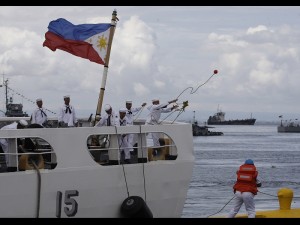
BRP Gregorio del Pilar

The United States will provide the Philippines at least $144.66 million (about P6.19 billion) in defense-related assistance this year, according to Foreign Secretary Albert del Rosario.
Speaking before the Manila Overseas Press Club at a Makati City hotel, Del Rosario noted on Wednesday night that the new US aid would be “an increase of $21.38 million (about P915.06 million) from the previous year’s appropriation.”
The funding, he emphasized, would help the country “improve our national defense by building a minimum defense posture to protect our national sovereignty.”
Citing the country’s lack of resources, Del Rosario said “it behooves us to proactively seek the assistance and cooperation of our various international partners to achieve this minimum credible posture, which is a fundamental attribute of any sovereign country.”
“Last year, we acquired a Hamilton-class cutter from the US, and we are expecting the delivery of a second cutter this year. Negotiations are likewise underway for more defense articles, including newer air assets for the Philippine Air Force,” he also said.
Manila is also “updating its mutual defense partnership (with Washington) under the Philippines-US Mutual Defense Treaty in view of the changes in the regional and global security environment.”
-------------------------------------------------

2:49 am | Friday, March 2nd, 2012

Saturday, February 25, 2012

Aquino govt, AFP defend US troops’ permanent “visit” under VFA

Can their semantics circumvent the Constitutional ban on permanent stationing of US troops?

MANILA — Since 2002, under the auspices of the VFA, there has not been a single day when there are no “visiting” US troops in the country. This was the admission to the joint House of Representatives Committees on National Defense, Security and Foreign Affairs hearing this week by Lt. Gen. Edilberto Adan, executive director of the Presidential Commission on VFA (VFACOM), under the questioning of Bayan Muna Rep. Teddy Casiño.
Adan said the “operations” of the US troops here are being covered by their monitoring committee. These operations, including the bigger Balikatan exercises and many more small military exercises such as the Pistons and CARATS, he said, are planned a year ahead as to where and when they would be held. These can last three days to weeks, and can be participated in by fewer soldiers than a squad or up to several hundreds of US and Filipino troops. Adan said that up to 45 US military exercises are held in the Philippines each year, of which “only six are big like the Balikatan with thousands of participants.”
When asked if there had been a day under the VFA when there were no US troops stationed in the Philippines, Adan said “no, since we allowed them to stay and visit here.”
The admission prompted Casiño to describe the Visiting Forces as definitely a “misnomer.” How could you call them as “just visiting,” he asked, when they have stayed on indefinitely? While staying here, where do they sleep and operate from? Where are they based?
Casiño enumerated the oft-reported military installations of US troops in the South, which are “practically” military bases of the US troops here. These are on top of installations they use while conducting the military “exercises” in various locations in the Philippines, as covered by the VFACom.
“Let’s be truthful and let’s not fool ourselves with regard to terminologies,” said deputy speaker and Quezon Rep. Lorenzo R. Tañada III, as he reiterated an anecdote attributed to former president Joseph Estrada who approved the VFA because it said the troops are only ‘visiting.’ “But visiting became permanent,” said Tañada.

Chairmen of House panels on national defense and national security distinguish between the pro-VFA ‘government panel’ and anti-VFA lawmakers and civil society groups present at their hearing Feb 22. (Photo by Marya Salamat / bulatlat.com)
The said House hearing was convened this week to tackle pending bills in Congress calling for the abrogation of the Visiting Forces Act. There is a corresponding resolution in the Senate. The “government panel,” as referred to by Rep. Rodolfo Biazon at the hearing, was composed of ranking officials of the Armed Forces of the Philippines (AFP), led by Defense Secretary Voltaire Gazmin, Defense Undersecretary Pio Lorenzo Batino, Foreign Affairs Secretary Albert del Rosario, representative of the Department of Justice and Lt. Gen. Edilberto Adan from the Presidential Commission on VFA (VFACOM).
Citing the legal approval of the VFA by the Supreme Court and the Mutual Defense Treaty between the US and the Philippines, the government panel defended the VFA against moves in Congress to abrogate it.
‘Semantics, circumvention’
It is not only in distinguishing between a “visit” and a permanent stay that the government panel defending the VFA and the lawmakers and civil society groups wanting its abrogation have opposite views.
In the matter of reviewing the VFA itself, the Presidential Commission on VFA (VFACOM) has not at all addressed the presence of American troops in Philippine soil or whether the US troops can come and go, visit or stay. Instead it has focused, so far, on the behavior of American troops while here, as Biazon himself noted based on Adan’s statements during the hearing.
Whether the American troops can visit and stay is not addressed in the VFA review because, in Adan’s interpretations, such matter is within the purview of the Mutual Defense Treaty (MDT). It is the VFA they are supposed to be reviewing and not the MDT.

Lt Gen Adan and Defense Undersec Batino at the House hearing on bills seeking the abrogation of VFA.(Photo by Marya Salamat / bulatlat.com)
Adan said the VFA is just a mechanism for laying down “house rules for the visitors we’ve invited.” As house rules go, he said, they have reviewed the “more contentious” subjects such as that of criminal jurisdiction and finding mutually agreed upon detention facilities, for example, in case an American serviceman is to be detained here.
Asked about the result of that review, Adan replied that it is still a work in progress. “We are continually conferring and the results will be released in time.”
But asked also where in Mutual Defense Treaty (MDT) is it stated that US troops can station permanently in Philippine soil and waters, despite the Constitutional ban on it, Adan replied that, to his interpretations of the MDT’s Article 2 which direct the US and Philippines to jointly or separately develop its military capability to resist armed attack, “that is why the joint military exercises (under VFA) are being conducted. How could the Philippines and the US develop its capability jointly if there are no joint exercises?” he said.

Temporary or permanent ‘bases’?
To reports that the US troops in the Philippines have their own bases and camps especially in the South, Adan explained that “these are not permanent facilities but shared facilities that will be turned over to the AFP when they leave.”
The problem is, the US troops are not leaving, and you don’t know for how long they would be staying, especially now that they have announced their desire to increase their presence here, Casiño pointed out. Quoting Adan’s admission, Casiño added that since 2002 it is the US troops who have been using certain facilities inside a Philippine camp, “so it is practically the US troops’ military base.”
Foreign Affairs secretary Albert del Rosario denied at first in the congressional hearing that there were discussions on increasing the US military presence here, and thus their use of facilities here, but he later said that “for our national interest, to establish a minimum defense posture, we’re looking for other ways to increase (the) presence of our allies.” He added that that may call for “increased rotational presence” of US troops here.
Right now there are “no conclusion“ yet to talks between the Philippine and US governments about the said increase in US troops’ presence, said del Rosario. But another high-level meeting (involving the two countries’ defense secretaries, Foreign Secretary del Rosario and US state secretary) tackling that topic is to be held “perhaps in April.” Del Rosario disclosed that the “full bilateral” meeting will discuss issues about “military, defense, security, trade, and so on and so forth.”
Asked to disclose the contents of previous high-level meetings between US and Philippine officials, del Rosario said it included “possible navy equipment” the US government may donate to the Philippine military, and “other areas of national security which I am not prepared to discuss here.”
Lack of transparency
What do the US troops do while stationed or “exercising” in the Philippines? The mystery and secrecy surrounding it have prompted lawmakers such as Bukidnon Rep. Jose Zubiri, and not just the progressive bloc, to ask the government panel for reports and transparency.
At present, there have been reports that stationed US troops, mostly from US special forces, have been participating in local combat operations. But against reports that hospital doctors for example had identified a couple of US soldiers as responsible for shooting at a Filipino, Adan told the congressional hearing that “in the past there have been reported misdemeanors… in some cases they were misidentification.”
Adan said that the troops involved in the Buyong-buyong incident was the 18th IB in Basilan.
In 2002, an International Solidarity Mission held to investigate the presence of US troops in the country revealed that they have interviewed a woman Juraida Isnijal, 27, of Barangay Canas, Tuburan, Basilan, who reported that her husband Buyong-buyong was shot at by an American soldier, who, together with AFP soldiers, took him to the Lamitan District hospital. A doctor later identified the American soldier as Reggie Lane. Buyong-buyong has not been seen since.

Defense Secretary Voltaire Gazmin(Photo by Marya Salamat / bulatlat.com)
In broad strokes, Defense Secretary Voltaire Gazmin said the VFA contributes in the training and skills enhancement of the Armed Forces of the Philippines (AFP). The military trainings and exercises held here, said Gazmin, promote “interoperability” of the two forces.
Gazmin said that because of the “frequent use of AFP training grounds, the US spends on improving AFP training activities and camps.” He said the VFA also helps the AFP through “intelligence exchange” which includes providing them assistance in training, acquisition and use of equipment for intelligence gathering, surveillance, monitoring and intelligence data itself.
Gazmin further claimed that with the VFA there has been increased foreign military financing, such as grants and loans, “enabling the government to purchase military articles” and receive the US excess defense articles, all of which are “not charged to AFP appropriations but on grants.”
The defense secretary claimed too that from 2001 to present, the medical and dental services the US troops provide “alongside military operations create an atmosphere of peace.”
He also attributes to the VFA and to the US presence in the Philippines the “tempering of actions of non-state actors that undermine the state.”
But do the US troops stationed here participate in local combat operations, as many local reports suggest? The US troops are prohibited from joining local combat operations on the ground, Biazon said. Adan confirmed the prohibition, but he also said that participation of US troops in “combat-related activities,” which he did not elaborate, “fall under the umbrella of what is authorized.”
The MDT refers to joint or separate preparation of the US and the Philippines against “external attacks,” but as some lawmakers pointed out, the government panel is selling the advantages of VFA in “providing cooperation in counter-insurgency,” from surveillance to reconnaissance to mobility and other cooperation efforts.” Local insurgents are not “external” threats, said some lawmakers.
“We want them to help us in dealing with counter-terrorism,” del Rosario said early in the hearing. “The trainings and exercises are geared for “non-traditional threats,” Adan said later.
Major Gen. Francisco Cruz told the congressional hearing that the intelligence operations where the US troops give them support “cover many forms.” It can be training, education, exchange of information on a regular basis. He denied that the US troops are conducting espionage in Philippine soil. But he also said that in many instances, the intelligence shared by the US military to them “resulted in successful operations.”
If the US troops are not joining local combat operations or doing espionage activities themselves, how did they collect said intelligence? ACT teachers’ Partylist Rep. Antonio Tinio asked the AFP.
Major Gen Cruz replied, “They have sources from other countries such as Indonesia, etc., and from other agencies.”
After that, lawyers of the government panel cited sensitivity of some security matters which they said should no longer be discussed further.
----------------------------------------
By MARYA SALAMAT
Bulatlat.com
PUBLISHED ON FEBRUARY 25, 2012 

Thursday, February 23, 2012

Military base-sharing scheme with US proposed


MANILA, Philippines - Iloilo Rep. Jerry Treñas yesterday pushed for a military “base-sharing” scheme with the United States to strengthen the country’s security without having to violate the Constitution and angering China.

Treñas, chairman of the House committee on good government, expressed support for the further enhancement of the country’s defense ties with the US but stressed it should be done within the bounds of the Philippine Constitution.

“We agree with the stand of President Aquino, who said that expansion of defense cooperation with the US should never deviate from the country’s existing laws, especially the Constitution,” he said.

Treñas said strengthening or expanding relations with any country “should be on a mutually beneficial level without sacrificing relations with other nations, especially neighboring countries in Asia and the Pacific.”

“If and when there is a need to improve the terms of the Visiting Forces Agreement, it should only cover areas of cooperation such as refueling, repair and logistics support for its aircraft and warships using already existing facilities and Filipino labor,” he said.

He said establishing exclusive facilities for the US military even on a temporary arrangement should be out of the question as this can be already be considered as setting up of a military base which violates the Constitution.

“One arrangement which can be studied is a base-sharing scheme but only for the purpose of refueling, repair and logistics support which can be reciprocated by the US by modernizing our own military camps with the latest defense technologies which could help us protect our territories not only from incursions in the disputed areas in the South China Sea but also from smuggling, illegal fishing, piracy and other maritime crimes,” Treñas said.

Treñas cited reports that the US Congress is set to approve the transfer of a second ship to the Philippine Navy, saying this is a “positive step” that would help the country patrol its 36,000 nautical miles of coastline and beef up its lowly 132-ship naval force Last year, the US transferred a Hamilton class cutter, which was recently sent on a mission to the Spratlys.
------------------------------------------------------------------
The Philippine Star 
February 23, 2012 12:00 AM

Sunday, February 12, 2012

Congress OKs 2nd warship for Philippines


MANILA, Philippines — The U.S. Congress has approved the transfer of a second U.S. Coast Guard ship to the Philippines, an official said Friday as Washington shifts its military ties with the Southeast Asian nation that has been engaged in a territorial spat with China.
In the past, U.S. cooperation with the Philippines has focused mostly on counterterrorism, but it has recently expanded to building up the country’s moribund navy.
U.S. Assistant Secretary of State for Political-Military Affairs Andrew Shapiro told reporters Friday that he will consider a Philippine request to have the warship turned over with as much military equipment as possible.
“I’m pleased that the congressional notification period for a second Coast Guard cutter expired this week, so that means Congress has now approved the transfer ... to the Philippines, which will further help Philippine security needs,” he said after talks with Filipino defense officials in Manila.
The ship — the second such delivery since last May under the 1951 Mutual Defense Treaty — is just one of many defense projects that the U.S. is discussing with the Philippines. That comes in addition to having American ships regularly visit and refuel in Philippine ports, rotating U.S. troops in the southern Philippines where al-Qaida-linked Muslim militants are active and holding large-scale joint military exercises.
China has said that it views with concern the increased U.S. military engagement with the Philippines and balked at what it sees as Washington’s interference in the South China Sea dispute. The Philippines, Brunei, Malaysia, Vietnam and Taiwan all have conflicting territorial claims over potentially gas and oil rich islands with the Asian superpower.
The Philippines last year accused Chinese vessels of harassing its oil exploration ships and laying claim to areas within its territorial waters.
Shapiro reiterated the U.S. policy that it takes no position on the claims by any of the parties, that disputes should not be resolved through the use of force and that its defense cooperation with the Philippines is not directed against any one country.
But he also said that his government is committed to helping the Philippines in its security needs and “fully intends to meet its obligations under the Mutual Defense Treaty.”
The increased focus on strengthening Philippine naval assets, which have lagged behind those of its neighbors and are no match to China’s superior military, comes a decade after American troops started training Filipino soldiers and sharing intelligence with them in a campaign to rout out al-Qaida-linked militants. They are blamed for a series of bombing attacks and kidnapping sprees mostly in the country’s southern island provinces.
“Traditionally our focus was on helping the Philippines address the internal security threat,” Shapiro said. “Given the progress that the Philippine forces and police have made addressing the threat, we’re now at a point when both our governments believe we can transition our support towards helping them in maritime security issues.”
Still, he said he did not anticipate any immediate changes in redeploying about 600 U.S. Special Forces troops in the southern Philippines.
Shapiro also ruled out any intention to re-establish U.S. bases in the Philippines following a 1991 historic vote in the Philippine Senate to close them down, nearly a century after the United States claimed the islands from Spain.
U.S. military presence continues to be a sensitive issue in the former colony. Left-wing and nationalist groups are opposed to the 1998 Visiting Forces Agreement, which allows American troops to train here.
-----------------------------------------------------
By Hrvoje Hranjski - The Associated Press
Posted : Friday Feb 10, 2012 8:35:47 EST
NavyTimes.Com

Featured Posts

AFP Modernization 2017: Highlights and Review

The modernization of the Armed Forces of the Philippines was on a roll this year, as we've seen a few big ticket items having completely...

Popular Posts