Showing posts with label MDT. Show all posts

Monday, July 16, 2012

Locklear Arrives in Manila for Security Talks

MANILA, Philippines, July 15, 2012 – The senior U.S. commander in the Pacific region arrived here today to reaffirm the strength of the U.S.-Philippines Mutual Defense Treaty and to explore how the United States can support efforts to boost Philippine military capacity.

Click photo for screen-resolution image
Navy Adm. Samuel J. Locklear III, commander of U.S. Pacific Command, arrives in the Philippines to meet with senior military officials in Manila, July 15, 2012. The United States and the Philippines share a Mutual Defense Treaty, and the two nations work closely together through bi-lateral and multi-lateral training to enhance interoperability. U.S. Navy photo by Petty Officer 1st Class Danny Hayes
  
(Click photo for screen-resolution image);high-resolution image available.
Navy Adm. Samuel J. Locklear III, paying his first visit here since taking command at U.S. Pacific Command in March, is slated to meet with President Benigno S. Aquino III, Defense Secretary Voltaire Gazmin and Armed Forces of the Philippines chief, Gen. Jessie Dellosa, for talks to center on maritime and regional security issues.

Locklear told American Forces Press Service during the flight here that he looks forward to building on the historic U.S.-Philippine bilateral defense relationship that marked its 60th anniversary last year.

The admiral recalled his days as a young Navy officer when the United States had a large presence at Subic Bay and U.S. military members worked closely with their Filipino counterparts. Although the U.S. footprint in the Philippines has changed significantly over the years, he said, the trust and collaboration established between the two nations hasn’t.

That foundation will be important, he said, as the United States helps the Filipino military transition from an army-centric, internally focused organization into one able to draw on more joint capabilities to address regional challenges.

“Now, as the security environment changes, many countries recognize that there has got to be more maritime domain awareness [and] more understanding of what is happening around them rather than [just] what is happening internally,” he said. “So what we are looking for is to try to provide [the Philippines] assistance that builds the interoperability of our defense forces over time.”

The United States isn’t alone in this endeavor, the admiral said, noting that other regional allies and partners are invested as well, recognizing that the broad challenges across the Asia-Pacific region demand strong multilateral cooperation.

Among those challenges are tense maritime disputes in the South China Sea. The Philippines, China, Malaysia, Brunei and Vietnam all claim portions of the contested waterways. The Philippines and China are currently locked in a naval standoff, with both claiming ownership of the contentious Scarborough Shoal. That dispute reached a new level just before Locklear’s arrival as a Chinese naval frigate ran aground about 70 miles off the Philippines’ western coast. The incident was resolved peacefully as the Chinese freed the stranded vessel earlier today.

Locklear, speaking with reporters in Australia before that latest development, said the United States doesn’t take sides in territorial disputes and encourages peaceful resolution through international legal processes. He warned, however, of excessive maritime claims that cause friction among neighbors, and if not resolved, could lead to “miscalculation” that threatens stability.

During his meetings with Filipino military and political leaders, Locklear said he’ll seek ways to expand the U.S.-Philippine military-to-military relationship in ways that promote regional stability and security.

“On the military side, a productive alliance requires us to be able to work together, to have connectivity with each other, to be able to share information, and to be able to bring our military systems together in a meaningful way across all aspects of military power -- whether it’s humanitarian assistance and disaster relief or a contingency or otherwise,” he said.

“I’m looking forward to giving the message to the Filipino military and to the leaders there that the United States is a very reliable ally,” he said. “We want the Filipinos to be a reliable ally to us as well.”

Locklear said he will reinforce the message of U.S. commitment that Army Gen. Martin E. Dempsey, chairman of the Joint Chiefs of Staff, made during his visit here in June. 

Dempsey and Defense Secretary Leon E. Panetta had delivered the same message days before that visit when they met with Gazmin and Dellosa at the annual Shangri-La regional security summit in Singapore.

That discussion followed U.S.-Philippine “Two Plus Two” talks in Washington in April. Panetta, Secretary of State Hillary Rodham Clinton, Gazmin and Philippine Foreign Affairs Secretary Albert del Rosario met for what Panetta called “very successful” sessions about expanding the alliance.

Locklear said he looks forward on building on this momentum in ways that deepen engagement between the two countries and identify ways they can work together to support common security goals.

“This is a reaffirmation that the Mutual Defense Treaty is still in place and still strong,” the admiral said of his visit here. “And it is an opportunity for us to find places and missions were we can partner and exercise together in a way that will increase our overall security cooperation and increase security in this critical part of the Asia-Pacific.”

---------------------------------------------------------------------------------------------------------
Donna Miles | American Forces Press Service | July 15, 2012 | Article Link
Sunday, June 10, 2012

Clinton: US to help build Philippine Coast Watch Center

MANILA, Philippines - The United States will help build a new National Coast Watch Center in the Philippines amid Manila's ongoing dispute with Beijing over ownership of Scarborough Shoal, US Secretary of State Hillary Clinton said Friday (early Saturday morning in Manila).

Clinton made the announcement in a lunch she hosted at the US Department of State's Benjamin Franklin Dining Room for Philippine President Benigno Aquino, who is in Washington, D.C. in an official state visit.

She mentioned the Mutual Defense Treaty between the United States and the Philippines, adding that American military special forces have been working side by side with their Filipino counterparts.

"We are also working closely together to increase information and intelligence exchanges and coordination on maritime domain issues," she said. 

"And in this context, I'm pleased to announce today that the United States will support the construction, outfitting, and training of a new National Coast Watch Center in the Philippines," she added.

Clinton said that as allies, Washington and Manila consult on on important regional issues and cited the South China Sea issue. 

She said that while the US does not take a position on the competing territorial claims in the region, it has "a clear interest in the maintenance of peace and stability, freedom of navigation, respect for international law, and unimpeded lawful commerce in the South China Sea."

Clinton praised the Aquino government's initial steps to defuse tensions surrounding Scarborough shoal. 

"We encourage continued diplomatic dialogue and further efforts to lessen tension, to disengage, and to resolve the situation peacefully," she said. "The United States has been consistent in that we oppose the use of force or coercion by any claimant to advance its claims, and we will continue to monitor the situation closely."

She also urged China and the Association of Southeast Asian Nations to reach consensus on a code of conduct for the South China Sea.

Clinton, during her speech, also announced the signing of a new agreement with Foreign Affairs Secretary Albert del Rosario.

She said the agreement will spur joint US-Philippine efforts on science and technology.
"When our scientists share their ideas and their resources, not only do our two countries but the world reaps the benefits," she said. 

Clinton also said the US will also increase the number of its Peace Corps volunteers in the Philippines. 

"President Aquino first came to the United States over 30 years ago to seek asylum with his family as political turmoil ravaged his country. Today, I welcome him here to reaffirm our shared future based on mutual respect and interests, our common democratic values, new partnerships, and the bonds between our peoples," Clinton said.

Aquino, meanwhile, hailed the partnership between the two nations.

"We are clearly at a new juncture in our relations while we both remained grounded in our history and in the democratic principles and values we both hold, our success is also about what we can do together: to build a more stable region and to achieve an even more prosperous future for both our peoples," he said.

"That we are here now signifies our desire to further accelerate the achievement of these goals. I see a very rewarding future ahead of us as we worked on the different elements that comprise our partnership, such as our ties in defense and security, in our economies and amongst our peoples," Aquino added. 

-----------------------------------------------------------------------------------------------------------------
Jojo Malig | ABS-CBNnews.com | June 9, 2012 | Article Link

Friday, June 08, 2012

US Senate approves resolution honoring mutual defense obligations with Philippines

MANILA – On the eve of the three-day official working visit to Washington of President Benigno S. Aquino III, the United States Senate on Tuesday unanimously passed a resolution calling for increased defense and security cooperation with the Philippines.

The Philippine Embassy in Washington, D.C. said Senate Resolution 481, sponsored by Senator Richard Lugar (Republican, Indiana) was approved unanimously by the chamber, adding that Washington was fully committed to honoring its mutual obligations with Manila.

The resolution, which was co-sponsored by Senators John Kerry (Democrat, Massachusetts); James Inhofe (Republican, Oklahoma); Jim Webb (Democrat, Virginia); Kelly Ayotte (Democrat, New Hampshire); Tad Cochran (Republican, Mississippi); and Daniel Inouye (Democrat, Hawaii), also called on Manila and Washington to continue high-level consultations.

In a statement released by his office, Lugar said:  “The United States–Philippines relationship represents shared sacrifice in defense of freedom. While historically we have worked well together on multiple fronts, it is necessary that the two countries discern new ways to expand trade, account for their mutual defense and promote stability throughout the region.”

Philippine Ambassador to the United States Jose L. Cuisia Jr. welcomed the adoption of the resolution, which Senator Lugar introduced in commemoration of the 60th anniversary of the Mutual Defense Treaty between the Philippines and the United States.  The Treaty, which was signed on August 30, 1951, requires both nations to support each other if an external party attacked either.

“This is a very positive development that further underscores the importance the United States places on its alliance with the Philippines,” Cuisia said. “The Filipino people greatly appreciate this gesture by our friends in the United States Senate.”

Cuisia said the resolution calls for increased cooperation and enhanced bilateral security ties between the two countries, including support for Philippine defense modernization, the rotational presence of US forces and increased humanitarian and disaster relief preparedness activities.

It also urged Washington to continue its efforts to assist Manila in the areas of maritime security, maritime domain awareness, humanitarian assistance and disaster relief and related communications infrastructure to enable enhanced information sharing and overall military professionalism.

The resolution mentioned the support the US government extended to the Philippines, particularly the recent turnover to the Philippine Navy of two decommissioned US Coast Guard cutters; the assistance provided by US forces in recent calamities in the country; and the conduct of more military exercises and other joint training activities with the Armed Forces of the Philippines.

The resolution also cited the April 30 meetings where Secretary of State Hillary Clinton and Defense Secretary Leon Panetta reaffirmed to Foreign Affairs Secretary Albert del Rosario and Defense Secretary Voltaire Gazmin that Washington remains “fully committed to honoring mutual obligations with the Philippines and that the alliance continues to serve as a pillar of the Philippines-US relationship and a source of stability in the region.”

The resolution also underscored the shared interest of the two countries “in maintaining freedom of navigation, unimpeded lawful commerce and transit of people across the seas and subscribe to a rules-based approach in resolving competing claims in maritime areas through peaceful, collaborative, multilateral and diplomatic processes within the framework of international law.”

“The Senate confirms the alliance’s centrality and enduring value as one of the key pillars of peace, stability and prosperity in the Asia-Pacific region and as a key tool in addressing the emerging security environment in the region,” the resolution read.

-------------------------------------------------------------------------------------------------------
| June 8, 2012 | Article Link

Aquino secures US pledge for Philippine defense upgrade

WASHINGTON - The United States pledged Thursday to help the Philippines step up its defenses in the face of a rising China as it welcomes President Benigno Aquino III, seen by US officials as a promising partner.

President Barack Obama will meet Friday at the White House with Aquino, who has raised the profile of the Philippines in Washington through his pledges to tackle corruption and to boost the military relationship with the United States.

Top US military officer General Martin Dempsey, who met Aquino on Monday in Manila, said that he spoke about expanding cooperation with the former US colony beyond recent efforts focused on fighting Islamic insurgents.

The Philippines "has been inward-focused on its internal terrorism and insurgent issues for some time - for decades really - and so have a very limited capability to project power or to influence activities around it," said Dempsey, the chairman of the Joint Chiefs of Staff.
"We think that they need some of that, particularly in maritime security," Dempsey told reporters in Washington.

The United States has already been helping to upgrade the notoriously antiquated Philippine military and Aquino has agreed to let a greater number of US troops rotate - but not set up bases - in the archipelago.

The cooperation comes as the Philippines sees particularly tense relations with China, which has butted heads with a number of its neighbors in recent years over territorial disputes in strategic waters.

Friction escalated in April when Chinese and Philippine vessels approached the Scarborough Shoal, which lies near the main Philippine island of Luzon. Manila says the rock formation falls within its exclusive economic zone, but China claims the shoal along with nearly all of the South China Sea.

Dempsey said he spoke with Aquino about the need to "ensure freedom of navigation" in the South China Sea.

Dempsey said that he and Aquino did not discuss the disputes in themselves but "we certainly called on all claimants to resolve these issues through existing international fora and without coercion."

----------------------------------------------------------------------------------------------------------------

Thursday, May 31, 2012

Philippines seeks broader influence with Aquino-Obama meet

WASHINGTON D.C. - The Philippines seeks to broaden its influence here as it looks to the United States to expand military and economic assistance to the country when President Aquino calls on President Obama next week.

Philippine Ambassador Jose L. Cuisia Jr. revealed the two leaders will hold an afternoon meeting at the White House that will involve the “full gamut” of US-Philippine relations. But he indicated regional security and trade issues are likely to dominate discussions.
President Aquino is scheduled to arrive at Andrews Air Base in Maryland Wednesday (June 6) evening but his first major events will begin the next day.

Cuisia said one highlight of his visit will be the launching of the US-Philippine Society that is jointly chaired by businessman Manny Pangilinan and former State department official and US ambassador to Manila John Negroponte.

Former US Ambassador John Maisto is president of the society.

Other countries have also formed similar groups in Washington DC, primarily to promote their specific interests in the vast US government bureaucracy.
Cuisia revealed the society has invited key US executives, lawmakers and business leaders to join the group.

According to the brochure, the US-Philippine Society aims to “strengthen educational, cultural, tourism and people-to-people ties, with emphasis on educational exchanges.”
But in this town, “education” is usually a euphemism for “lobbying” or trying to influence decision-makers in and outside the US government. The Philippines, for instance, is trying to push the SAVE Act, potentially the first trade agreement in nearly half a century, and greater access to surplus military equipment.

The Aquino-Obama summit is also expected to build on agreements forged during the series of top-level meetings including last month’s 2x2 conference of State Secretary Hillary Clinton and Defense Secretary Leon Panetta with their Filipino counterparts, and the US-Philippine Strategic Dialogue last January.

Those meetings reiterated US commitment to the Philippines under the Mutual Defense Treaty (MDT), setting the groundwork for expanded military assistance for the Philippines.
Meanwhile, Cuisia challenged the view the MDT cannot be invoked if the Philippines is attacked in disputed isles like Scarborough Shoal or the Spratly Islands.

He was reacting to a May 15 editorial in the Manila Mail, the longest-running Fil-Am newspaper in the Metro DC region that argued they were not parts of the Philippines when the MDT was ratified 60 years ago and therefore excluded from the reciprocity guaranteed by the military pact.

Cuisia cited a January 1979 letter from then US State Secretary Cyrus Vance that said an attack didn’t have to occur only in Philippine metropolitan or island territories as long as it falls under the definition of “Pacific Area”. A subsequent letter from US Ambassador to the Philippines Thomas Hubbard 2 decades later expanded the definition of “Pacific Area” to the South China Sea.

These, along with other official declarations, bolster the Philippine’s belief that the US would come to its aid if attacked in Scarborough Shoal, the Spratlys or other parts of the South China Sea where the Philippines have legitimate territorial claims, the envoy indicated.

Cuisia told ABS-CBN News the White House meeting was important as the Philippines stakes its place in America’s strategic pivot to the Asia-Pacific region.
Although merely a working visit, the White House encounter has been over 2 years in the making.

This meeting also almost didn’t push through because of President Obama’s tight schedule as he campaigns for a 2nd term.

There are about 3.4 million Filipino Americans according to the 2010 Census, making them the 2nd biggest Asian American group in the US. Although traditionally conservative with a history of backing Republican candidates, over 58 percent of Fil-Ams went for Democratic Barack Obama in 2008.

Philippine officials here have tied a campaign to push absentee voter registration for the next polls back home to urging Fil-Ams to register and vote in the US November elections.
President Aquino does not have scheduled meetings with the Fil-Am community here but will instead meet with them in Los Angeles, California after the June 8 White House meeting, Cuisia said.

-----------------------------------------------------------------------------------------------------------
Rodney Jaleco | ABS-CBN North America | May 31, 2012 | Article Link

Thursday, May 10, 2012

DFA chief enumerates U.S. commitments to Philippines in case China attacks Filipino forces in Spratlys

MANILA, Philippines - Amid the the territorial dispute in the West Philippine Sea (South China Sea) between the Philippines and China, Department of Foreign Affairs Albert F. del Rosario issued a statement enumerating the commitments made by the United States under its 61-year-old Mutual Defense Treaty (MDT) with the Philippines in case the latter is attacked by Chinese forces.

Signed on August 30, 1951, the MDT contains eight articles on how the two countries will support each other if either of them would be attacked by an external party. 
Del Rosario stressed that, even in the absence of an actual armed attack against either the Philippines and the US, the MDT provides that the Philippines and the US will consult together from time to time regarding the implementation of the treaty and whenever in the opinion of either of them the territorial integrity, political independence or security of either of the parties is threatened by external armed attack in the Pacific.

1. The Philippines and the United States entered into a Mutual Defense Treaty (MDT) on August 30, 1951, in Washington, D.C.

2. As stated in the MDT’s preamble, both the Philippines and the US desire to publicly declare, through the MDT, their sense of unity and common determination to defend themselves against external armed attack, so that no potential aggressor could be under the illusion that either of them stands alone in the Pacific Area. (Refer to the third paragraph of the MDT’s preamble.)

3. Article IV of the MDT states: “Each party recognizes that an armed attack in the Pacific area on either of the parties would be dangerous to its own peace and safety and declares that it would act to meet the common dangers in accordance with its constitutional processes.”

4. Article V of the MDT further provides that “an armed attack on either of the parties is deemed to include an armed attack on:
a. The metropolitan territory of either of the parties, or
b. On the island territories under its jurisdiction in the Pacific Ocean, and
c. Its armed forces, public vessels or aircraft in the Pacific.”

5. On Jan. 6, 1979, US Secretary of State Cyrus Vance in his letter to Foreign Secretary Carlos P. Romulo, cited Article V of the MDT and stated that “… as provided in Article V, an attack on Philippine armed forces, public vessels or aircraft in the Pacific would not have to occur within the metropolitan territory of the Philippines or island territories under its jurisdiction in the Pacific in order to come within the definition of Pacific area in Article V” (underscoring supplied).

6. On May 24, 1999, US Ambassador to the Philippines Thomas C. Hubbard wrote a letter to Foreign Secretary Domingo L. Siazon affirming that “the US government stands by its statements in the Vance-Romulo letter of Jan. 6, 1979.” Moreover, in the same letter, Ambassador Hubbard cited US Defense Secretary William Cohen’s statement that “the US considers the South China Sea to be part of the Pacific Area” (underscoring supplied).

7. On June 23, 2011, US Secretary of State Hillary Clinton reaffirmed to Foreign Secretary Albert F. del Rosario during their meeting in Washington, D.C., that the US “will honor its treaty obligations to the Philippines.”

8. In her remarks to the media after the said meeting, Clinton declared: “The Philippines and the United States are longstanding allies, and we are committed to honoring our mutual obligation.”

9. During the question-and-answer session in the same media event, Clinton was asked by a correspondent from ABS-CBN this question: “What will America do if China attacks Filipino forces in the Spratly Islands?” Clinton’s reply was: “Well, as to your first question, the United States honors our Mutual Defense Treaty and our strategic alliance with the Philippines. I’m not going to discuss hypothetical events, but I want to underscore our commitment to the defense of the Philippines.” (Source: “Remarks with Philippines Foreign Secretary Albert del Rosario After Their Meeting,” Washington, D.C., June 23, 2011)

10. On Nov. 16, 2011, Clinton and Del Rosario signed the Manila Declaration which states: “The Republic of the Philippines and the United States today reaffirm our shared obligations under the Mutual Defense Treaty.” (Source: “Manila Declaration on US-Philippine Alliance,” Nov. 16, 2011)11. On April 30, 2012, during the 2+2 meeting in Washington, D.C., Clinton reiterated that the US “reaffirms our commitment and obligations under the mutual defense treaty.” (Source: “Remarks during Press Availability,” State Department, Washington, D.C., April 30, 2012)

12.  As additional information, under the US Constitution, the US president as commander in chief may commit US armed forces into action overseas although the US president is obliged to notify the US Congress within 48 hours of such action, as provided for under the US War Powers Resolution of 1973. The same resolution requires that such commitment of US armed forces could not go beyond 60 days, with a further 30-day withdrawal period, without US congressional authorization. This means that a US congressional authorization is needed only if the engagement of US armed forces abroad would go beyond 60 days.

13. It is important to note that, even in the absence of an actual armed attack against either the Philippines and the US, Article III of the MDT provides that the Philippines and the US, “through their foreign ministers or their deputies, will consult together from time to time regarding the implementation of this treaty and whenever in the opinion of either of them the territorial integrity, political independence or security of either of the parties is threatened by external armed attack in the Pacific” (underscoring supplied).

14. The recently concluded 2+2 meeting, at the ministerial level, is a new mechanism for such high-level consultations.

--------------------------------------------------------------------------------------------------
InterAksyon.Com | May 10, 2012 | Article Link

Tuesday, May 08, 2012

Philippine-US security ties to grow stronger – analyst

WASHINGTON, D.C.: The United States will not only become more involved in Asia-Pacific security, but will also deepen its security partnership with the Philippines, a US analyst said.

According to Ernest Bower, senior adviser and director of the Southeast Asia Program at the Center for Strategic and International Studies (CSIS), the April 30 “2+2” ministerial meeting between Manila and Washington signals a “new plateau” in bilateral relations consistent with emerging security realities in Asia.

In that meeting, Foreign Affairs Secretary Albert del Rosario and Defense Secretary Voltaire Gazmin and their US counterparts, Secretary of State Hillary Clinton and Defense Secretary Leon Panetta, engaged in wide-ranging discussions on strategic bilateral relations.

Bower said the meeting came at a time when the United States is giving priority to strengthening and deepening ties with its treaty allies and expanding its partnership with other countries in the Asia-Pacific region.

The fact that the meeting took place days after Filipino and American troops conducted Balikatan [shoulder-to-shoulder] joint military exercises, and amid the ongoing standoff between Philippine and Chinese maritime vessels in an area just 120 nautical miles from the Philippine coastline, “underlines some of the new realities for US engagement in Asia,” he added.

“Given the current standoff at the Scarborough [Panatag] Shoal and the steady rise in cooperation between Washington and Manila, the reaffirmation of the Manila Declaration was intended to send a strong signal of US support for the Philippines, and the Asean [Association of Southeast Asian Nations] claimants in general, in their attempts not to be bullied by Beijing in the South China Sea [West Philippine Sea],” said the analyst in “Critical Questions”, a paper he wrote with CSIS Southeast Asia Program research assistant Gregory Poling.

Although Washington made it clear that it does not take sides on territorial disputes, Bower said that it had reassured its oldest Asian ally by committing to expand port visits, increasing troop rotations and joint trainings in the Philippines, and helping Manila achieve its desired “minimum credible defense capability.”

Following the “2+2” meeting, Washington agreed to triple its foreign military financing allocation (FMF) to the Philippines from $11.9 million last year to $30 million this year, he added.

According to the analyst, this increase marks an important, albeit quantitatively insignificant amount,
step toward rebalancing US military assistance to the Philippines, compared to other Asian countries.
In 2004, Manila accounted for 70 percent of FMF for East Asia compared to just 30 percent today.

The two countries have also agreed to pursue further military cooperation, Bower said.

“In addition to a second Hamilton-class cutter due to arrive later this month, talks moved forward on the transfer of a third cutter and a squadron of F-16 fighter jets to the Philippines,” he added.

According to Bower, Manila has become an increasingly important partner for Washington in the last several years, particularly in light of the Obama administration’s renewed interest in Asia and the two countries’ shared interest in the peaceful resolution of territorial disputes and preserving maritime security and freedom of navigation in the West Philippine Sea.

The Philippines, he noted, has had several run-ins with China over disputed waters in the West Philippine Sea. The most high profile of these was the 2011 threat by a Chinese maritime surveillance vessel to ram a Forum Energy survey ship operating off the Philippine coast.

For nearly a month now, Philippine and Chinese vessels are engaged in a tense standoff at the Panatag Shoal, which the Philippines also calls Bajo de Masinloc, based on an old map dating back to the 1700.

Outmatched by China, Manila has looked to Washington and other countries to help pressure Beijing to respect international law in resolving the West Philippine Sea disputes.

Bower said that the Philippines was seeking clarification from the United States on obligations for mutual defense as reaffirmed by both countries at the end of their historic consultation.

“The official statement following the ‘2+2’ reaffirmed the two countries’ ‘shared obligations under the Mutual Defense Treaty and our mutual commitment to the peace and security of the region,’” he added.

“What precisely those obligations are and which areas they cover remain purposely ambiguous,” the analyst said.
---------------------------------------------------------------------------------------------------

Friday, May 04, 2012

US triples military aid to Philippines in 2012

MANILA, Philippines - The United States will nearly triple its military funding for the Philippines this year, the Philippine foreign ministry said on Thursday, as tensions rise with China over disputed islands and Washington bolsters its alliance with Manila.

However, the Philippines expressed concern over what it said was a sharp decline in its share of U.S. foreign military financing (FMF) despite Manila's central role in the U.S.'s military "pivot" back to Asia.

Foreign Minister Albert del Rosario said the Philippines accounted for over 70 percent of total FMF allocation for East Asia in 2006, compared to 35 percent this year.

"We hope this is not indicative of the priority placed on the Philippines as a regional partner, as even non-treaty allies appear to be getting a bigger share of the FMF allocation," del Rosario said in a speech at the Heritage Foundation in Washington, according to a foreign ministry statement.

Del Rosario was in Washington for the first "two-plus-two" dialogue among their foreign and defence secretaries as they look at ways to deepen ties and help Manila build a "minimum credible defence posture".

Washington agreed to provide $30 million in FMF this year, up from an initial 2012 allocation of $15 million and from $11.9 million last year. In 2003, funding amounted to $50 million as Washington sent forces to help the Philippines battle al Qaeda-linked militants.

The Philippines is offering the United States greater access to its airfields and may open new areas for U.S. soldiers to use as it seeks stronger military ties with its ally and faces rising tensions with China in the maritime dispute.

The United States also agreed at the meeting to share "real-time" data on the South China Sea, suggesting it will give Manila more of its surveillance data on naval activity. The State Department also promised to explore "creative funding streams" to help the Philippine military.

Del Rosario, who previously served as Manila's ambassador to Washington, also urged the U.S. to lift conditions on a portion of FMF allocation for the Philippines.

Since 2008, the United States has withheld the release of about $3 million in military financing for the Philippines due to political killings and human rights abuses.

He said the current government of President Benigno Aquino has already taken significant steps to end these killings and has improved human rights conditions.

Since 2002, the Philippines has received nearly $500 million in military aid from the United States, according to the U.S. embassy in Manila. The amount does not include the transfer of 20 reconditioned helicopters, a Cyclone-class ship and a Hamilton-class cutter.

A second Hamilton-class cutter will be transferred later this month and the two sides are discussing the possibility of a third Hamilton-class ship and a squadron of second-hand F-16 fighters. 

--------------------------------------------------------------------------------------------
Manuel Mogato | Reuters | ABS-CBN News | May 4, 2012 | Article Link

Thursday, May 03, 2012

Philippines asks US for radar, patrol boats and aircraft

The Philippines said Wednesday it has asked the United States to supply its armed forces with patrol boats and aircraft as well as radar systems amid an escalating territorial dispute with China.

Philippine Foreign Secretary Albert del Rosario said the hardware would help his country achieve a "minimum credible defense," a phrase he used in unprecedented talks with senior US officials in Washington earlier this week.

"We need to know what's going on around us. That's maritime domain awareness," del Rosario said in answer to a question following a speech at The Heritage Foundation think tank.

"And we also need to deter any additional incursions into our seas where we have sovereign rights," the chief Philippine diplomat said, referring to its dispute with China in the South China Sea.

"We are submitting a list of hardware that the US can help us out with. This would be in terms of patrol vessels, patrol aircraft, radar systems, coast watch stations," del Rosario said.

"We're looking for assistance from other international partners who have also been very forthcoming," he added.

In his speech, del Rosario said the Philippines was strengthening its partnerships with Japan, Australia, South Korea and others in areas like maritime security, humanitarian assistance and disaster relief.

While awaiting new hardware, he said it is important for the Philippines and its treaty ally the United States to continue to conduct military exercises "in a better way, in more locations, in a more frequent manner."

The two nations, which completed extensive war games earlier this month, are bound by a mutual defense treaty in which the United States has pledged to come to the aid of its weaker ally if it faces military aggression.

"The US needs a stronger ally in the region who will be able to take on a bigger share of guaranteeing the stability of that region," del Rosario said in his speech.

"It is therefore in the strategic interest of the US to invest in the development of the Philippines' defense and military capability," he said.

"For the Philippines, the tension in the West Philippines Sea are particularly challenging," he said.

The Philippines and China have been embroiled in a dispute over a shoal in the South China Sea, or West Philippines Sea, with both nations stationing vessels there for nearly three weeks to assert their sovereignty.

The Philippines says Scarborough Shoal is its territory because it falls well within its 200-nautical-mile exclusive economic zone, as recognized by international law.

The Philippines has called for arbitration through the United Nations to end the dispute, but China has refused.

--------------------------------------------------------------------------------------------------------
Agence Free Presse/Yahoo News Online | May 3, 2012 | Article Link

Friday, April 27, 2012

Philippines to ask US for excess military hardware

MANILA, Philippines—The Philippines will ask the United States for excess military hardware in the “2 plus 2″ meeting in Washington DC next week, an defense official said Friday.

“We will ask from the US some excess defense articles and the systems that were removed from the Hamilton class that arrived earlier,” Defense Undersecretary Honorio Escueta told reporters in an ambush interview after the closing ceremonies of the Balikatan exercises.

Escueta was referring to the BRP Gregorio del Pilar, the Navy’s first Hamilton class vessel acquired last year through the Excess Defense Articles program.

Among what the equipment taken off from BRP del Pilar when it was turned over to the Philippine Navy were sensors, communications and electronic equipment and close-in weapon systems.

Manila would also ask for long range patrol aircrafts and radar systems, Escueta said.

A second Hamilton ship from the US Coast Guard will arrive in the country within the year.

Defense Secretary Voltaire Gazmin and Foreign Affairs Secretary Albert del Rosario will meet with their US counterparts, Defense Secretary Leon Panetta and State Secretary Hilary Clinton, next week to discuss “defense, security, political and economic concerns.”

-----------------------------------------------------------------------------------------------

Philippines seeks US defense boost amid China row

MANILA, Philippines—The Philippines said Thursday it would seek more US military help during top-level talks next week, as it ignored a warning from China not to “internationalize” a tense territorial dispute.

Foreign Secretary Albert del Rosario said the Philippines was looking to the United States to help it achieve a “credible” defense system, and wanted to extract maximum benefits from a mutual defense treaty between the allies.

Signed in 1951, the treaty calls on both sides to come to each other’s aid in times of external attacks, and the Philippines has highlighted the pact as it stands up to Beijing over rival claims to the West Philippines Sea (South China Sea).

“We are going to the United States in order to be able to maximize the benefits derived out of this mutual defense treaty,” Del Rosario told reporters.

“The idea of achieving a minimum credible defense posture is something that we should try to do.”

Del Rosario and Defense Secretary Voltaire Gazmin are expected to meet with their US counterparts Hillary Clinton and Leon Panetta in Washington on April 30.

The meeting comes as the Philippines is locked in an increasingly tense dispute with China over Scarborough Shoal, a group of islets in the South China Sea where vessels from both sides have been in a stand-off since April 8.

China on Wednesday warned the Philippines not to “internationalize” the issue and force other countries to take sides.

But Del Rosario said Thursday the dispute also impacted other countries that wanted unhampered access to vital sea lanes.

“I think all nations who have an interest in keeping freedom of navigation… should be watching carefully as to what is happening there,” he said.

“We would want all nations, including the United States, to make a judgment on what is happening there and what the implications are to their own country,” he said.

Del Rosario did not say what specific help the Philippines wanted in the US talks, but defense officials earlier said Manila would ask to acquire a coast guard vessel and F-16 fighter jets.

China claims all of the West Philippine Sea as a historic part of its territory, even waters close to the coasts of the Philippines and other Southeast Asian countries.

Experts say the overlapping claims are a potential flashpoint that could destabilize regional security.

The Philippines has accused China of increasingly being aggressive in staking its claims.

------------------------------------------------------------------------------------------
| The Philippine Star | April 26, 2012 | Article Link

Monday, April 23, 2012

US commander reaffirms Philippines defense treaty

PUERTO PRINCESA, Philippines - A senior US commander in the Pacific reaffirmed the United States' mutual defense treaty with the Philippines Sunday, April 22, amid increased tensions between the archipelago and China.

In the strongest comments yet from an American official on the South China Sea dispute, Commander of the US Marines in the Pacific Lieutenant General Duane Thiessen said the Philippines and US were bound by a military agreement.

"The United States and the Philippines have a mutual defense treaty which guarantees that we get involved in each other's defense and that is self explanatory," he told reporters in Puerto Princesa, the capital of Palawan.

Thiessen was responding to a question about whether the US would provide assistance if Chinese armed forces attacked Philippine units over conflicting claims to the Scarborough Shoal which have flared up in recent weeks.

The US commander did not elaborate on what kind of assistance would be provided.

He also stressed that US-Philippine military exercises that began last week were not directed at China and not linked to territorial tensions.

"There is no direct linkage. There is no tie between Scarborough Shoal and US movement in the Pacific," he said.

His remarks came after Philippine Foreign Secretary Albert del Rosario issued a statement calling on other countries to take a stand on China's alleged aggressiveness in the region.

"Since the freedom of navigation and unimpeded commerce in the (South China Sea) are of great import to many nations, all should consider what China is endeavoring to do in the Scarborough Shoal," del Rosario said.

"All, not just the Philippines will be ultimately negatively affected if we do not take a stand," he said in an SMS message sent to reporters.

Chinese and Philippine ships began a standoff in Scarborough Shoal on April 8, giving increased attention to the annual joint military exercise this year.

A Philippine coast guard ship and two Chinese vessels are still facing off over the two countries' conflicting claims to the shoal, about 230 kilometers (140 miles) from the main Philippine island of Luzon.

A Chinese military paper recently warned that the latest US-Philippine exercise increased the threat of an armed confrontation in the region.

China claims all of the South China Sea, even up to the coasts of other countries including the Philippines, directly conflicting with the claims of many of its neighbors.

While the Philippines concedes it cannot stand up to China's military might, officials have also cited its 1951 mutual defense treaty which calls on the United States to come to the country's aid in case of external attack.

-------------------------------------------------------------------------------------------
Agence France-Presse | Rappler.Com | April 23, 2012 | Article Link

Friday, March 23, 2012

Palace: Increased US presence not because of China

Malacañang on Thursday denied the disputes with other countries over territories in the West Philippine Sea (South China Sea) were the reason for the increased US presence in the Philippines that was announced by President Benigno Aquino III on Wednesday.

Secretary Edwin Lacierda, Mr. Aquino’s spokesperson, nevertheless acknowledged that the rise in the numbers of US troops and vessels visiting the country would contribute to the stability of the region, as well as improve the Philippine military’s capability to protect the country.

Military ‘updates’

Lacierda said the beefed-up US presence was not related to the territorial disputes with China and other claimant-countries to the Spratlys and other potentially rich islands in the West Philippine Sea.

“No, it’s in line with the belief of the President [that] we have to update our military training and capability,” he said during the daily Malacañang news briefing.

“As you know, our military hardware are not quite up to date with [that of] our neighbors. So it’s imperative for us to update our military hardware and that’s for purposes of the protection of our country as well. But this is primarily to improve our military training and capability,” he said.

As for whether an increased US presence would contribute to stability in the West Philippine Sea, Lacierda said: “It will certainly.

He reiterated, however, that the primary reason for expanding the joint military exercises with the United States was the expected improvement in the capability of the Philippine military.

“What we can say for certain is that the acquisition of military hardware and the training of our Philippine troops would certainly improve our capability to protect our borders and to protect ourselves from any threat from without,” he said.

“So that is our position. That’s the reason we’re getting training, not only from them (US), by the way,” he added.

Defense Secretary Voltaire Gazmin on Thursday described plans to hold more joint military training exercises with the United States as an “expanded VFA (Visiting Forces Agreement), but definitely with no bases” involved.

He said the “high value” and “high impact” exercises would benefit the armed forces of both the Philippines and the US—which would be sending over more troops—although he could not say how many servicemen would be participating on both sides.

“I cannot be definite on the numbers but definitely there will be more participation of forces from both the US and the Philippines,” Gazmin told reporters during the 115th anniversary celebration of the Philippine Army at Fort Bonifacio.

New exercises

He said the exercises would be different from those conducted in Mindanao, which American forces traditionally visit as part of the annual Balikatan joint training exercise.
“We are looking at exercises that will be of value to both countries, those high-impact exercises that can help us in a lot of areas,” said Gazmin.

He cited among these exercises at sea to help the Philippine Navy improve its emergency and disaster response skills.

President Aquino earlier said the Philippines was looking to the United States for help in building up its defense capability in the midst of maritime tensions with China in the West Philippine Sea and other security concerns.

----------------------------------------------------------------------------

Wednesday, March 21, 2012

Philippines' Aquino says more US troops welcome

MANILA, Philippines - Philippine President Benigno Aquino said Tuesday more US troops would be welcome to rotate through the Southeast Asian nation, but ruled out permanent bases.

Aquino told AFP in an interview that talks were under way for the longtime allies to hold more military training exercises in the Philippines, as well as increase the number of times that US navy ships visited.

"We are talking with them. We will have more of the same, is what I am trying to say," Aquino said, referring to a longstanding partnership that sees regular joint exercises and US port calls in the Philippines.

"Their ships can come and call on us, can be replenished, but our constitution will not allow any permanent berthing here in any form.

"There might be increases in terms of personnel, but it will have to be very clear on when they come in and go out. They can not be here permanently."

The negotiations come as the United States is expanding its military presence in the Asia Pacific as a counterweight to rising China, having brokered a deal with Australia to place more troops there.

It is also expecting to station several combat ships in Singapore and step up deployments in Thailand, the chief of US naval operations, Admiral Jonathan Greenert, wrote in December.

Aquino said the Philippines was at the same time looking to the United States for help in building up its defence capabilities, amid a maritime territorial dispute with China and a host of other security issues.

The Philippines had asked the United States for F-16 fighter jets, as well as patrol vessels, transport aircraft and radar systems.

"They are still studying the request for the excess F16s. We are hoping they will look at it favourably," he said. 

------------------------------------------------------------------
Agence France Presse | Interaksyon.Com | March 20, 2012 | Article Link

Tuesday, March 20, 2012

Top PH, US execs to meet on expansion of US military presence


MANILA, Philippines—The foreign and defense secretaries of the Philippines and the United States  are to meet in Washington D.C. on April 30 to discuss a proposed expansion of US military presence in the Philippines, Foreign Secretary Albert del Rosario said Tuesday.
With Del Rosario at the talks with US Secretary of State Hillary Clinton and Defense Secretary Leon Panetta will be Defense Secretary Voltaire Gazmin, Del Rosario said in a text message, adding that the two sides were still “finalizing the agenda.”
“But I would expect a comprehensive discussion of important bilateral areas of cooperation, especially since this is the first time we will participate in this format,” Del Rosario said.
“We will be guided by having the US as one of two strategic partners for the Philippines—the other being Japan—and also by having the US as our only treaty ally,” he added.
Raul Hernandez, spokesman of the Department of Foreign Affairs, said the meeting “will be the first time ever that the Philippine foreign affairs and defense secretaries together will be meeting with their American counterparts.”
“We are readjusting and fine-tuning our bilateral engagement in view of changes in our regional and global environment,” he said.
“The Philippines and the US are also exploring new modes of cooperation that would enable the Philippines to achieve minimum credible defense capabilities,” he added.
Last January  27, senior officials of the Manila and Washington governments issued a joint statement at the end of a round of strategic talks saying they looked forward to continuing their high-level consultations at the higher level of the foreign and defense secretaries.
--------------------------------------------------------------------------------------------------------------

Friday, March 02, 2012

US to boost PH defenses with P6-B aid


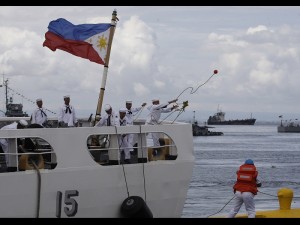
BRP Gregorio del Pilar

The United States will provide the Philippines at least $144.66 million (about P6.19 billion) in defense-related assistance this year, according to Foreign Secretary Albert del Rosario.
Speaking before the Manila Overseas Press Club at a Makati City hotel, Del Rosario noted on Wednesday night that the new US aid would be “an increase of $21.38 million (about P915.06 million) from the previous year’s appropriation.”
The funding, he emphasized, would help the country “improve our national defense by building a minimum defense posture to protect our national sovereignty.”
Citing the country’s lack of resources, Del Rosario said “it behooves us to proactively seek the assistance and cooperation of our various international partners to achieve this minimum credible posture, which is a fundamental attribute of any sovereign country.”
“Last year, we acquired a Hamilton-class cutter from the US, and we are expecting the delivery of a second cutter this year. Negotiations are likewise underway for more defense articles, including newer air assets for the Philippine Air Force,” he also said.
Manila is also “updating its mutual defense partnership (with Washington) under the Philippines-US Mutual Defense Treaty in view of the changes in the regional and global security environment.”
-------------------------------------------------

2:49 am | Friday, March 2nd, 2012

Wednesday, February 22, 2012

DFA says frequency of Phl, US joint exercises will be constitutional


MANILA, Philippines - Foreign Affairs Secretary Albert del Rosario said on Monday that the discussions between the Philippines and the United States on increasing the frequency of joint military exercises and enhancing treaty alliance will be in accordance with the Constitution and Philippine law.


Del Rosario said Manila and Washington agreed that enhancing treaty alliance between the two countries should go beyond providing military articles to the Philippines.


The Secretary met on Feb. 10 with US Assistant Secretary for Political-Military Affairs Andrew Shapiro.


Shapiro visited the country to consult with senior civilian and military officials on further enhancing defense and security cooperation for the mutual benefit of the US and the Philippines.


“What we discussed was how to enhance the treaty alliance between our two countries and so I feel that it should go beyond providing military articles to us. And actually we are going to have a planning session with the Department of National Defense (DND) so that we can see what else we can do to enhance this partnership, and of coursewhatever we do will be in accordance with the Constitution and not violative of Philippine law,” del Rosario told The STAR in a chance interview at the reception for the assumption of office of Chinese Ambassador Ma Kequing.


“We spoke of many areas of cooperation. We spoke of increasing the frequency of the joint exercises so that we can have a higher rotational presence, which of course would be consistent in terms of our establishing our minimum defense credibility posture. We are talking of many things but as I said, we will talk more,” he added.


The Philippines is exploring other means of military assistance and cooperation from the US.


The Department of Foreign Affairs (DFA) said any actions will be consistent with treaty obligations and in accordance with Philippine laws and the Constitution.


Among the options under consideration are operating US Navy ships from the Philippines, deploying troops on a rotational basis and staging more frequent joint exercises.


Although discussions are in the early stages, officials from both governments are favorably inclined toward a deal.


No US presence expansion in Asia Pacific


But China is opposed to plans to expand US military presence in Asia Pacific, saying all countries, especially the major players, should work together for peace and stability in the region.


Ambassador Ma Keqing said on Monday that Chinese Vice President Xi Jinping was clear in saying during his recent visit to the United States that the region is broad and large enough to have space for China and US.


“That is to say that we can cooperate in this region. That means we are not in a Cold War and we should give up the mentality,” Ma said on the sidelines of the reception for her assumption of office.


Prior to his visit to the US, Xi, China’s next likely leader, warned Washington against plans to boost its military strength in Asia.


“We expressed our wish that all countries in this region, especially major players, should work together toward a more peaceful region so that all countries can have economic and social development to the benefit of their own people,” Ma said. “That is the basic starting point that countries here, all they do is conducive to the peace and stability in the region so that is basic.”


During a visit to Manila last month, American lawmakers, led by Arizona Senator John McCain, underscored the need to strengthen the Philippine military and expand US military presence in the Asia Pacific and its waters for peace and stability in the region.


McCain said the attention of the world economy is shifting to Asia, with the Philippines as one of the major leaders in the region.


The lawmakers stressed US commitment to work cooperatively to build up the militaries of its allies in the Asia Pacific region and carry out joint exercises.


The senators also opposed exercise of disproportionate control by China over the West Philippine Sea (South China Sea).


Shapiro said during his recent visit to Manila that a redeployment of US forces to the Philippines after the pull out of US troops and military facilities in Okinawa may be considered at the invitation of the Philippine government. 


Navy upgrading assets


Meanwhile, the Philippine Navy is acquiring five new multi-purpose helicopters this year in line with its ongoing capability upgrade and modernization programs.


Funds for the acquisition of the five new multi-purpose helicopters, whose deliveries are expected before the year ends, came from the Department of Energy (DOE) and the AFP Modernization program, Navy chief Vice Admiral Alexander Pama said.


Three of these naval helicopters will be purchased from the P1.35-billion allocation from the DOE, while the remaining two will be acquired under the military’s defense modernization program.


Navy spokesman Lt. Col. Omar Tonsay said that aside from the five brand-new helicopters, funds have been set aside for the recovery of three Bolkows (BO105) helicopters. Repairs of these three BO105s are expected to be completed as early as the 4th quarter of this year.


“With the three refurbished BO105 helicopters and five new helicopters, naval aviators will definitely be set to conquer the country’s maritime skies,” Lieutenant Junior Grade Yron Celison Sarile, a Naval Aviation student, said in an article in the latest issue of Navy Journal.


Aside from the scheduled deliveries of eight naval helicopters, the Navy is expected to receive this year another Hamilton Class vessel from the US.


A Hamilton Class vessel had been previously acquired from the US Coast Guard. Named BRP Gregorio del Pilar, the navy frigate is currently deployed to protect the country’s infrastructure projects in the West Philippine Sea, specifically the Malampaya Natural Gasproject off Palawan.
----------------------------------------------------------
Jaime Laude
By Pia Lee-Brago 
The Philippine Star
February 22, 2012 12:00 AM
Link


Featured Posts

AFP Modernization 2017: Highlights and Review

The modernization of the Armed Forces of the Philippines was on a roll this year, as we've seen a few big ticket items having completely...

Popular Posts