Showing posts with label vfa. Show all posts

Saturday, June 09, 2012

Philippines studying military accord with Singapore

The Philippines is studying a military training agreement with Singapore and is closely watching the progress of a similar accord with Australia for lessons, the defence department said.

The proposed Visiting Forces Agreement (VFA) would allow Philippine and Singaporean troops to train in each other's countries, reviving joint exercises that were suspended in 1996, department spokesman, Peter Galvez, said on Saturday.

The department is looking at the experiences with both the Philippines' existing VFA with the United States and a VFA bill with Australia being debated in the Senate, Galvez said.

"They are collating all the experiences with the various agreements so we can craft a well-rounded VFA (with Singapore) that everyone can agree to," he told AFP.

Singapore had a military training agreement with the Philippines in 1994 but joint exercises were suspended in 1996 because under Philippine law the entry of foreign troops for wargames must be covered by a VFA approved by the Senate.

Singapore submitted a draft proposal to the Philippines in 2007 but progress in crafting the final bill was slow due because the Manila office concerned lacked manpower, said Galvez.
The United States, the country's main defence ally, sealed such a VFA in 1999 and a similar accord with Australia is pending.

Nationalists and leftists have opposed such agreements as a violation of the country's sovereignty.

The Philippines' defence ties have received greater attention in recent weeks after a maritime standoff with China broke out two months ago over disputed territory in the South China Sea.

Galvez said "we are more positive with the Australian VFA. If it rolls out, that will be template for the other countries".

However he said it would be a long time before the agreement with Singapore is presented to the senators.

--------------------------------------------------------------------------------------------------------
Agence France-Presse/Yahoo News Online | June 9, 2012 | Article Link

Thursday, June 07, 2012

7 senators reject VFA with Australia

MANILA, Philippines – Seven senators, just one vote shy of what’s needed to torpedo the Visiting Forces Agreement between the Philippines and Australia, voted to reject treaty ratification on Wednesday as Congress prepared to adjourn sine die until July 23, when another round of voting is scheduled.

Senator Joker Arroyo led six of his peers in rejecting ratification of the VFA, citing Australia’s disregard for Philippine interest in several matters, notably  for continuously banning the country’s fruit exports.

“The Senate cannot simply concur in treaties if other contracting countries have no consideration of the country’s interest,” Arroyo said in his interpellation.

The Senate approved the treaty on second reading with 7 negative votes and 14 affirmative votes.

According to Majority Leader Vicente Sotto III, the third reading of SRN 788 will be done when session resumes on July 23.

Under the Constitution, the Senate has the sole power to ratify any treaty or international agreement entered into by the Executive Department and a 2/3 vote of the present members of the Upper Chamber is needed to adopt it.

“Like the impeachment trial, the treaty needs 2/3 votes of the members of the Senate. As seven senators voted against the agreement at this stage, it only needs one more vote to finally reject the treaty,” Arroyo said in an interview after the voting.

The senator recalled that when he entered the Senate in 2001, one of the first matters taken up was the issue of Manila’s mango exports to Australia. “During that time, Philippine mangoes were banned and Sen. (Edgardo) Angara was fuming mad because with his experience in agriculture, he knew that the country’s mangoes were accepted in the US, Japan and other advanced countries.

“Today when I asked Senator Angara about the problem, he replied that Australia has not only banned mangoes but also bananas and pineapples, and that the country’s balance of trade with Australia was P500 million in imports and only P50 million in exports, meaning, it is lopsided,” he argued.

Aside from Arroyo, Senators Miriam Defensor-Santiago, Sergio Osmena III, Ferdinand Marcos Jr., Aquilino Pimentel III, Manuel Villar and Ralph Recto opposed the measure.

Senate President Juan Ponce Enrile, together with Senators Loren Legarda, Jinggoy Estrada, Franklin Drilon, Vicente Sotto III, Pia Cayetano, Bong Revilla, Teofisto “TG” Guingona III, Antonio Trillanes IV, Edgardo Angara,  Kiko Pangilinan, Panfilo Lacson and Gregorio Honasan voted to approve the measure on second reading.

Senator Kiko Pangilinan, meanwhile, reserved the right to explain his vote once the resolution is taken up on third reading. 

Santiago pointed out a part of the Agreement which says that the visiting forces may temporarily use land, sea and air space or other facilities of the receiving state for training, exercises or other activities mutually approved by both countries, but noted that there is no clear constitutional basis for the country’s military forces to be trained by a visiting force.

“Proponents of the Agreement between the Philippines and Australia have not made clear what the constitutional basis is for the Philippines to allow our military forces to be trained by a visiting force in our own territory,” Santiago said, and warned that concurrence of the Philippines “may threaten the sovereignty of the country.”

Explicit terms on environment

The Agreement, which was ratified by President Benigno Aquino III on December 23, 2010, called for the issuance of a Memorandum Order (MO) directing the Department of Environment and Natural Resources (DENR) to closely monitor the activities of the Australian Visiting Forces and its Civilian Component in the Philippines, and ensure that these activities do not violate any of the environmental laws and ordinances of the country.   

“The Status of Visiting Forces Agreement (SOVFA) with Australia sets a precedent in defense agreements in that it has unique provisions on environmental protection. The Agreement explicitly prohibits the conduct of exercises or other activities in protected areas, ancestral domain areas, critical watersheds and protected forest areas,” Senator Loren Legarda, sponsor of the resolution and chair of the Senate Committees on Foreign Relations and Climate Change, said.

“It also provides that any environmental damage will be subjected to claims and compensation and that the sending state will be responsible for the rehabilitation of damaged areas,” Legarda added.

“The Agreement will enforce the duties and obligations of both parties with respect to environmental protection, including the clean-up and restoration of any local site or body of water that may be affected by the activities allowed for under the Agreement,” she added.

The Agreement also calls for the Service Authorities of Australia to cooperate with the Philippine government to prevent any abuse or misuse of the privileges granted in favor of Australian Visiting Forces and its Civilian Component, and to ensure that proper discharge of the obligations imposed on the visiting party are met.

The Agreement addresses the sensitive issue of criminal jurisdiction “through a clear set of rules,” and that the “authorities of the receiving state have jurisdiction over visiting forces with respect to offenses committed within the receiving state and punishable by the law of the receiving state, but not by the law of the sending state.”

“With respect to criminal jurisdiction, it is provided in the Philippine-Australian VFA that the receiving state shall exercise primary jurisdiction over all offenses except for offenses relating to the property and security of the sending state, and offenses performed in official duty. Thus, as a general rule, offenses shall be under the primary jurisdiction of the receiving state. We believe that these are but reasonable rights afforded to the sending state,” Legarda added.

Respect for the other's laws

According to Legarda, there is also emphasis made in the SOVFA regarding the principle of respect for the laws of the receiving state.  

“No offender from the visiting forces who commits a crime in the Philippines will escape justice under the SOVFA,” Legarda stressed.

The resolution also states that the Agreement must provide for a comprehensive legal framework that will govern the status of the Armed Forces of the Philippines and the Australian Defense Forces personnel who will participate in education, training, combined exercises and humanitarian activities in each others territories.

The Agreement, which provides for enhanced bilateral defense and military cooperation between the two countries through the exchange of visits, was anchored on the 1995 Memorandum of Understanding on Cooperative Defense Activities with Australia through exchange of visits.

Since 2001, Australia has extended defense assistance to the Philippines totalling an estimated P1.16 billion.

This includes, among others, military education and training of an average of 120 AFP officers annually in Australia, costing an average of US$ 26.751 million per year;  contribution of US$ 17.834 million worth of riverine boats as part of the efforts to upgrade counter-terrorism and maritime security capabilities; supporting the implementation of the Coast Watch System to strengthen the country’s capability in addressing maritime security challenges; and conducting counter-terrorism trainings and mutual training assistance to help develop inter-operability between the special operations units of the armies and navies of the Philippines and Australia.

------------------------------------------------------------------------------------------------------------------

Tuesday, March 06, 2012

Zamboanga better with American troops


ZAMBOANGA CITY, Philippines - A guard signaled our driver to move between rows of 7-ft-high concrete barriers of a bomb containment area, before allowing us to move to the side of the bullet-proof sentry gate of the Armed Forces of the Philippines (AFP) Western Mindanao Command, manned by rifle-carrying soldiers in camouflage uniform.

This scene is somehow different to other military facilities I've visited in the Philippines, since this is also the camp where US troops are stationed under the Philippines-US Visiting Forces Agreement.

Since 1999, when the treaty was signed by the Philippine Senate, US troops were stationed here in this part of Southern Philippines, holding training missions with and for Philippine troops.

AFP Western Mindanao Command (Wesmincom) chief Major General Noel Coballes said the American soldiers are very cordial in dealing with their Filipino counterparts.

"May mga panahon na down-to-earth, meron din namang professional ang dating. But most of these are all cordial," Coballes told ABS-CBN News.

Comrades-in-arms

Coballes said the US troops have been accustomed to the way of life in the camp that they treat Filipino soldiers like their own comrades, rendering salute even to Filipino officers. 

The main purpose of the US troops' presence is to train with their Filipino counterparts on military inter-operability.

Coballes said both sides have benefitted greatly in the training they have undergone.

A concrete example is the capture of prominent leaders of Abu Sayyaf Group, which is known to have links with the international terror group Al-Qaeda.

Americans, on their part, have also tried to maximize the value of their presence here in the country by undertaking civil-military operations.

These kind of operations include medical missions and building infrastructure projects like road networks and classrooms in different parts of the country where American troops are present.

"As of this time, nagsimula yan ng mga 2006, more than $20 million na iyung na-contribute nila sa Jolo and there are also some projects in Basilan, like iyung ngayon, I understand yung Amaoy roadnet, kanilang project yun. Although iyung nagta-trabaho noon ay civilian contractor, but the funding came from them," Coballes said.

Best sentry gate

Even Camp Navarro -- the compound that hosts the AFP Wesmincom and the US troops -- benefited from the infrastructure projects through road concreting and improvement of its sentry gate.

The sentry gate can be considered the best in the Philippines, incomparable to other military facilities in the country.
Camp Navarro's gate is similar to the set-up used by US troops in Afghanistan and Iraq. It has solar-powered lights, blast-proof windows and 7-ft-high concrete bomb containment area.

Lt. Col. Randolph Cabangbang of AFP Wesmincom's Civil-Military Operations said he even got the Americans to renovate the camp's Public Affairs Center, which used to house Zamboanga's Defense Press Corps.

"Nagkaroon ako ng chance dati na makasama yung American counterpart ko, naglalakad kami dito, tinanong ko kung pwede kaming tulungan na ipaayos yan, pinaayos naman nila," said Cabangbang.

No problem in Zamboanga

The AFP Wesmincom said US soldiers have not given a big problem to Zamboanga City. "Hindi naman sila naging problema dito. Never silang (residents of Zamboanga) nagkaroon ng malakihang reklamo sa mga Amerikano. Of course, hindi naman natin mape-perpekto lahat ng organization eh. Merong mailiiit, pero hindi nakaapekto yun sa kanilang, ang presensya nila dito, di nakaapekto yun," Coballes said.

The last time the Philippines had a major problem with American soldiers was in 2006, when a rape case was filed against Lance Corporal Daniel Smith in Subic.

The case was eventually dismissed in 2010 after the complainant retracted her affidavit where she claimed she was raped. The girl who filed the complaint is now reportedly living in the US.

The Philippines is not new to these cases.

During the 1970s and the 1980s, when Americans still had bases in Subic and Clark, cases of sexual abuse and maltreatment involving American troops were filed by Filipinas. Most of the cases never prospered in court.

On June 17, 1991, the Americans pulled out and evacuated from the bases.

It was 2 days after the eruption of Mount Pinatubo in Pampanga, an eruption that was worse than that of Mount St. Helens in US.

Two months later, the Philippine Senate voted against extending or renewing the US government's lease on the land where their military bases stood, ending their 50-year stay in the country.

Business growing in Zamboanga

Now, more than a decade has passed since "GI Joes" returned to the Philippines.

Their presence in Zamboanga has somehow brought good vibes to the local business here.

Zamboanga is the hub of business in Western Mindanao, being the transhipment point of goods and produce not only from Zamboanga Peninsula but also from the areas of Basilan, Sulu and Tawi-tawi provinces.

Business is now growing despite negative reports of bombings and kidnappings in the southern Philippines.
A hotel owner said the presence of Americans has somehow brought positive effects to their community. "In a way, nakakatulong. I would say na it is an added security blanket for ZamboangueƱos, because nakikita nga natin, we're threatened by terrorists," said Brian Go, general manager of Garden Orchid Hotel.

Go, however, also admitted that the presence of the Americans in their city also has its negative side. 
----------------------------------------

Friday, March 02, 2012

US to boost PH defenses with P6-B aid


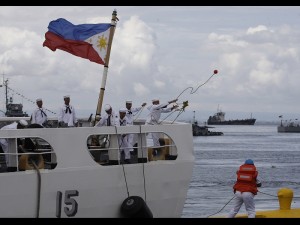
BRP Gregorio del Pilar

The United States will provide the Philippines at least $144.66 million (about P6.19 billion) in defense-related assistance this year, according to Foreign Secretary Albert del Rosario.
Speaking before the Manila Overseas Press Club at a Makati City hotel, Del Rosario noted on Wednesday night that the new US aid would be “an increase of $21.38 million (about P915.06 million) from the previous year’s appropriation.”
The funding, he emphasized, would help the country “improve our national defense by building a minimum defense posture to protect our national sovereignty.”
Citing the country’s lack of resources, Del Rosario said “it behooves us to proactively seek the assistance and cooperation of our various international partners to achieve this minimum credible posture, which is a fundamental attribute of any sovereign country.”
“Last year, we acquired a Hamilton-class cutter from the US, and we are expecting the delivery of a second cutter this year. Negotiations are likewise underway for more defense articles, including newer air assets for the Philippine Air Force,” he also said.
Manila is also “updating its mutual defense partnership (with Washington) under the Philippines-US Mutual Defense Treaty in view of the changes in the regional and global security environment.”
-------------------------------------------------

2:49 am | Friday, March 2nd, 2012

Thursday, February 23, 2012

Military base-sharing scheme with US proposed


MANILA, Philippines - Iloilo Rep. Jerry TreƱas yesterday pushed for a military “base-sharing” scheme with the United States to strengthen the country’s security without having to violate the Constitution and angering China.

TreƱas, chairman of the House committee on good government, expressed support for the further enhancement of the country’s defense ties with the US but stressed it should be done within the bounds of the Philippine Constitution.

“We agree with the stand of President Aquino, who said that expansion of defense cooperation with the US should never deviate from the country’s existing laws, especially the Constitution,” he said.

TreƱas said strengthening or expanding relations with any country “should be on a mutually beneficial level without sacrificing relations with other nations, especially neighboring countries in Asia and the Pacific.”

“If and when there is a need to improve the terms of the Visiting Forces Agreement, it should only cover areas of cooperation such as refueling, repair and logistics support for its aircraft and warships using already existing facilities and Filipino labor,” he said.

He said establishing exclusive facilities for the US military even on a temporary arrangement should be out of the question as this can be already be considered as setting up of a military base which violates the Constitution.

“One arrangement which can be studied is a base-sharing scheme but only for the purpose of refueling, repair and logistics support which can be reciprocated by the US by modernizing our own military camps with the latest defense technologies which could help us protect our territories not only from incursions in the disputed areas in the South China Sea but also from smuggling, illegal fishing, piracy and other maritime crimes,” TreƱas said.

TreƱas cited reports that the US Congress is set to approve the transfer of a second ship to the Philippine Navy, saying this is a “positive step” that would help the country patrol its 36,000 nautical miles of coastline and beef up its lowly 132-ship naval force Last year, the US transferred a Hamilton class cutter, which was recently sent on a mission to the Spratlys.
------------------------------------------------------------------
The Philippine Star 
February 23, 2012 12:00 AM

Sunday, February 12, 2012

Congress OKs 2nd warship for Philippines


MANILA, Philippines — The U.S. Congress has approved the transfer of a second U.S. Coast Guard ship to the Philippines, an official said Friday as Washington shifts its military ties with the Southeast Asian nation that has been engaged in a territorial spat with China.
In the past, U.S. cooperation with the Philippines has focused mostly on counterterrorism, but it has recently expanded to building up the country’s moribund navy.
U.S. Assistant Secretary of State for Political-Military Affairs Andrew Shapiro told reporters Friday that he will consider a Philippine request to have the warship turned over with as much military equipment as possible.
“I’m pleased that the congressional notification period for a second Coast Guard cutter expired this week, so that means Congress has now approved the transfer ... to the Philippines, which will further help Philippine security needs,” he said after talks with Filipino defense officials in Manila.
The ship — the second such delivery since last May under the 1951 Mutual Defense Treaty — is just one of many defense projects that the U.S. is discussing with the Philippines. That comes in addition to having American ships regularly visit and refuel in Philippine ports, rotating U.S. troops in the southern Philippines where al-Qaida-linked Muslim militants are active and holding large-scale joint military exercises.
China has said that it views with concern the increased U.S. military engagement with the Philippines and balked at what it sees as Washington’s interference in the South China Sea dispute. The Philippines, Brunei, Malaysia, Vietnam and Taiwan all have conflicting territorial claims over potentially gas and oil rich islands with the Asian superpower.
The Philippines last year accused Chinese vessels of harassing its oil exploration ships and laying claim to areas within its territorial waters.
Shapiro reiterated the U.S. policy that it takes no position on the claims by any of the parties, that disputes should not be resolved through the use of force and that its defense cooperation with the Philippines is not directed against any one country.
But he also said that his government is committed to helping the Philippines in its security needs and “fully intends to meet its obligations under the Mutual Defense Treaty.”
The increased focus on strengthening Philippine naval assets, which have lagged behind those of its neighbors and are no match to China’s superior military, comes a decade after American troops started training Filipino soldiers and sharing intelligence with them in a campaign to rout out al-Qaida-linked militants. They are blamed for a series of bombing attacks and kidnapping sprees mostly in the country’s southern island provinces.
“Traditionally our focus was on helping the Philippines address the internal security threat,” Shapiro said. “Given the progress that the Philippine forces and police have made addressing the threat, we’re now at a point when both our governments believe we can transition our support towards helping them in maritime security issues.”
Still, he said he did not anticipate any immediate changes in redeploying about 600 U.S. Special Forces troops in the southern Philippines.
Shapiro also ruled out any intention to re-establish U.S. bases in the Philippines following a 1991 historic vote in the Philippine Senate to close them down, nearly a century after the United States claimed the islands from Spain.
U.S. military presence continues to be a sensitive issue in the former colony. Left-wing and nationalist groups are opposed to the 1998 Visiting Forces Agreement, which allows American troops to train here.
-----------------------------------------------------
By Hrvoje Hranjski - The Associated Press
Posted : Friday Feb 10, 2012 8:35:47 EST
NavyTimes.Com

Saturday, February 11, 2012

Shapiro: US gov’t keeps military assistance levels to RP


United States foreign military assistance (FMF) to the Philippines will stay at the same levels, despite budget constraints, even as the two countries look for “cost-effective” ways to beef up defense capabilities in maritime security, a US state official said on Friday.

Assistant Secretary of State for Political-Military Affairs Andrew J. Shapiro, in a roundtable discussion with reporters in Manila, said that the US government will be enhancing its military assistance to the Philippines, and particularly, “emphasize the use of FMF for maritime security.”
“We continue to provide foreign military financing... it’s a challenging budget environment in Washington, however the Philippines is a priority,” Mr. Shapiro told reporters on Friday, after his meeting with defense officials, and prior to meeting with his counterparts at the foreign ministry.
“We are looking to transition our support from internal security to maritime security and our FMF agreements and support will reflect that shift,” underscored Mr. Shapiro.
Ongoing discussions between the two governments, to culminate in a state meeting in Washington, have revolved around aligning the US agenda to increase its military presence in the Asia-Pacific, with the Philippine agenda to improve its capabilities to defend territorial sovereignty, particularly in light of repeated incursions from China.
He could not give a “ballpark figure” for the amount of financing allotted to the Philippines, explaining that the numbers are still being worked out in Congress, but indicated that the trend has been roughly $30 million for several years already.
“We will see how the fiscal year 2012 budget shapes up but again we’re looking through all possible assistance for the Philippines,” stated Mr. Shapiro.
“Going forward, we intend to continue these discussions... We’ll also be looking at further ways to help the Philippines with their maritime security needs,” added Mr. Shapiro.
Thus far, the US has successfully turned over the first of three Hamilton class cutters for the Philippine Coast Guard -- previously announced by the Aquino administration -- with the second vessel just recently approved by the US Congress, said Mr. Shapiro.
“We would like to work with the Philippines on the most cost-effective platforms that will serve their defense needs... the ongoing dialogue is designed to identify what would be the best way to meet those needs...,” said Mr. Shapiro, without further elaboration.
The two vessels are merely the first of possible transfers, said Mr. Shapiro, as they expect “further opportunities down the road for future excess defense articles. He admitted, however, that such equipment will depend on what the US defense department can spare at this point in time.
“Excess defense articles are excess, and as our services are able to spare certain equipment -- that will determine what will be able to be turned over as excess defense articles,” said Mr. Shapiro.
The desired F-16 aircraft that President Benigno S.C. Aquino III said he would be bringing up with US President Barack Obama when he visited sometime in May or June, has yet to be discussed, said Mr. Shapiro.
However, he made a point of noting that his bureau is also involved in licensing commercial sales, and that he in fact will be attending the Singapore air show, which will be “an opportunity” to meet with US companies “to discuss the best way we can support US companies that are seeking to make sales in the region.”
Providing linkages between “partners” and the US firms will be a benefit to both, he said.
“We greatly value our military assistance to the Philippines -- we think that it helps deepen the partnership,” Mr. Shapiro said.
“There is no discussion of renegotiating the bilateral treaty, and other agreements as the discussions unfold whether new agreements are necessary or changes to existing agreements, we’ll see, but right now we have not entered into discussions as to changing any agreements,” said Mr. Shapiro.
He underscored that the US will not be establishing bases in the Philippines, whereas the rotational troops -- including the special forces in the south -- will be limited to joint military training and disaster response and humanitarian assistance, rather than active combat duty.
Mr. Shapiro, who will be traveling to Indonesia and Malaysia, as well as Singapore, later this month, also underscored that while the US will stand by its obligations to the Philippines under the MDT, the defense dialogue on maritime cooperation is not designed as a specific deterrent for China.
“Our discussions are designed not targeted to any one country; they are designed to meet legitimate security requirements of the Philippines,” said Mr. Shapiro. 
----------------------------------- 
Johanna Paola D.Poblete
 February 10, 2012 07:56:47 PM
Business World Online

US official here for talks on defense cooperation


MANILA, Philippines - Visiting US Assistant Secretary of State for Political-Military Affairs Andrew Shapiro will consult with senior Philippine civilian and military officials on further enhancing broad defense and security cooperation between the Philippines and the United States.

The US embassy in Manila said yesterday Shapiro is in Manila for a visit from Feb. 9-11.

In a joint statement by the Philippines and the US issued last Jan. 27 in Washington following the second Bilateral Strategic Dialogue, the two sides said the visit of Shapiro and Deputy US Trade Representative Demetrios Marantis would take place this month before the visit of Foreign Affairs Secretary Albert del Rosario and Defense Secretary Voltaire Gazmin to the US next month.

The two sides will discuss economic issues and the interest of the Philippines in potentially joining the Trans-Pacific Partnership.

Shapiro will also travel to Indonesia and Malaysia after the Philippines.

He will meet with senior officials during his visit in Jakarta, Indonesia from Feb.12-13 to further bilateral political-military cooperation, such as Indonesia’s recent decision to upgrade its air force with the acquisition of F-16 aircraft.

The US official will also attend the groundbreaking for the new US-funded barracks at Sentul Peacekeeping Training Center, a facility which helps to meet the growing global demand for specialized military and civilian personnel to serve in peacekeeping missions.

Shapiro will then visit Singapore on Feb. 14-16 to attend the Singapore Air Show 2012 and also discuss political-military and defense trade issues with senior government officials and industry representatives. 

On Feb. 15, he will travel to Kuala Lumpur, Malaysia, where he will hold bilateral meetings with senior civilian and defense officials.
---------------------------------------------------
The Philippine Star
February 10, 2012 12:00 AM

Philippines wants to retain equipment from US ship


CLARK, PAMPANGA, Philippines  – The Philippine Navy is requesting the United States to keep intact some features of the second ship it plans to provide the country.

“We are hoping that they would add and retain (some of the ship’s capabilities),” Navy chief Vice Admiral Alexander Pama said at the sidelines of the Hot Air Balloon Festival here yesterday.

Among the ship’s features that Pama wants retained are communication equipment, sensors and radars.

The Navy chief said that they are grateful to the US because the second ship will be a big help to their naval defense capability.

Last year, the Philippines acquired the BRP Gregorio del Pilar from the US Coast Guard to enhance its territorial defense capabilities.

The ship – the Navy’s first Hamilton-class vessel – was acquired under the US Foreign Military Sales program.

The government spent P450 million for the vessel’s transfer costs.

The US, however, removed some of the ship’s accessories before it was turned over to the Philippines.

Some of the features stripped from the ship were the sensors, communications andelectronics equipment, and close-in weapons system.

Reports have quoted Kurt Campbell, US diplomat for East Asia, as saying that his government is considering a request by the Philippines to transfer equipment removed from the ship.

The Gregorio del Pilar was deployed to Palawan on Dec. 23.

On Wednesday, Republican Rep. Ed Royce told a congressional hearing that the review process for transferring the second ship to the Philippines would be finished this week.

“I am pleased to report that the congressional review process for another ship – Coast Guard cutter Dallas – wraps up this week. It should soon be on its way to Manila,” Royce said.

Armed Forces of the Philippines chief Lt. Gen. Jessie Dellosa said the acquisition of the second ship is still under negotiation.

Meanwhile, the Communist Party of the Philippines (CPP) said the transfer of the US ship to the Philippines would provoke conflict in the West Philippine Sea.

“The transfer of another naval cutter from the US government serves the purpose of US military buildup in the (West Philippine) Sea,” CPP said in a statement.

“By acquiring the US naval cutters and manning it to serve US interests, the Aquino regime is making the Philippines a possible target of the potential enemies of the US,” it explained.

According to the CPP, the US is planning to use the Philippine Navy as an “augmentation force” as it projects its military presence in the region.

Lawmakers: No to US bases

Meanwhile, San Juan Rep. Joseph Victor “JV” Ejercito opposed yesterday the reported plan of the United States to build a small military base in the country.

“We fought long and hard to oust the US bases in Subic and Olongapo City. To reopen the US bases or set up new bases anywhere in the country should be non-negotiable. Clearly, at this point, our country does not have much to gain from this strategic military and economic plan of the US,” Ejercito said.

He was reacting to a report in the American media that the US plans to “rotate” some 4,000 troops through “Australia, Hawaii, Subic Bayand perhaps a smaller base in the Philippines.”

Twenty years ago, the Senate voted to terminate the RP-US Military Bases Agreement because the Constitution prohibits the presence of foreign troops in the country.

Ejercito’s father, former President and then senator Joseph Estrada, was among those who voted for removing the American bases.

Ejercito explained if the government does not handle US “rotation” proposals well, they could “eventually lead to the return of American bases here.”

“The Visiting Forces Agreement (VFA) should suffice if the country wants to continue building relations with the US to explore increased joint military exercises and other military cooperation,” he noted.

Ejercito added, “For the government to give more than what we have already acceded to the US within the VFA would be counter-productive and a step towards infringing on the sovereignty of our country.”

He pointed out that building a US base, however small, would require an amendment of the Constitution, which clearly bans foreign military bases in the country.

Ejercito also expressed fears that the re-entry of more US troops here could cause other problems such as prostitution, gambling and abandonment of children fathered by American servicemen, and could even worsen the local communist insurgency problem.

Another congressman, Walden Bello of the party-list group Akbayan, urged the House of Representatives and the Senate to closely monitor talks to foster RP-US military cooperation.

“We in Congress should monitor the decisions that the administration is making. Talks between Philippine officials and their American counterparts are all over the news, but information about what is happening, and what is being agreed on, is very rare to come by,” Bello said during a privilege speech.

“Many of us in Congress have no knowledge of the plans that the Department of Foreign Affairs (is) discussing with the US. And while we don’t expect to have access to all the details, as the people’s representatives in government, Congress must gain an understanding of the overall direction of these plans,” he explained.
----------------------------------------
With Jess Diaz
By Alexis Romero
The Philippine Star
February 10, 2012 12:00 AM
Link

Featured Posts

AFP Modernization 2017: Highlights and Review

The modernization of the Armed Forces of the Philippines was on a roll this year, as we've seen a few big ticket items having completely...

Popular Posts