Showing posts with label South Korea. Show all posts

Tuesday, March 19, 2013

Six nations to join in talks during US-Philippines drill


Manila, March 18 (IANS) Australia, Brunei, Japan, South Korea, Singapore and Thailand will take part in a maritime security discussion with the US and the Philippines during a military exercise to be held in April, a Philippine official said.
The "Multinational Maritime Security Roundtable Discussion" is part of the upcoming Balikatan Exercise 2013, Arnulfo Marcelo Burgos, spokesman for the Armed Forces of the Philippines (AFP), was quoted as saying by Xinhua.
The exercises will take place April 5-17.
However, the six other countries will not be taking part in the actual field training exercises which will be limited to Filipino and US forces alone, the official said.
"The roundtable discussion seeks to determine specific humanitarian assistance and disaster relief operations in high- traffic international waters, and build response confidence among multi-national partners," said Burgos.
"The event will be one of the highlights of this year's military exercise where more than 8,000 soldiers from the AFP and US military are set to participate," he said.
Burgos said the annual exercise seeks to "further promote and foster the existing friendship" between the two countries and "advance the security and stability of the region in the near future".
--------------------------------------------------------------------------------------------------------
Indo Asian News Service | March 18, 2013 | Article Link

Thursday, March 07, 2013

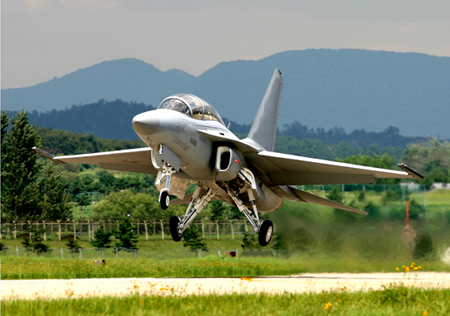
Terms Of Reference for F/A-50 'Golden Eagle' now being crafted


MANILA — The Philippines is now on track to operate again supersonic jet aircraft as the "term of reference" (TOR) for the F/A-50 "Golden Eagle" is now in the works.
"Procurement for the F/A-50 will be on a government-to-government basis," the Department of National Defense (DND) observer stressed.
He also said the go-ahead signal for the TOR only came last week.
The order came from the Government Procurement Policy Board (GPPB), an attached agency of the Department of Budget and Management.
The DND observer declined to comment on when the TOR will be completed but stressed that it will be done within the year.
But he expressed confidence that the Philippine Air Force (PAF) will be flying the F/A-50 within two years time.
The last supersonic planes operated by the country was the Northrop F-5 "Freedom Fighter" which was decommissioned due to lack of parts and air frame aging sometime in 2005.
The TOR describes the purpose and structure of a project, committee, meeting and negotiation.
It also defines the vision, objectives, scope and deliverables (i.e. what has to be achieved); stakeholders, roles and responsibilities (i.e. who will take part in it); resource, financial and quality plans (i.e. how it will be achieved); work breakdown structure and schedule (i.e. when it will be achieved) and includes success factors/risks and restraints.
The Philippines is in the market for 12 supersonic trainer aircraft which can double as interim fighter and attack planes for the PAF. It has allocated P18 billion for this program.
The GPPB earlier gave the DND the "green-light" to start pre-negotiations with the South Korean government for 12 F/A 50 aircraft last January.
The plane is manufactured by the Korea Aerospace Industries (KAI). The F/A-50 is also known as the TA-50.
The F/A-50 design is largely derived from the F-16 "Fighting Falcon", and they have many similarities: use of a single engine, speed, size, cost, and the range of weapons.
KAI's previous engineering experience in license-producing the KF-16 was a starting point for the development of the F/A-50.
The aircraft can carry two pilots in tandem seating. The high-mounted canopy developed by Hankuk Fiber is applied with stretched acrylic, providing the pilots with good visibility and has been tested to offer the canopy with ballistic protection against four-pound objects impacting at 400 knots.
The altitude limit is 14,600 meters (48,000 feet), and airframe is designed to last 8,000 hours of service.
There are seven internal fuel tanks with capacity of 2,655 liters (701 US gallons), five in the fuselage and two in the wings.
An additional 1,710 liters (452 US gallons) of fuel can be carried in the three external fuel tanks.
Trainer variants have a paint scheme of white and red, and aerobatic variants white, black, and yellow.
The F/A-50 "Golden Eagle" uses a single General Electric F404-102 turbofan engine license-produced by Samsung Techwin, upgraded with a full authority digital engine control system jointly developed by General Electric and KAI.
The engine consists of three-staged fans, seven axial stage arrangement, and an afterburner.
The aircraft has a maximum speed of Mach 1.4-1.5.
Its engine produces a maximum of 78.7 kN (17,700 lbf) of thrust with afterburner. 
----------------------------------------------------------------------------------------------
Priam F. Nepomuceno | Philippine News Agency/Zambo Times | 
March 6, 2013 | Article Link

Sunday, March 03, 2013

South Korean defense manufacturer signifies interest to provide DND's frigate requirements


MANILA, March 2 (PNA) -- A South Korean defense manufacturer is now talking with the Department of National Defense (DND) regarding its requirements for two brand new frigates.

A DND observer said that the company is offering the Philippines varieties of the "Incheon" class frigates.

"Some initial talks are now being held and hopefully, the company will get a chance to bid for our frigate requirements," he stressed.

He also pointed out that talks with the South Korean defense manufacturer came about when the DND decided to not go ahead with the planned purchase of the Italian "Maestrale" frigates due to questions of cost and hull aging.

The "Incheon" are coastal defense frigates of the Republic of Korea Navy with its lead ship launched on April 29, 2011.

The "Incheon" class frigates will replace the aging fleet of "Pohang" class corvettes and "Ulsan" class frigates, and take over multi-role operations such as coast patrol, anti-submarine warfare and transport support.

Later batches are planned to be specialized on anti-air and anti-submarine warfare.

"Incheon" class frigates are armed with the 127mm/L62 Mk. 45 Mod 4 naval gun.

Point-defense armaments include a single 20 mm Phalanx CIWS and a RIM-116 Rolling Airframe Missile Block 1 21-round launcher.

Anti-Submarine Warfare armaments consists of K745 LW Cheong Sahng-uh (Blue Shark) torpedoes.

Its anti-ship capability is provided by 16 SSM-700K Hae Sung (Sea Star) long-range anti-ship missile, each with performance similar to the US Harpoon while land-attack capability is provided by the recently-developed Hyunmoo IIIC (Guardian of the Northern Sky) cruise missile, which is similar to the US Tomahawk.

It has a length of 374 feet, speed of 30 knots, capable of carrying a naval helicopter and a complement of 140 officers and men.

"Incheon" frigates weigh around 3,000 tons and has cruising range of 5,000 miles. 

--------------------------------------------------------------------------------------------------
Priam F. Nepomuceno | Philippine News Agency | March 2, 2013 | Article Link

Friday, February 22, 2013

No more second frigates for Philippine Navy - DND official


MANILA, Feb. 22 (PNA) -- A ranking Department of National Defense (DND) official has said the option to acquire second-hand frigates to boost the numbers and capabilities of the Philippine Navy (PN) has been waived.

Fernando Manalo, DND undersecretary for finance, munitions,installation and materiel, said this because evaluation studies found out that acquiring these vessels will be more costly in the long run.

"The PN found out that it will be more expensive to maintain second hand vessel(s) than buying a new one," he added.

With this conclusion, the Italian-made "Maestrale" frigates, are no longer in the running for possible acquisition by the Philippines.

"Its no longer being evaluated," Manalo stressed.

The "Maestrale" was earlier touted by the DND as the next ships to be acquired for the PN due to its credible missile and anti-submarine capabilities.

With this development, Manalo said the Philippines is now looking for new build naval ships with the same configuration.

The DND earlier said that five countries have expressed their intention to sell the Philippines modern frigates and offshore patrol vessels which will help the country protect its vast maritime territories.

These offers came from the United States, Israel, Croatia, South Korea and Australia.
All vessels being offered by these nations are brand new.

Manalo added that offers of the above-mentioned countries started coming during the last quarter of 2012.

The DND official attributed the sudden influx of would-be-suppliers to the fact the Philippine is now seriously upgrading its military forces.

The Philippines is in the market for two modern and powerful frigates in order to enhance its maritime domain awareness and protection capabilities.

---------------------------------------------------------------------------------
Priam F. Nepomuceno | Philippine News Agency | February 22, 2013 | Article Link

Tuesday, August 14, 2012

TA-50 to revive PAF's 'fast mover' capability

MANILA, Aug. 14 (PNA) - The Philippine Air Force (PAF) will regenerate its "fast mover" capability once the decision to acquire South Korea's TA-50 "Golden Eagle" becomes final. 

The ability refers to the capacity to intercept aircraft intruding or encroaching over the country's airspace. 

Fernando Manalo, DND undersecretary for finance, munitions, installation, and materiel, said that the TA-50 offers the PAF the best means to reacquire such capability. 

"It may be small and not that fast, but under the hands of a well-trained and capable pilot, this plane can prove itself a much for much faster and bigger aircraft," he said. 

The PAF lost its interception capability in 2005 when it formally retired the last 10 F-5 "Tiger" jet fighters in its inventory due to airframe aging and lack of spare parts. 

The T-50 "Golden Eagle" design is largely derived from the F-16 Fighting Falcon, and they have many similarities: use of a single engine, speed, size, cost, and the range of weapons. 

Korea Aerospace Industries, the designer of the TA-50, developed the the aircraft from the US F-16 "Falcon". 

The aircraft can carry two pilots in tandem seating. The high-mounted canopy developed by Hankuk Fiber is applied with stretched acrylic, providing the pilots with good visibility, and has been tested to offer the canopy with ballistic protection against four-pound objects impacting at 400 knots. 

The altitude limit is 14,600 meters (48,000 ft), and airframe is designed to last 8,000 hours of service. 

There are seven internal fuel tanks with capacity of 2,655 liters (701 US gallons), five in the fuselage and two in the wings. 

An additional 1,710 liters (452 US gallons) of fuel can be carried in the three external fuel tanks. 

T-50 trainer variants have a paint scheme of white and red, and aerobatic variants white, black, and yellow.[43] 

It uses a single General Electric F404-102 turbofan engine produced by Samsung Techwin) and upgraded with a full authority digital engine control system jointly developed by General Electric and Korea Aerospace Industries. 

The engine consists of three-staged fans, seven axial stage arrangement, and an afterburner. 

The aircraft has a maximum speed of Mach 1.5. 

Its engine produces a maximum of 78.7 kilo Newton (17,700 pound force) of thrust with afterburner. 

The aircraft can also be fitted with heat-seeking missiles, 20mm to 25mm automatic cannon, various surveillance equipment and is very capable of undertaking the air-superiority role due to its sleek design. 

And once the go-ahead signal is given for the TA-50, the DND official expressed confidence that the fighter will be in PAF service within two year's time. 

"We will get two immediately for training purpose so that when the 10 other aircraft arrive, our pilots are already trained for its use," Manalo said. 

"The other good thing about the TA-50 is that we will (be) buying it straight from the manufacturers. We will be its first-time users and not the second or third as in previous PAF aircraft," he said.

-----------------------------------------------------------------------------------------------------------
Priam F. Nepomuceno | Philippine News Agency | August 14,2012 | Article Link

Thursday, August 09, 2012

Korea to discuss export of 12 trainer jets to Philippines

It is likely that Korea’s trainer jets will be exported to the Philippines.

The Defense Acquisition Program Administration said Tuesday that Korea and the Philippines will hold their 16th bilateral joint commission talks on military cooperation in Manila from Aug. 13 to 16.

An official said that the two governments will deal with the export of TA-50s to the Philippines at the talks. The TA-50 is the earlier version of the advanced T-50 supersonic trainer jet.

Local media in Manila reported in June that the Philippine Air Force plans to import 12 TA-50s over two years. However, the Korean government denied the report, saying, “There was no official discussion, or request for a proposal.” The value is estimated at 400 billion won.

The two countries reportedly agreed to trade TA-50 trainer jets, rewriting the bilateral pact on procurement of defense supplies. The revision has extended the defense supplies subject to private contract for complex weapons system, such as warships and aircraft. Park Chung-won, deputy administrator of the agency, will lead the Korean delegation in the talks with the Philippines.

“What the Philippines actually needs is TA-50 of Korea, a model a step nearer to a light attack aircraft,” the official said. “It’s highly probable that the Philippines will sign a contract once the military secures funds from the central government.”

It is reported that the Philippine defense authorities expressed their intention to purchase the TA-50 trainer jets to President Benigno Aquino III early this month. The Philippines is determined to set aside 70 billion pesos (approximately 1.9 trillion won ) involving the modernization program to the beef-up the Air Force.

Korea’s T-50 Golden Eagle is a jet trainer and light attack aircraft designed to provide pilot training for current and next-generation fighters such as the F-15, F-16, F-18, F-22, F-35, the Eurofighter and Mirage supersonic jet interceptors.

Meanwhile, with a weak military capability, the Philippine Air Force and the Navy failed to intercept 26 foreign intrusions into Philippine territory during the first quarter of this year, not including the stand-off at the Panatag Shoal or Scarborough Shoal by scores of Chinese vessels since April.

------------------------------------------------------------------------------------------------------------------
The Korea Times | August 8, 2012 | Article Link

Friday, August 03, 2012

Purchase Of Korean Jets Recommended

The Department of National Defense (DND) has recommended to President Aquino the purchase of South Korean-made jet fighters to boost the country’s external defense capability.

Fernando Manalo, DND undersecretary for finance, munitions, installations and materiel, said the assessment conducted revealed that it is South Korea’s T50s which is ideal for the country’s Philippine Air Force.

“Based on our assessment it is the T50 of South Korea that is most advantageous to us in consideration to the obtaining situation in the West Philippine Sea,” said Manalo.

Aside from capability, the T50s are also ideal in terms of the country’s limited budget for Air Force modernization, he said.

If the contract is signed with South Korea before the end of 2012, Manalo said the fighter jets could be delivered to the country within two years from 2013.

What would happen if the contract is signed, according to Defense Secretary Voltaire Gazmin, is that they would request for immediate delivery of two of the T50s to facilitate the training of Air Force pilots.

“We will negotiate so we can get the two immediately for training so that when the rest of the 10 arrives, our pilots are already trained,” said Gazmin.

Manalo stressed the need to sign into law the P75-billion modernization budget for military modernization.

“Without the law, we cannot implement the acquisition of these fighters . . . because there is no budget,” said Manalo.

The Philippines is now focusing on its external defense after it became locked in a standoff with China a few months ago near the Scarborough Shoal.

The two Philippine civilian ships have already pulled out several weeks ago to deescalate the tension but Chinese ships remain in the area and even set structure to block other ships from entering the Shoal.

--------------------------------------------------------------------------------------------------------------
Aaron B. Recuenco | Manila Bulletin | August 2, 2012 | Article Link

Thursday, June 21, 2012

DND eyes Korea, Brazil for military aircraft


The Department of National Defense said Thursday that it is eyeing government-to-government transactions with South Korea and Brazil for the procurement of T-50 advanced jet trainers and Embraer EMB 314 Super Tucano turboprop light attack aircraft.
 
In a phone patch interview with reporters, Defense Secretary Voltaire Gazmin said that these aircraft are needed to protect Philippine airspace.
 
The South Korean built T-50 is a supersonic trainer that can also perform in the light-strike role. The Super Tucano is designed for light attack, counter insurgency (COIN), close air support, aerial reconnaissance missions.
 
Government-to-government, or G2G, transactions are non-commercial interactions between two governments’ organizations, departments, and authorities.
 
Gazmin made the disclosure amid criticisms from Bayan Muna party list Rep. Teddy CasiƱo that the use of G2G transactions in the acquisition of military equipment is prone to corruption due to lack of bidding.
 
Gazmin countered that G2G transactions will eliminate middlemen who benefit from commissions, thereby resulting in cheaper acquisition prices.
 
Also, Gazmin gave assurances that under the transparency program of the Aquino administration, “all contracts and processes are open to scrutiny by the people.” He said this transparency is being observed in the bidding for similar assets.
 
“If you are going to go through a third party, there will be commissions and the price will be higher. Now, in government to government (deals), middle men are avoided and at the same time, government officials are accountable in their dealings,” he said.
 
The DND is also looking to obtain ships and communication equipment from either South Korea, Italy, France, Great Britain or Brazil. These acquisitions are also to be carried out through G2G transactions.
 
“But nothing is final yet,” said Gazmin.

----------------------------------------------------------------------------------------------------------------------------
GMA News Online | June 21, 2012 | Article Link

Air Force to beef up fleet with South Korean-made jets


MANILA, Philippines - As part of the modernization of the Philippine Air Force (PAF), the military plans to acquire a dozen South Korean-made fighter jets in the coming months.
Twelve TA-50 fighter jets from South Korea, each costing P1.25-B, will arrive in the Philippines by 2013, ABS-CBN News reported Wednesday, June 20.
The total cost will be P25 billion, or around US $ 591 million.
The TA-50 aircraft is based on the T-50 supersonic trainer jet, and, according to Yonhap News, is a "full-fledged attack platform" that can carry precision-guided weapons.
The fighter jet is part of the T-50 family of aircraft, developed by the Korea Aerospace Industries Ltd. The T-50 family is touted as the "only 21st century supersonic advanced trainer and light attack jet."
The TA-50 has an embedded radar and reinforced weapon capacity compared to the original T-50 model, and is said to be fitted with machine guns and AIM-9 Sidewinder weapons, and can carry bombs and AGM-65 Maverick missiles. It was first built last year.
The acquisition of the fighter jets is part of the P70 billion modernization plan for the Armed Forces of the Philippines under the current administration.
The planes will be part of the aging and minimal PAF fleet, which currently only has 2, 25-year-old S-211 trainer jets and an unusable F-5 fighter jet.
Defense Secretary Voltaire Gazmin told ABS-CBN News that beefing up the country's air defense capabilities is needed to strengthen not just the fleet but also our image abroad.
Last month, President Benigno Aquino III said the government has been planning to purchase fighter jets made outside the United States.
Back in April, the country requested aircraft, patrol boats and radar systems from the US military to help it achieve "minimum credible defense."
Among the choices the government had, Aquino said back in May, was to buy second-hand F-16s from the US, but maintenance costs could be too high because of their age.
The country previously relied on obsolete US hand-me-downs, and the country currently has no effective air defenses.
The news also came as the standoff between the Philippines and China enters its 3rd month
---------------------------------------------------------------------------------------------------------------------
Rappler.Com | June 20, 2012 | Article Link

Monday, May 21, 2012

Military ready for Pacific Partnership 2012

CITY OF SAN FERNANDO -- The Armed Forces of the Philippines (AFP) will host the largest annual humanitarian and civic assistance mission in the Pacific sponsored by the US Pacific Fleet. 

The Pacific Partnership 2012 will focus on the province of Samar from June 18 to July 1 with the conduct of civic action programs and humanitarian assistance and disaster response (HADR) activities.

This year’s partner nations will include Thailand, Australia, Malaysia, Canada, France, Japan, New Zealand, Singapore, Korea, Chile, Peru, and Netherlands, the AFP said in a statement. 

Foreign non-government organizations (NGO) like the Project Hope, Oceanit, World Vets, and Vietnam Medical Assistance Program will also join local NGOs in the implementation of engineering civic action programs; medical civic action programs, dental civic action programs, and veterinary civic action programs; and HADR lectures and seminars.

The AFP will also maximize the participation of reservists in the conduct of Pacific Partnership 2012 as part of the AFP Chief of Staff General Jessie D. Dellosa’s directive to mobilize reservists and highlight their roles in the implementation of humanitarian assistance, disaster response, and other civil military operations.

This has also been the case with the successful implementation of the “territorial battalion” of the 24th Infantry Battalion in Zambales where reservists joined regular soldiers to form Bayanihan Patrol Teams where they were involved in providing community services, developmental activities, rescue and relief operations, medical and dental mission assistance, environmental protection engagements, youth leadership seminars and civil military activities.

The Pacific Partnership 2012 was rooted from humanitarian initiatives following the tsunami that hit Indonesia in 2004 and killed more than 200,000 people. It was developed by the US Navy in a “whole of government” approach of American policy in the Pacific.

The Pacific Partnership 2012 will adopt the motto, “Prepare in Calm to Respond in Crisis” in addressing necessary precautions in calamity prone countries in the Pacific. 

The AFP Central Command will organize and inter-agency task force that is expected to include the Philippine National Police, the Philippine Coast Guard, and local government units to ensure close coordination and security in the activities.

Meanwhile, Dellosa welcomed the Pacific Partnership 2012 as another means to expand partnership and cooperation with foreign nations. 

“The Pacific Partnership 2012 will come with a vast source of opportunities in building strong and stable relationships with our foreign partners,” said Dellosa.

“There will also be opportunities for our soldiers, particularly our engineers and reservists, to expand their knowledge with new approaches in the conduct of humanitarian, disaster response, community relations, and civic action programs that are important as we continue to innovate our preparations for the different tests and challenges that come our way,” Dellosa added.

 --------------------------------------------------------------------------------------------------------
Ian Campo Flora | SunStar.Com.Ph | May 19, 2012 | Article Link

Sunday, May 20, 2012

Japan, SoKor, Australia to help Philippines improve defense capability – DFA

MANILA, Philippines — Aside from the United States, at least three other countries – Japan, South Korea and Australia – are helping the Philippines establish a minimum credible defense posture to complement its diplomatic capacity in dealing with its territorial disputes with China in the West Philippine Sea (South China Sea).

Foreign Affairs Secretary Albert del Rosario pointed this out over the weekend as he also disclosed that the Tokyo government is likely to provide the country with 12 patrol boats.

“They’re considering 10 forty-meter patrol boats on ODA (Official Development Aid) and two larger ones as grants,” Del Rosario told the Philippine Daily Inquirer
In a text message, he also said: “Regarding South Korea, we have a logistics agreement and we have received equipment, such as vests and helmets (for the Armed Forces of the Philippines).”

“I understand our defense department is looking to possibly purchase aircraft from there,” according to Del Rosario.

In November, President Benigno Aquino III asked visiting South Korean President Lee Myung-bak for aircraft, patrol boats and other hardware to help boost the country’s military amid then rising tensions with China over the Spratlys Islands.

Lee did not disclose any response to the specific request but said Seoul wanted to help Manila resolve its maritime problems.

From Australia, the Department of Foreign Affairs head said the country could expect to get “a number of vessels for search-and-rescue, as well as significant training here and abroad for large numbers of our military (personnel).”

“We expect increased help (from the Australian government) when the Status of the Visiting Forces Agreement (or SOFVA between Manila and Canberra) is ratified, hopefully this week,” said Del Rosario.

The SOFVFA, which covers the “status of visiting forces from each state while in the territory of the other state,” was signed on May 31, 2007 in the Australian capital by then Defense Secretary Hermogenes Ebdane Jr. and his counterpart Defense Minister Brendan Nelson.

The signing of the bilateral pact was witnessed by then President Gloria Macapagal-Arroyo and then Australian Prime Minister John Howard.

Last week, Defense Secretary Voltaire Gazmin confirmed reports that the Philippines would acquire at least 10 patrol boats from Japan. However, he declined to discuss with reporters details of the acquisition still in progress.

Coast Guard head Vice Admiral Edmund Tan said they have been negotiating a loan for the acquisition of the vessels.

Meanwhile, the AFP chief of staff, Lt. Gen. Jessie Dellosa, said the process of building a credible defense for the country has been moving fast, with the Navy’s acquisition of a second Hamilton-class cutter from the US.

The first such acquisition, the BRP Gregorio del Pilar, figured in the early part of the standoff between the Philippines and China over the Scarborough Shoal in the West Philippine Sea, which Manila calls Bajo de Masinloc and Panatag Shoal.

On the other hand, Beijing refers to the rock formation as Huangyan Island.

Del Rosario has repeatedly said “we have committed ourselves to improve our national defense by building a minimum credible defense posture” as he also stressed the need to protect national sovereignty.

“Given the country’s lack of resources, it behooves us to proactively seek the assistance and cooperation of our various international partners to achieve this minimum credible posture, which is a fundamental attribute of any sovereign country,” he also said.

According to Del Rosario, the “defense track” is part of the DFA’s comprehensive overall plan in promoting national security.

This year, the Philippines would be receiving about $144.66 million (about P6.25 billion) in defense assistance from the US, he said.

Aside from the delivery of a second Coast Guard cutter, “negotiations are likewise underway for more defense articles, including newer air assets for the Philippine Air Force. We also successfully secured funding in the amount of $53 million (about P2.3 billion) for radar systems to be used by the Coast Guard Watch Council for enhanced maritime domain awareness.”

He said Manila has been upgrading its defense partnership with Washington under the two allies’ Mutual Defense Treaty, citing changes in the regional and global security environment.

Del Rosario emphasized their focal point for cooperation has been to “increase our capacity for territorial defense and maritime security.”

Aside from the defense track, he also referred to the DFA’s diplomatic or political track, where the country would continue to push for the transformation of the West Philippine Sea into a Zone of Peace, Freedom, Friendship, and Cooperation, or ZoPFFC.

Under the ZoPFFC, Manila would observe a rules-based approach to all disputes in accordance with the United Nations Convention on the Law of the Sea (UNCLOS).

For the legal track, the DFA plans to continue coordinating with other concerned government agencies as it resorts to dispute settlement mechanisms under UNCLOS.

According to Del Rosario, “there are five of them and we’re assessing which one is best for us, one that will serve our purpose well.”

Scarborough Shoal lies north of the Spratlys and 124 nautical miles west of Zambales province.

Both asserting their territorial claim to the shoal, Manila and Beijing have refused to recall their vessels from the area.

China has violated the Asean Declaration on the Conduct of Parties “for not allowing us to enforce our laws in the country’s 200-nautical mile Exclusive Economic Zone,” according to Del Rosario.

The Philippines earlier filed a protest with the UN, challenging China’s nine-dash claim that encompasses the whole West Philippine Sea.

Last month, Manila asked the Association of Southeast Asian Nations (Asean) to take a stand on its dispute with China over the Scarborough Shoal.

Del Rosario asserted that “all, not just the Philippines, will ultimately be negatively affected if we do not take a stand.”

He observed “if you take a good look, it appears to us that China wants to establish the rules. Obviously, there’s a negative implication for everyone, not just the Philippines.”
Asked if they would ask the US government’s help in resolving the conflict, he said they “would want all nations to make a judgment as to what’s happening there and what the implications are to their own countries.”

He claimed Washington has already taken a “very constructive role” in resolving the Spratlys dispute, when it pushed for the application of international law in solving the problem.

-------------------------------------------------------------------------------------------------------

Friday, March 23, 2012

Navy set to acquire multirole vessels, helicopters

TWO multirole vessels (MRVs) along with three new helicopters will be delivered to the Navy under the military’s ongoing modernization program.

The acquisition of the naval assets and choppers was disclosed on Thursday by Vice Adm. Alex Pama, Navy flag officer in command, during the celebration of the 115th foundation day of the Army in Fort Bonifacio, Makati City.

President Aquino did not attend the event and instead sent Defense Secretary Voltaire Gazmin as his representative.

Pama said defense and military authorities are expected to sign the contract for the delivery of the MRVs and the three helicopters, at least by July this year. However, he did not reveal the source or sources of the new assets.
Aside from the vessels and helicopters, the Navy is set to receive other major items under the Armed Forces modernization program.

A contract for the delivery of one MRV worth P5 billion from South Korea had been signed by the Arroyo administration. The amortization for the MRV amounting to P1 billion annually started last year.

Meanwhile, Gazmin said the military is expecting to have bigger exercises with the US with the planned increase of the visits of US troops and the presence of American forces in the country, although the number of such activities would have to be pared down eventually.

“We will be having bigger exercises with more participation of US forces and our forces as well, but these [exercises] will be lessened in order for us to focus on the high-value, high-impact exercises that will benefit us,” Gazmin said.

He said these exercises would be on the high seas and in the area of disaster response.
The defense chief was not definite on the number of participating soldiers from both sides, but said the number “could be bigger” than previous exercises.

The US has more than 600 troops currently stationed in Mindanao, under its Joint Special Operations Task Force-Philippines, that is helping the military in counter-terrorism operations.

Gazmin said the exercises would be held under the Visiting Forces Agreement with the US, and ruled out any permanent basing of US troops in the country.

----------------------------------------------------------------------------
 Rene Acosta / Reporter| Business Mirror | March 22, 2012 | Article Link

Wednesday, November 23, 2011

DND to prepare list of equipment to be acquired from Korea

MANILA, Philippines - The Department of National Defense (DND) will prepare a list of equipment that the government would acquire from South Korea after President Aquino sought its assistance in improving the military’s capability.

“This is for the DND so it will be the DND who will specify and make specifications of what exactly is needed as far as the AFP (Armed Forces of the Philippines) is concerned,” DND spokesman Zosimo Paredes told reporters yesterday.

Paredes said the drawing up of the list would be done in coordination with the military’s major services.

“We are still awaiting specific instructions from President vis-a-vis the agreement that will be signed,” he said.

Paredes said Aquino’s request for South Korea to help the AFP is significant given the need to boost the military’s capability.

“We welcome other friendly nations to help in this regard. We will not react negatively in terms of defense assistance from friendly countries,” he said.

The military said South Korea has been a “valuable partner” in its upgrade efforts.

“The AFP welcomes President Aquino’s plans to purchase military hardware and defense articles from South Korea,” AFP spokesman Col. Arnulfo Burgos Jr. told The STAR.

“For many years now, South Korea has been a valuable partner of the AFP as we continuously upgrade our capability to address the nation’s security concerns and challenges,” he said.

Burgos said among the military equipment acquired from South Korea were the one-ton and two-ton truck troop carriers and squad automatic weapons.

“The K3 squad automatic weapons from South Korea provide superior firepower for our ground troops in the infantry and are now being used in our internal security operations,” he said.

Burgos said the KM 450 one-ton trucks provide “fast and efficient” troop lift capability to their field units.

“Aside from the one-ton and two-ton truck troop carriers and the squad automatic weapons from South Korea, we also purchased ballistic helmets and Kevlar vests for our troops’ force protection,” he said.

The President requested the assistance of Korean President Lee Myung-Bak in upgrading the AFP during their meeting in MalacaƱang last Monday.

“On defense cooperation, I expressed to President Lee the interest of the Philippines to gain some specific defense articles, such as military-grade helicopters, boats and aircraft,” Aquino told reporters. “This is in consonance with the upgrading and modernization of the AFP.”

‘Ninoy impressed with Koreans’

Meanwhile, Aquino told President Lee over dinner Monday that his father – the late senator Benigno “Ninoy” Aquino Jr. – was impressed with the strength of character of Koreans.

“I remember during our own Martial Law years, when I was but a mere child, my father, who also first introduced us to Korean cuisine, would relate to the family his stories about the deprivations that your country had to go through,” he said.– With Delon Porcalla

------------------------------

By Alexis Romero (The Philippine Star) Updated November 23, 2011 12:00 AM

Link

Tuesday, November 22, 2011

PNoy to Korean president: PHL needs ‘defense articles’

President Benigno Aquino III has expressed to visiting Korean President Lee Myung-Bak the government's interest to improve the Armed Forces of the Philippines (AFP) by obtaining "defense articles."

"On defense cooperation, I expressed to President Lee the interest of the Philippines to gain some specific defense articles such as military grade helicopters, boats, and aircrafts," Aquino said in his speech Monday after the expanded bilateral meeting held in MalacaƱang.

"This is in consonance with the upgrading and modernization of the Armed Forces of the Philippines," Aquino added.

The Aquino administration has moved to fast-track the modernization of the AFP following the tensions earlier this year between the Philippines and China due to accusations that China is becoming increasingly aggressive in staking its South China Sea claims.

Aquino, on Monday, also said they updated each other on developments in the Korean peninsula and the West Philippine Sea, and agreed to steadily advance bilateral relationship between the two countries for it to be able to reach greater heights.

"I have full confidence that our meeting this morning has [positioned] our two countries toward a more positive, dynamic, and nurturing friendship that will best serve the mutual interest of the Filipino and Korean peoples," Aquino said.

Limitless potential


For his part, Lee, through an interpreter, said the potential for a much improved cooperation between Korea and the Philippines is “limitless," noting the Philippines’ highly-skilled labor force and abundance of natural resources.

Aquino said the Republic of Korea is the fifth largest trade partner of the Philippines with bilateral trade reaching P6.08 billion in 2010. It was also the third top investor in the Philippines last year with investments that reached $691.3 million.

“The Republic of Korea and its business sector have continued to display confidence in the economic prospects and opportunities found in the Philippines and, for this, I thank them," he said.

Lee said they agreed to continuously improve the business and environment conditions here in the Philippines as this will entice more Korean companies to come to the Philippines to do business, which will lead to increased trade and investments between the two countries.

The Philippines and Korea signed five agreements on trade and agriculture.

Aquino said he and Lee had extensive discussions on bilateral and multilateral issues of mutual interest, which have significant bearing on the Philippines-Republic of Korean relations.

They also recalled the vital role played by the Philippine Expeditionary Forces to Korea, locally known as PEFTOK, in aiding the Republic of Korea during the Korean War—just one year after the two countries formally established bilateral relations.

Aquino said his father, slain Senator Benigno Aquino Jr., was one of those sent to Korea during the war and became the youngest war correspondent at the age of 17.

Forever grateful

Lee said the Koreans will forever be grateful to the Filipinos for the help during the war. “The young soldiers here from the Philippines came all the way to Korea to help us defend against communist aggression and help us defend our freedom and our democracy and for this we will always remain eternally grateful," he said.

Lee and Aquino also held a broad ranging and in-depth exchange of views on how to enhance the bilateral relationship within the context of regional milieu. They noted the productive meetings held during the recently conducted East-Asia Summit in Bali, Indonesia and both reaffirmed their commitment to enhance regional cooperation through the ASEAN framework.

Lee said in their “very constructive and useful talks we discussed not only about the state of the current affairs between our two countries but also talking about the future that we both hope to see."

He also conveyed to Aquino his “deepest admiration for what you are doing for the people of the Philippines."

Lee said despite the economic crisis that all of the countries are going through, the Philippine economy posted remarkable 7.6 percent growth.

“This is an outstanding number as the envy of many countries around the world and also you are on a path towards continuous growth. And I believe that this was possible because President Aquino you have demonstrated tremendous vision and resolve in your inclusive growth of vision which is about providing the Filipino people with a better future and prosperity for all," he said. - Amita O. Legaspi/KBK, GMA News
----------------
11/21/2011 | 02:24 PM

Featured Posts

AFP Modernization 2017: Highlights and Review

The modernization of the Armed Forces of the Philippines was on a roll this year, as we've seen a few big ticket items having completely...

Popular Posts