Showing posts with label Lead-in Fighter Trainer. Show all posts

Wednesday, January 08, 2014

Php18.9-B FA-50 trainer jet project hangs; DND pitches counter offer to Koreans


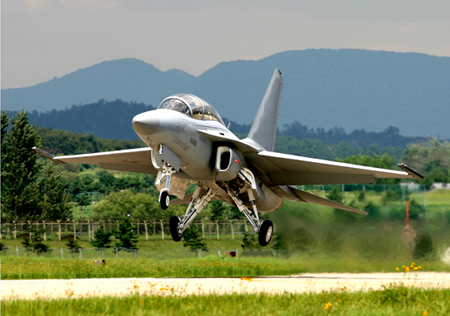
The project to procure 12 units of Korean trainer jets worth a total P18.9 billion for the Philippine Air Force continues to hang over issues of downpayment and after-sales service turnaround, but the Department of National Defense, which recommended a counter-offer, remains confident the deal will push through.   

Apparently, sources said, President Benigno Aquino III himself seemed not keen on signing the contract owing to the hurdles that cropped up in DND negotiations with manufacturer Korean Aerospace Incorporation (KAI) for the sale of the 12 FA-50s.

Among the key issues, as identified earlier by Undersecretary Fernando Manalo, is the 52 percent “advance payment” sought by KAI before it starts production. Republic Act 9184 only allows 15-percent advance payment.

Manalo is head for Finance, Munitions, Installations and Materiel of the DND.

The second major issues revolves around KAI’s reluctance to accept the Philippine government’s terms for it to deliver spare parts within 30 to 45 days upon receipt of notice.

“The turnaround time, our standard turnaround time is between 30 and 45 days upon receipt of the notice of the proponent, and that the warranty is still valid. They have to deliver the spare parts so we can immediately replace the defective spare parts. I think the warranty is two years or 600 hours, whichever comes first,” said Manalo. He explained that the dispute stems from KAI’s insistence on a 180-day turnaround, which DND deems too long. 

The issues notwithstanding, Defense Secretary Voltaire Gazmin is optimistic negotiations can still proceed. At Tuesday’s joint DND-Armed Forces New Year Call at Camp Aguinaldo in Quezon City, Gazmin said the department recommended a counteroffer to KAI, which they are asking Malacanang Palace to clear.

“Nag-submit na kami ng recommendation to the President for his approval…Ang recommendation nito [We submitted our recommendation to the President for his approval. The recommendation] is progressive billing,” he said.

Should the project push through, delivery of the first batch of the units is targeted in 2015. This means delivery will only be completed after President Aquino’s term ends. 

Military insiders earlier expressed doubts over the wisdom of the FA-50 negotiations, saying among others that the jet platform is not what the country needs for territorial defense. “Painfully, the much touted FA-50 Lead-In Fighter has revealed itself to be newly designed short-range trainer aircraft with recent certifications for only very basic weapons; in effect, just enough rhetoric to label it a Lead-In Fighter, as opposed to its true form, an Advanced Jet Trainer with limited weapons,” one source said.

Another source had another track: “As FA-50 negotiations continue and the request for a P10-billion down payment looms, the DND should look towards its counterparts in Brazil, where the Super Tucano is manufactured.  After a long number of years of extensive research, study, and consideration, Brazil has just announced its choice for its next Multi-Role Fighter aircraft,” he said. 

Compared to the Super Tucano, the source added, “the FA-50’s combat capability is disappointing. 

The propeller-driven Super Tucano can travel further, stay on patrol longer, and is a combat-proven aircraft with a myriad of advanced weapons, superior to the weapons of the FA-50.  Although not a Multi-Role Fighter, the Super Tucano’s combat abilities quite embarrass those of the FA-50.” 

Article Source: InterAksyon
Thursday, January 02, 2014

DND may spend P4.5 B for fighter jet munitions


The Department of National Defense is planning to spend about P4.5 billion to arm the 12 lead-in fighter trainer jets it is seeking to acquire from South Korea.
Defense department data show that the munitions for the fighter jets are not included in the aircraft acquisition program under the revised Armed Forces modernization law.
The acquisition of munitions for the fighter jets will be divided into four phases – P4.33 billion for the first two and P139 million for the other two.
Details of the items to be installed in the jets were not immediately available. Previous reports, however, said the aircraft being eyed can be armed with precision guided bombs and air-to-air and air-to-surface missiles.
The defense department said the munitions may be acquired either through negotiated or public bidding.
The mode of procurement depends on the availability of the items in the market. Military equipment being offered by several suppliers are normally acquired through public bidding, while specialized ones are usually acquired through negotiations.
The government aims to shell out P18.9 billion to acquire 12 FA-50 jets from South Korea to improve the country’s territorial defense capabilities.
Security officials are now negotiating with South Korean firm Korean Aerospace Industries (KAI) for the project.
The government also aims to spend P135.99 million for the basing support systems for the fighter jets.
Earlier, Defense Secretary Voltaire Gazmin said the delivery of the jets may start in June 2015.
The defense department had asked MalacaƱang to allow the release of a 52-percent down payment to KAI.
The law permits state agencies to pay 15- percent down payment to suppliers while the rest of the amount would be paid upon delivery of the goods.
KAI wants the Philippines to pay 52- percent down payment to cover the aircraft manufacturing costs. Such payment scheme would require the approval of President Aquino.
The acquisition of FA-50 jets is one of the big ticket items in the military’s multibillion-peso upgrade program.

Thursday, March 07, 2013

Terms Of Reference for F/A-50 'Golden Eagle' now being crafted


MANILA — The Philippines is now on track to operate again supersonic jet aircraft as the "term of reference" (TOR) for the F/A-50 "Golden Eagle" is now in the works.
"Procurement for the F/A-50 will be on a government-to-government basis," the Department of National Defense (DND) observer stressed.
He also said the go-ahead signal for the TOR only came last week.
The order came from the Government Procurement Policy Board (GPPB), an attached agency of the Department of Budget and Management.
The DND observer declined to comment on when the TOR will be completed but stressed that it will be done within the year.
But he expressed confidence that the Philippine Air Force (PAF) will be flying the F/A-50 within two years time.
The last supersonic planes operated by the country was the Northrop F-5 "Freedom Fighter" which was decommissioned due to lack of parts and air frame aging sometime in 2005.
The TOR describes the purpose and structure of a project, committee, meeting and negotiation.
It also defines the vision, objectives, scope and deliverables (i.e. what has to be achieved); stakeholders, roles and responsibilities (i.e. who will take part in it); resource, financial and quality plans (i.e. how it will be achieved); work breakdown structure and schedule (i.e. when it will be achieved) and includes success factors/risks and restraints.
The Philippines is in the market for 12 supersonic trainer aircraft which can double as interim fighter and attack planes for the PAF. It has allocated P18 billion for this program.
The GPPB earlier gave the DND the "green-light" to start pre-negotiations with the South Korean government for 12 F/A 50 aircraft last January.
The plane is manufactured by the Korea Aerospace Industries (KAI). The F/A-50 is also known as the TA-50.
The F/A-50 design is largely derived from the F-16 "Fighting Falcon", and they have many similarities: use of a single engine, speed, size, cost, and the range of weapons.
KAI's previous engineering experience in license-producing the KF-16 was a starting point for the development of the F/A-50.
The aircraft can carry two pilots in tandem seating. The high-mounted canopy developed by Hankuk Fiber is applied with stretched acrylic, providing the pilots with good visibility and has been tested to offer the canopy with ballistic protection against four-pound objects impacting at 400 knots.
The altitude limit is 14,600 meters (48,000 feet), and airframe is designed to last 8,000 hours of service.
There are seven internal fuel tanks with capacity of 2,655 liters (701 US gallons), five in the fuselage and two in the wings.
An additional 1,710 liters (452 US gallons) of fuel can be carried in the three external fuel tanks.
Trainer variants have a paint scheme of white and red, and aerobatic variants white, black, and yellow.
The F/A-50 "Golden Eagle" uses a single General Electric F404-102 turbofan engine license-produced by Samsung Techwin, upgraded with a full authority digital engine control system jointly developed by General Electric and KAI.
The engine consists of three-staged fans, seven axial stage arrangement, and an afterburner.
The aircraft has a maximum speed of Mach 1.4-1.5.
Its engine produces a maximum of 78.7 kN (17,700 lbf) of thrust with afterburner. 
----------------------------------------------------------------------------------------------
Priam F. Nepomuceno | Philippine News Agency/Zambo Times | 
March 6, 2013 | Article Link

Tuesday, August 14, 2012

TA-50 to revive PAF's 'fast mover' capability

MANILA, Aug. 14 (PNA) - The Philippine Air Force (PAF) will regenerate its "fast mover" capability once the decision to acquire South Korea's TA-50 "Golden Eagle" becomes final. 

The ability refers to the capacity to intercept aircraft intruding or encroaching over the country's airspace. 

Fernando Manalo, DND undersecretary for finance, munitions, installation, and materiel, said that the TA-50 offers the PAF the best means to reacquire such capability. 

"It may be small and not that fast, but under the hands of a well-trained and capable pilot, this plane can prove itself a much for much faster and bigger aircraft," he said. 

The PAF lost its interception capability in 2005 when it formally retired the last 10 F-5 "Tiger" jet fighters in its inventory due to airframe aging and lack of spare parts. 

The T-50 "Golden Eagle" design is largely derived from the F-16 Fighting Falcon, and they have many similarities: use of a single engine, speed, size, cost, and the range of weapons. 

Korea Aerospace Industries, the designer of the TA-50, developed the the aircraft from the US F-16 "Falcon". 

The aircraft can carry two pilots in tandem seating. The high-mounted canopy developed by Hankuk Fiber is applied with stretched acrylic, providing the pilots with good visibility, and has been tested to offer the canopy with ballistic protection against four-pound objects impacting at 400 knots. 

The altitude limit is 14,600 meters (48,000 ft), and airframe is designed to last 8,000 hours of service. 

There are seven internal fuel tanks with capacity of 2,655 liters (701 US gallons), five in the fuselage and two in the wings. 

An additional 1,710 liters (452 US gallons) of fuel can be carried in the three external fuel tanks. 

T-50 trainer variants have a paint scheme of white and red, and aerobatic variants white, black, and yellow.[43] 

It uses a single General Electric F404-102 turbofan engine produced by Samsung Techwin) and upgraded with a full authority digital engine control system jointly developed by General Electric and Korea Aerospace Industries. 

The engine consists of three-staged fans, seven axial stage arrangement, and an afterburner. 

The aircraft has a maximum speed of Mach 1.5. 

Its engine produces a maximum of 78.7 kilo Newton (17,700 pound force) of thrust with afterburner. 

The aircraft can also be fitted with heat-seeking missiles, 20mm to 25mm automatic cannon, various surveillance equipment and is very capable of undertaking the air-superiority role due to its sleek design. 

And once the go-ahead signal is given for the TA-50, the DND official expressed confidence that the fighter will be in PAF service within two year's time. 

"We will get two immediately for training purpose so that when the 10 other aircraft arrive, our pilots are already trained for its use," Manalo said. 

"The other good thing about the TA-50 is that we will (be) buying it straight from the manufacturers. We will be its first-time users and not the second or third as in previous PAF aircraft," he said.

-----------------------------------------------------------------------------------------------------------
Priam F. Nepomuceno | Philippine News Agency | August 14,2012 | Article Link

Thursday, August 09, 2012

Korea to discuss export of 12 trainer jets to Philippines

It is likely that Korea’s trainer jets will be exported to the Philippines.

The Defense Acquisition Program Administration said Tuesday that Korea and the Philippines will hold their 16th bilateral joint commission talks on military cooperation in Manila from Aug. 13 to 16.

An official said that the two governments will deal with the export of TA-50s to the Philippines at the talks. The TA-50 is the earlier version of the advanced T-50 supersonic trainer jet.

Local media in Manila reported in June that the Philippine Air Force plans to import 12 TA-50s over two years. However, the Korean government denied the report, saying, “There was no official discussion, or request for a proposal.” The value is estimated at 400 billion won.

The two countries reportedly agreed to trade TA-50 trainer jets, rewriting the bilateral pact on procurement of defense supplies. The revision has extended the defense supplies subject to private contract for complex weapons system, such as warships and aircraft. Park Chung-won, deputy administrator of the agency, will lead the Korean delegation in the talks with the Philippines.

“What the Philippines actually needs is TA-50 of Korea, a model a step nearer to a light attack aircraft,” the official said. “It’s highly probable that the Philippines will sign a contract once the military secures funds from the central government.”

It is reported that the Philippine defense authorities expressed their intention to purchase the TA-50 trainer jets to President Benigno Aquino III early this month. The Philippines is determined to set aside 70 billion pesos (approximately 1.9 trillion won ) involving the modernization program to the beef-up the Air Force.

Korea’s T-50 Golden Eagle is a jet trainer and light attack aircraft designed to provide pilot training for current and next-generation fighters such as the F-15, F-16, F-18, F-22, F-35, the Eurofighter and Mirage supersonic jet interceptors.

Meanwhile, with a weak military capability, the Philippine Air Force and the Navy failed to intercept 26 foreign intrusions into Philippine territory during the first quarter of this year, not including the stand-off at the Panatag Shoal or Scarborough Shoal by scores of Chinese vessels since April.

------------------------------------------------------------------------------------------------------------------
The Korea Times | August 8, 2012 | Article Link

Friday, August 03, 2012

Purchase Of Korean Jets Recommended

The Department of National Defense (DND) has recommended to President Aquino the purchase of South Korean-made jet fighters to boost the country’s external defense capability.

Fernando Manalo, DND undersecretary for finance, munitions, installations and materiel, said the assessment conducted revealed that it is South Korea’s T50s which is ideal for the country’s Philippine Air Force.

“Based on our assessment it is the T50 of South Korea that is most advantageous to us in consideration to the obtaining situation in the West Philippine Sea,” said Manalo.

Aside from capability, the T50s are also ideal in terms of the country’s limited budget for Air Force modernization, he said.

If the contract is signed with South Korea before the end of 2012, Manalo said the fighter jets could be delivered to the country within two years from 2013.

What would happen if the contract is signed, according to Defense Secretary Voltaire Gazmin, is that they would request for immediate delivery of two of the T50s to facilitate the training of Air Force pilots.

“We will negotiate so we can get the two immediately for training so that when the rest of the 10 arrives, our pilots are already trained,” said Gazmin.

Manalo stressed the need to sign into law the P75-billion modernization budget for military modernization.

“Without the law, we cannot implement the acquisition of these fighters . . . because there is no budget,” said Manalo.

The Philippines is now focusing on its external defense after it became locked in a standoff with China a few months ago near the Scarborough Shoal.

The two Philippine civilian ships have already pulled out several weeks ago to deescalate the tension but Chinese ships remain in the area and even set structure to block other ships from entering the Shoal.

--------------------------------------------------------------------------------------------------------------
Aaron B. Recuenco | Manila Bulletin | August 2, 2012 | Article Link

Saturday, July 14, 2012

Farnborough 2012: KAI confident T-50 family ready for Philippines, other international markets

Korean Aerospace Industries (KAI) officials are confident of winning the Philippine Air Force's (PAF's) competition for a light-attack trainer but are playing down expectations of a quick decision.

A T-50 variant is competing with five other platforms to supply a jet-powered light-attack/trainer aircraft to Manila: AleniaAermacchi's M-346; BAE Systems' Hawk; Yakovlev's Yak-130; Aero Vodochody's L-159; and AMX International's AMX.

"We have been told that we are leading the competition but that no decision has been made yet," Sky Lee, T-50 senior marketing manager for Asia-Pacific and South American, told IHS Jane's at the Farnborough Airshow on 10 July.

The Republic of Korea Air Force's Black Eagles aerobatic team, which flies T-50Bs, made its European debut at a number of airshows in the UK, including Farnborough.

If Manila selects the T-50 it will become the second international customer for the platform after Indonesia, which in 2011 agreed to buy 16 T/A-50s: the light attack/lead-in fighter trainer variant of the aircraft. Reports from the Philippines have led to some confusion over which variant of the aircraft was on offer: as well as the standard unarmed T-50 trainer, KAI offers the T/A-50 and F/A-50, which both feature an Elta EL/M-2032 fire-control radar provided by South Korean manufacturer LigNex.

----------------------------------------------------------------------------------------------
James Hardy | Janes.Com | July 13, 2012 | Article Link

Sunday, May 27, 2012

Philippine Air Force buying new trainer jets

MANILA, Philippines—The Philippine Air Force (PAF) is ordering this year a number of brand new aircraft.

These include 12 lead-in fighter trainer jets, eight light transports, three medium transports and attack helicopters.

The PAF said the order is among 38 contracts that the air branch of the Armed Forces of the Philippines will sign this year. Delivery of the aircraft is expected in two years.

“Within the year we expect to sign contracts. We have 38 projects lined up, foremost of which is the FAA lead-in fighter trainer or LIFT. We have attack helicopters coming, light transports and medium transports that are slightly smaller than the C-130 cargo plane” currently in use, PAF spokesperson Col. Miguel Okol said.

“They have been approved by the senior leadership (of the Department of National Defense),” he added.

He said the rest of the 38 contracts were still being finalized.

From being one of the best in Southeast Asia during the 1960s, the Air Force fleet gradually deteriorated and became obsolete without being replaced, leaving the country with no external defense capability.

To upgrade the entire military’s capabilities, the DND and AFP are working to fast-track the approval by July this year of a total of 138 contracts.

The contracts, mostly aimed at boosting badly depleted air and naval assets, would be implemented for the duration of the Aquino administration.

-------------------------------------------------------------------------------------------------------

Featured Posts

AFP Modernization 2017: Highlights and Review

The modernization of the Armed Forces of the Philippines was on a roll this year, as we've seen a few big ticket items having completely...

Popular Posts